Gold Price Forecast: XAU/USD steadies near $1,750 as central bankers head to Jackson Hole
- Gold price remains steady after bouncing off monthly low.
- DXY retreat underpins the recovery as yields ease, recession woes test XAU/USD bulls.
- Cautious sentiment ahead of Jackson Hole symposium, US data could restrict immediate moves.

Gold price (XAU/USD) remains sidelined near $1,745-46, following the rebound from the monthly low, as traders brace for Wednesday’s European session.
In doing so, the bright metal portrays the markets’ cautious mood ahead of the US Durable Goods Orders for July. Also restricting the bullion’s immediate moves are the news that the global policymakers have recently left for Friday’s key speech at the Kansas City Fed’s symposium in Jackson Hole.
“Many of the central bankers heading to the Grand Teton mountains this week hoping today's inflation pressures will abate quickly enough to allow them to counter the downturns anticipated in economies around the world,” said Reuters.
It’s worth noting that the retreat in the US 10-year Treasury yields, down 2.5 basis points (bps) near 3.03% also favors the gold price. On the contrary, economic fears surrounding China, the world’s largest commodity user, weigh on the XAU/USD prices. “Authorities have been trying to put a floor under a slowdown spurred by China’s deepening real estate crisis, as well as an ongoing hit to consumer and business sentiment fueled by a stop-start Covid containment strategy,” said Bloomberg.
Amid these plays, stock futures remain mildly offered while the US Dollar Index (DXY) seesaw around the intraday high, after reversing from the yearly peak the previous day.
Moving on, US Durable Goods Orders for July, expected 0.6% versus 2.0% prior, will be important for intraday directions. However, major attention should be given to Friday’s speech by Fed Chairman Jerome Powell at the Kansas City Fed’s symposium in Jackson Hole. Should policymakers accept recession as a major risk than inflation and shows readiness to shift the previously hawkish bias, XAU/USD may witness further upside.
Technical analysis
A clear upside break of the two-week-old descending trend line keeps XAU/USD buyers hopeful amid a firmer RSI (14). However, the MACD signals a mildly negative and hence the immediate hurdle surrounding the 100-HMA and the 200-HMA, respectively near $1,748 and $1,764, will be important for the gold price upside to watch.
If the quote rises past $1,764, the mid-August high near $1,785 will be an important hurdle to watch before welcoming XAU/USD bulls.
On the contrary, pullback remains elusive until the quote stays beyond the previous resistance line from August 12, around $1,737 by the press time.
If at all the gold price weakens past $1,737, the south-run towards the monthly low near $1,727 appears imminent.
Gold: Four-hour chart
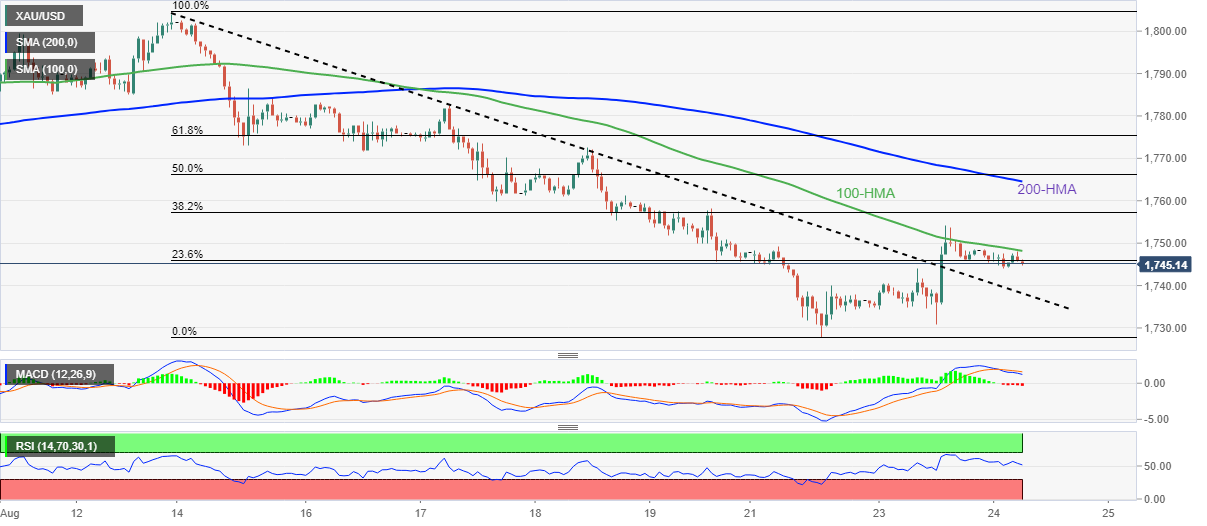
Trend: Further weakness expected
Author

Anil Panchal
FXStreet
Anil Panchal has nearly 15 years of experience in tracking financial markets. With a keen interest in macroeconomics, Anil aptly tracks global news/updates and stays well-informed about the global financial moves and their implications.

















