Gold Price Forecast: XAU/USD returns above $4,600 as the Dollar hesitates
- Gold finds support near $4,580 and bounces up to levels past $4,600.
- The US Dollar Index ticks down from highs amid upbeat UK and Eurozone economic data.
- Technical indicators hint at a fading bullish momentum.

Gold’s (XAU/USD) reversal from all-time highs found buyers near $4,580 on Thursday, before returning to levels past $4,600 during the European trading session. A somewhat softer US Dollar is providing support to the precious metal, in spite of the easing geopolitical tensions and strong US macroeconomic figures.
U.S. President Donald Trump lowered his tone against Iran as US advisors warned about the risks of a military intervention in the country. Trump said that he believes ths the killings in Iran have stopped, which lessens the odds of an immediate attack on the Islamic Republic.
The yellow metal, however, remains pinned near all-time highs in the $4,640 area, favoured by a moderate pullback in the US Dollar, as upbeat data for the Eurozone and the UK boosted the Euro and the Pound while intervention warnings from Japanese authorities keep Yen bears in check for now.
Technical Analysis: Gold holds gains despite signs of an overstretched rally
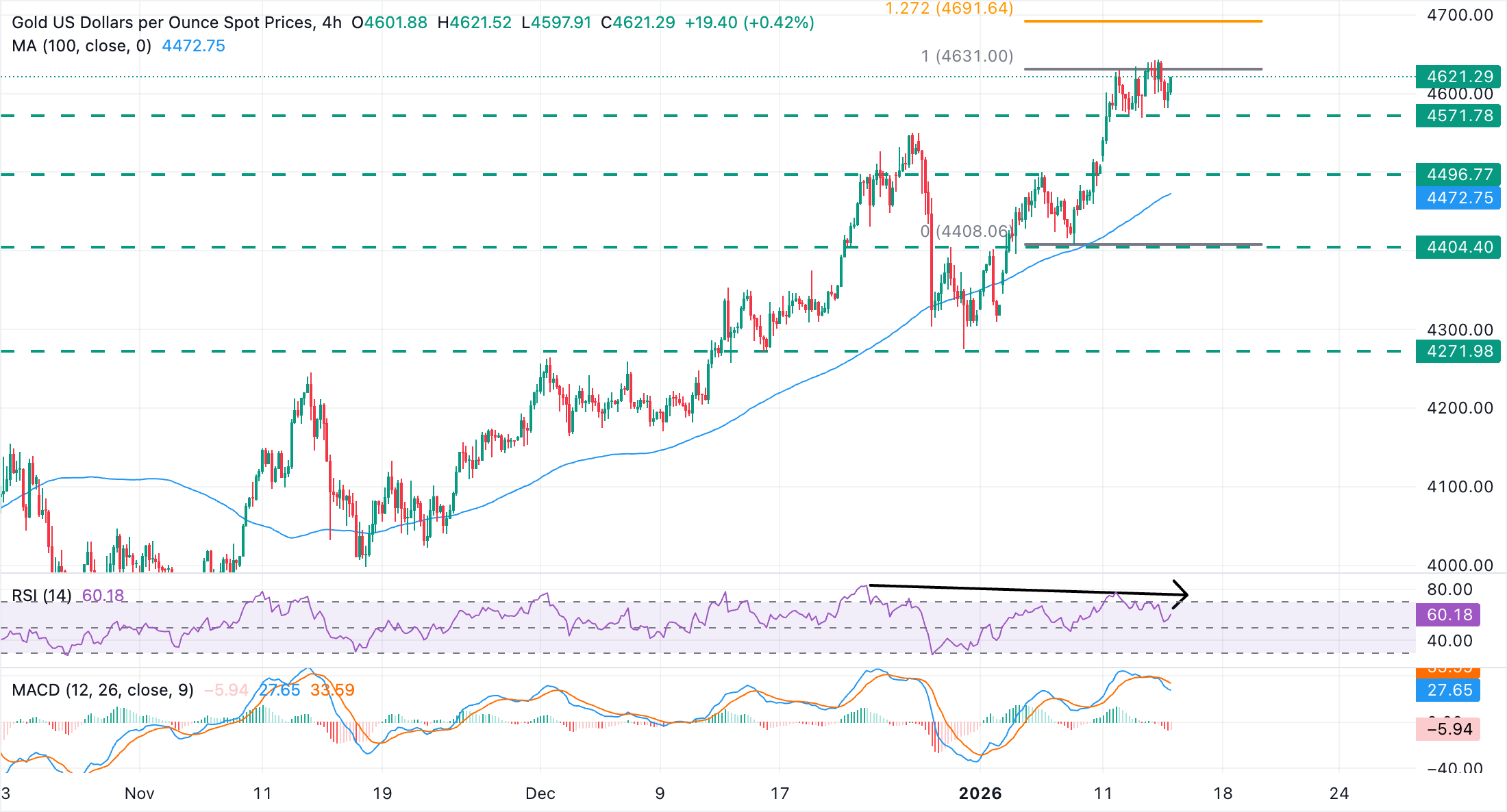
The 4-hour chart shows XAU/USD trading at $4,620 at the time of writing, with support in the $4,670-$4,680 area holding bears from now. Technical indicators, however, are showing a fading bullish momentum. The Relative Strength Index (14) stands at 60.0, although it shows a bearish divergence with price action. The Moving Average Convergence Divergence (MACD) line has crossed below the signal line, hinting at weaker upside impetus.
Bears, however, will need to clear out the mentioned $4,570 area (January 13, 14 lows) to confirm a deeper correction, aiming for the January 6 high, right below $4,500, and the 100-period Simple Moving Average (SMA), which keeps trending higher at $4,472.74, reinforcing the positive underlying bias.
To the upside, above $4,630, the next targets would be at the 127.2% and the 161.8% Fibonacci extensions of the January 8-12 rally, at $4,689 and $4,763, respectively.
(The technical analysis of this story was written with the help of an AI tool.)
Gold FAQs
Gold has played a key role in human’s history as it has been widely used as a store of value and medium of exchange. Currently, apart from its shine and usage for jewelry, the precious metal is widely seen as a safe-haven asset, meaning that it is considered a good investment during turbulent times. Gold is also widely seen as a hedge against inflation and against depreciating currencies as it doesn’t rely on any specific issuer or government.
Central banks are the biggest Gold holders. In their aim to support their currencies in turbulent times, central banks tend to diversify their reserves and buy Gold to improve the perceived strength of the economy and the currency. High Gold reserves can be a source of trust for a country’s solvency. Central banks added 1,136 tonnes of Gold worth around $70 billion to their reserves in 2022, according to data from the World Gold Council. This is the highest yearly purchase since records began. Central banks from emerging economies such as China, India and Turkey are quickly increasing their Gold reserves.
Gold has an inverse correlation with the US Dollar and US Treasuries, which are both major reserve and safe-haven assets. When the Dollar depreciates, Gold tends to rise, enabling investors and central banks to diversify their assets in turbulent times. Gold is also inversely correlated with risk assets. A rally in the stock market tends to weaken Gold price, while sell-offs in riskier markets tend to favor the precious metal.
The price can move due to a wide range of factors. Geopolitical instability or fears of a deep recession can quickly make Gold price escalate due to its safe-haven status. As a yield-less asset, Gold tends to rise with lower interest rates, while higher cost of money usually weighs down on the yellow metal. Still, most moves depend on how the US Dollar (USD) behaves as the asset is priced in dollars (XAU/USD). A strong Dollar tends to keep the price of Gold controlled, whereas a weaker Dollar is likely to push Gold prices up.
Author

Guillermo Alcala
FXStreet
Graduated in Communication Sciences at the Universidad del Pais Vasco and Universiteit van Amsterdam, Guillermo has been working as financial news editor and copywriter in diverse Forex-related firms, like FXStreet and Kantox.