Gold Price Forecast: XAU/USD remains within touching distance of $3,400
- Gold price looks for a fresh trigger to break above the key resistance of $3,400.
- Fed officials turn dovish on the monetary policy outlook.
- US President Trump is expected to announce the tariff penalty on China for buying Oil from Russia.

Gold price (XAU/USD) struggles to break above $3,400.00 after testing this key level early Thursday. The precious metal hesitates to extend upside even as Federal Reserve (Fed) officials have shown support for interest rate cuts in the remainder of the year.
On Wednesday, Minneapolis Fed President Neel Kashkari, San Francisco Fed President Mary Daly and Fed Governor Lisa Cook argued in favor of reducing interest rates amid growing labor market concerns. “The economy is slowing and the Fed needs to respond to the slowing economy,” Kashkari said in an interview with CNBC. Kashkari added, “It may still be relevant in the near term to begin adjusting the policy rate, and two rate cuts this year still seem appropriate.”
The CME FedWatch tool showed that traders have almost fully priced in a 25 basis points (bps) interest rate reduction in the September policy meeting.
Theoretically, lower interest rates by the Fed bode well for non-yielding assets, such as Gold.
Meanwhile, resurfacing United States (US) President Donald Trump's tariff fears are expected to improve the demand for safe-haven assets, such as Gold. On Wednesday, Trump stated that he could impose a penalty on China in the form of tariffs for buying Oil from Russia. The same day, Trump increased import duties on India by 25% for buying Russian Oil.
Gold technical analysis
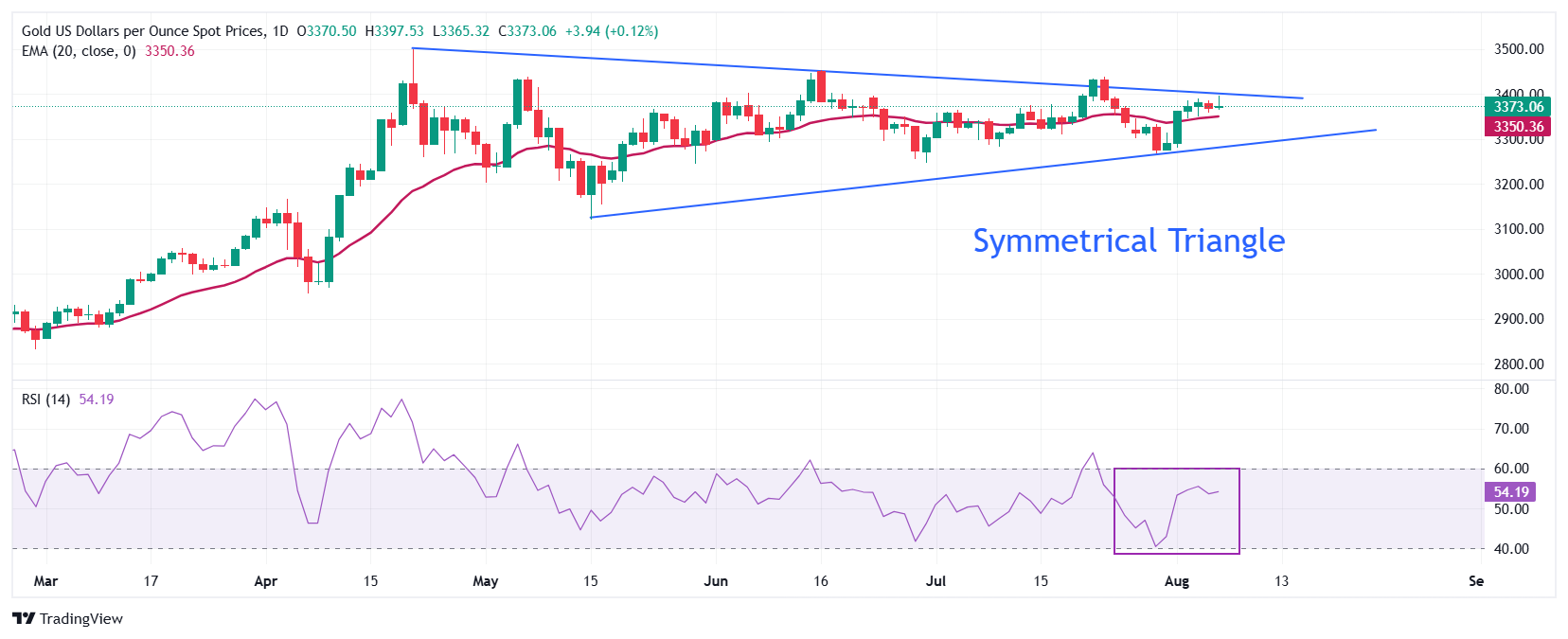
Gold price trades close to the upper boundary of the Symmetrical Triangle formation around $3,400, which is plotted from April’s high near $3,500. The lower boundary of the yellow metal is placed from the May’s low of $3,120.85.
The precious metal holds slightly above the 20-day Exponential Moving Average (EMA), which trades near $3,350, suggesting that the near-term trend is on the upside.
The 14-day Relative Strength Index (RSI) wobbles inside the 40.00-60.00, which indicates indecisiveness among market participants.
Looking down, the Gold price would fall towards the round-level support of $3,200 and the May 15 low at $3,121, if it breaks below the May 29 low of $3,245
Alternatively, the Gold price will enter uncharted territory if it breaks above the psychological level of $3,500 decisively. Potential resistances would be $3,550 and $3,600.
Gold daily chart
Fed FAQs
Monetary policy in the US is shaped by the Federal Reserve (Fed). The Fed has two mandates: to achieve price stability and foster full employment. Its primary tool to achieve these goals is by adjusting interest rates. When prices are rising too quickly and inflation is above the Fed’s 2% target, it raises interest rates, increasing borrowing costs throughout the economy. This results in a stronger US Dollar (USD) as it makes the US a more attractive place for international investors to park their money. When inflation falls below 2% or the Unemployment Rate is too high, the Fed may lower interest rates to encourage borrowing, which weighs on the Greenback.
The Federal Reserve (Fed) holds eight policy meetings a year, where the Federal Open Market Committee (FOMC) assesses economic conditions and makes monetary policy decisions. The FOMC is attended by twelve Fed officials – the seven members of the Board of Governors, the president of the Federal Reserve Bank of New York, and four of the remaining eleven regional Reserve Bank presidents, who serve one-year terms on a rotating basis.
In extreme situations, the Federal Reserve may resort to a policy named Quantitative Easing (QE). QE is the process by which the Fed substantially increases the flow of credit in a stuck financial system. It is a non-standard policy measure used during crises or when inflation is extremely low. It was the Fed’s weapon of choice during the Great Financial Crisis in 2008. It involves the Fed printing more Dollars and using them to buy high grade bonds from financial institutions. QE usually weakens the US Dollar.
Quantitative tightening (QT) is the reverse process of QE, whereby the Federal Reserve stops buying bonds from financial institutions and does not reinvest the principal from the bonds it holds maturing, to purchase new bonds. It is usually positive for the value of the US Dollar.
Author

Sagar Dua
FXStreet
Sagar Dua is associated with the financial markets from his college days. Along with pursuing post-graduation in Commerce in 2014, he started his markets training with chart analysis.