Gold Price Forecast: XAU/USD recovers above $2,800 as USD gives up some gains
- Gold price rebounds strongly above $2,800 as the US Dollar surrenders some gains.
- The imposition of tariffs by US President Trump on his North American peers and China has improved safe-haven demand.
- This week, investors will focus on the US NFP data for January.

Gold price (XAU/USD) recovers its intraday losses and turns positive in Monday’s North American session. The precious metal returns to near its all-time highs above $2,800 as the US Dollar (USD) surrenders some of its gains.
Earlier in the day, the Gold price slumped to near $2,770 after opening mildly higher. The precious metal faced selling pressure as the US Dollar had a gap-up opening after United States (US) President Donald Trump imposed 25% tariffs on Canada and Mexico and 10% on China and started the global trade war. He also reiterated his intentions of a slappy tariff on the Eurozone but didn’t provide much information.
Technically, geopolitical tensions improve the appeal of safe-haven assets such as Gold. However, the higher USD has capped Gold’s upside.
At the press time, the US Dollar Index (DXY), which tracks the Greenback’s value against six major currencies, gives up gains after rallying to near 109.90 but is still 0.6% higher than its previous close.
This week, investors will pay close attention to the US Nonfarm Payrolls (NFP) data for January, which will be released at the end of the week. The NFP data will significantly influence market expectations for how long the Federal Reserve (Fed) will keep interest rates in the range of 4.25%-4.50%. Fed’s approach of keeping a restrictive monetary policy stance weighs on Gold.
Gold technical analysis
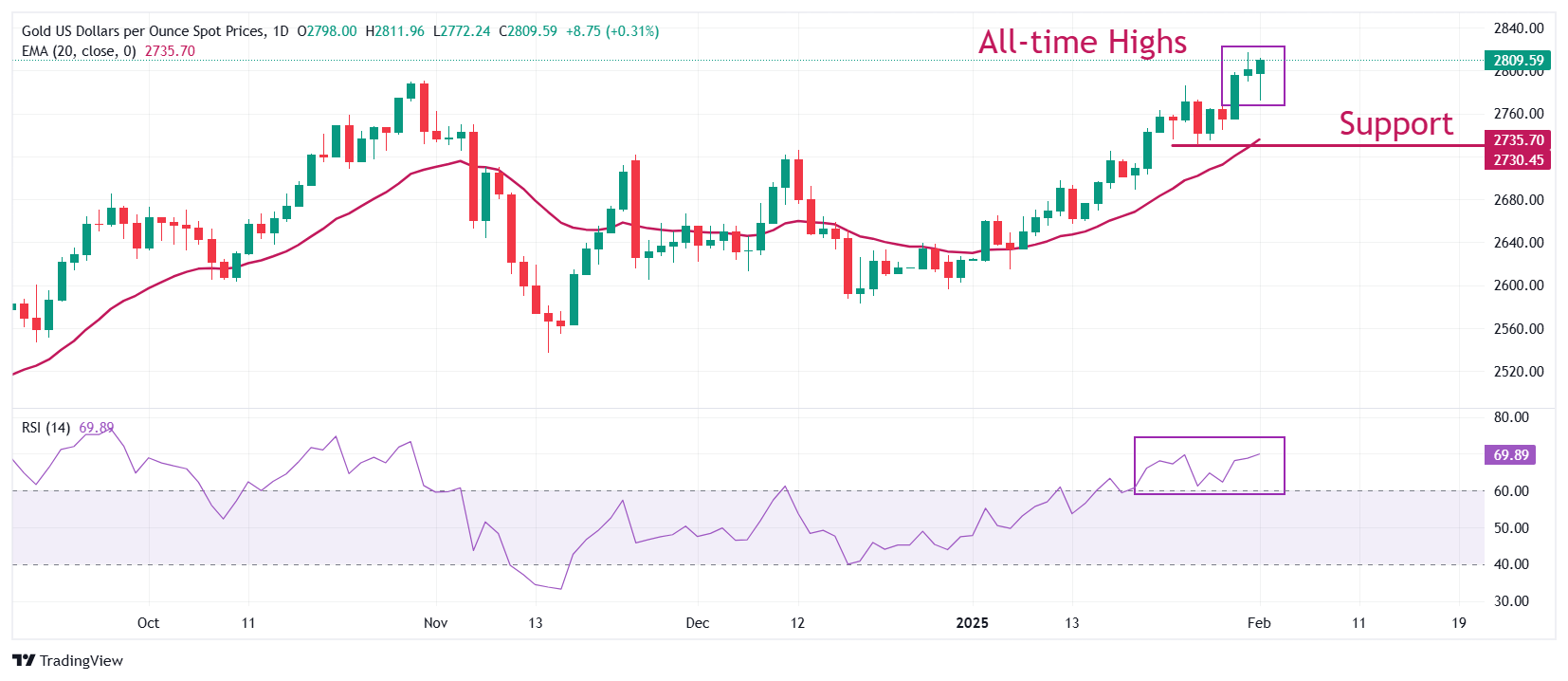
Gold price trades around all-time highs at $2,817.30. The upward-sloping 20-day Exponential Moving Average (EMA) near $2,735.70 suggests that the near-term trend is bullish.
The 14-day Relative Strength Index (RSI) oscillates in the 60.00-80.00 range, indicating a strong bullish momentum.
Looking up, the Gold price could rise to near $2,900. On the contrary, the January 27 low of $2,730.50 will act as support.
Gold daily chart
Gold FAQs
Gold has played a key role in human’s history as it has been widely used as a store of value and medium of exchange. Currently, apart from its shine and usage for jewelry, the precious metal is widely seen as a safe-haven asset, meaning that it is considered a good investment during turbulent times. Gold is also widely seen as a hedge against inflation and against depreciating currencies as it doesn’t rely on any specific issuer or government.
Central banks are the biggest Gold holders. In their aim to support their currencies in turbulent times, central banks tend to diversify their reserves and buy Gold to improve the perceived strength of the economy and the currency. High Gold reserves can be a source of trust for a country’s solvency. Central banks added 1,136 tonnes of Gold worth around $70 billion to their reserves in 2022, according to data from the World Gold Council. This is the highest yearly purchase since records began. Central banks from emerging economies such as China, India and Turkey are quickly increasing their Gold reserves.
Gold has an inverse correlation with the US Dollar and US Treasuries, which are both major reserve and safe-haven assets. When the Dollar depreciates, Gold tends to rise, enabling investors and central banks to diversify their assets in turbulent times. Gold is also inversely correlated with risk assets. A rally in the stock market tends to weaken Gold price, while sell-offs in riskier markets tend to favor the precious metal.
The price can move due to a wide range of factors. Geopolitical instability or fears of a deep recession can quickly make Gold price escalate due to its safe-haven status. As a yield-less asset, Gold tends to rise with lower interest rates, while higher cost of money usually weighs down on the yellow metal. Still, most moves depend on how the US Dollar (USD) behaves as the asset is priced in dollars (XAU/USD). A strong Dollar tends to keep the price of Gold controlled, whereas a weaker Dollar is likely to push Gold prices up.
Author

Sagar Dua
FXStreet
Sagar Dua is associated with the financial markets from his college days. Along with pursuing post-graduation in Commerce in 2014, he started his markets training with chart analysis.