Gold Price Forecast: XAU/USD reaches new week high on soft US Dollar, post-Fed minutes
- US Dollar weakened due to the dovish tone of the Federal Reserve’s last meeting minutes.
- US S&P Global PMIs dropped to contractionary territory, a headwind for the USD.
- According to the University of Michigan Consumer Sentiment poll, inflation expectations in the United States remained unchanged.
- Gold Price Analysis: Upward biased, needing to clear $1800 to extend the uptrend.

Gold Price advanced steadily on Thursday amidst thin liquidity conditions courtesy due to the observance of the Thanksgiving holiday in the United States (US), with Wall Street and the bond market closed. Factors like Federal Reserve (Fed) policymakers agreeing to moderate interest-rate increases and a risk-on mood keep the US Dollar (USD) on the defensive. Therefore, XAU/USD is trading at $1756 a troy ounce at the time of writing.
Federal Reserve minutes a headwind for the US Dollar
On Wednesday, the Federal Reserve revealed its latest minutes, which showed that officials are ready to begin hiking rates on smaller sizes after lifting the Federal Funds rate (FFR) by 75 bps four times in 2022. Even though the minutes are slightly dovish, investors should know that Federal Reserve officials are uncertain how high rates will end, with most policymakers expressing that 5% could be the peak for some participants.
US S&P Global PMI tumbled to recessionary territory, triggering USD weakness
On Wednesday, S&P Global PMIs revealed for the United States showed that the economy is slowing faster than expected, with Manufacturing, Services, and Composite Indices lying in contractionary territory. Chris Williamson, Chief Business Economist at S&P Global Market Intelligence, said that “business conditions across the US worsened in November” and added that “according to the preliminary PMI survey findings, with output and demand falling at increased rates, consistent with the economy contracting at an annualized rate of 1%.”
US consumer sentiment remained positive
At the same time, the University of Michigan (UOM) Consumer Sentiment for November, on its final reading, came at 56.9, above expectations but below the 59.9 preliminary reading. The same report updated American expectations for inflation, with one-year estimated to rise hit 4.9%, while the 5-10 year estimates remained unchanged at 3%.
Mixed US economic data pressured the US Dollar
Earlier, the US economic docket featured Initial Jobless Claims for the last week, which jumped above expectations, flashing that the labor market is easing. At the same time, US Durable Good Orders for October rose sharply by 1% MoM, against 0.4% estimates, as consumers’ resilience kept manufacturing activity from slowing down.
Aside from this, US Treasury yields extended their losses, with the 10-year T-bond yield dropping six bps, down to 3.70%, a tailwind for the Gold price, undermining the USD. Meanwhile, the US Dollar Index (DXY), a gauge of the buck’s value against a basket of rivals, stumbles 0.36%, at 105.705.
Gold Price Analysis (XAU/USD): Technical outlook
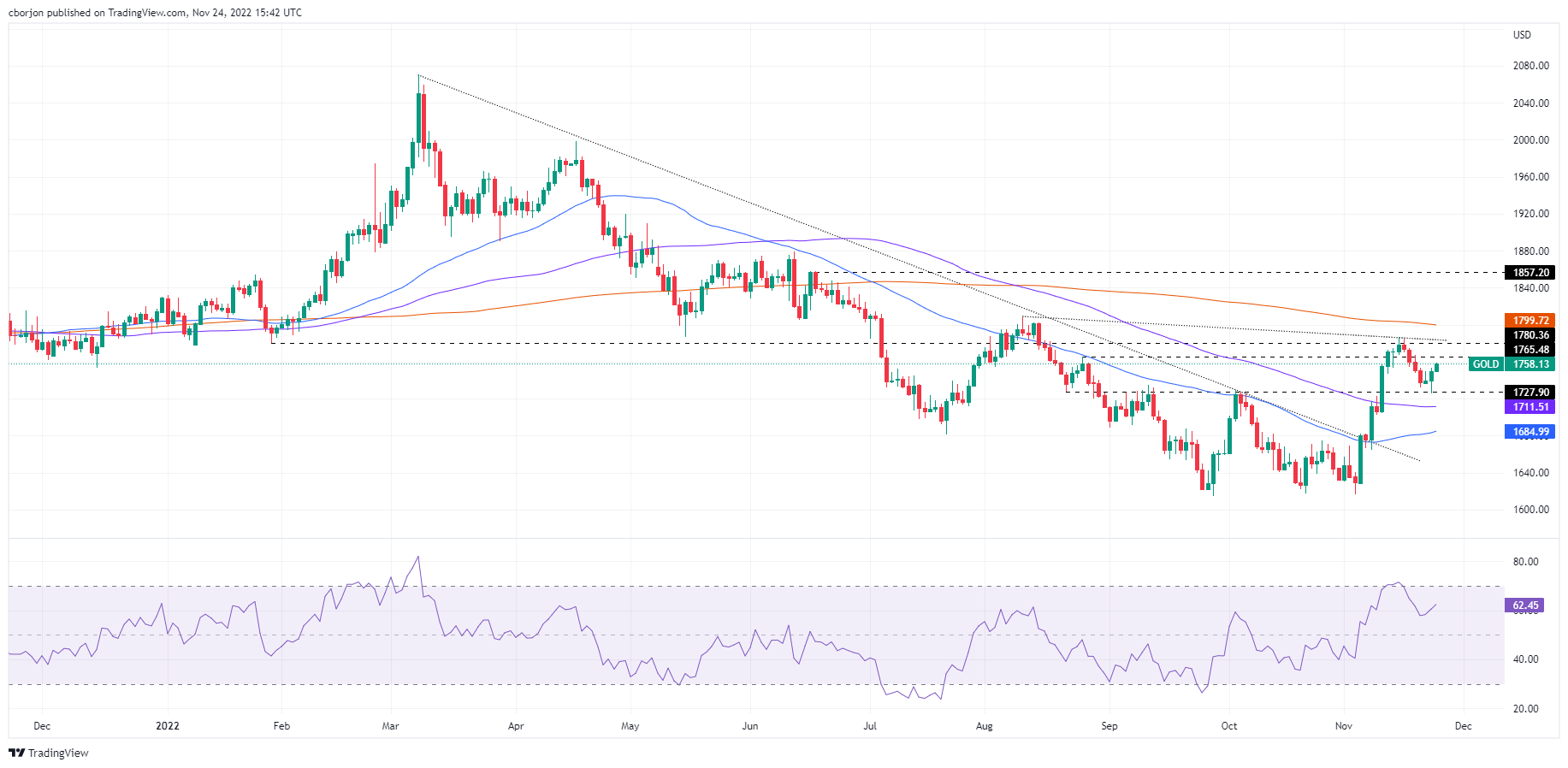
From a daily chart perspective, XAU/USD is neutral-upward biased. However, Gold stays below the “trendsetter” 200-day Exponential Moving Average (EMA), used as confirmation for bullish/bearish bias in the long term. So if XAU buyers want to regain control, they need to clear $1800, so they can pose a threat to send XAU/USD rallying towards the June 17 swing high at $1857 ahead of the psychological $1900 figure. Otherwise, the XAU/USD will be exposed to selling pressure, opening the door for a fall to the 100-day EMA at $1711.51, ahead of the $1700 mark.
Author

Christian Borjon Valencia
FXStreet
Markets analyst, news editor, and trading instructor with over 14 years of experience across FX, commodities, US equity indices, and global macro markets.