Gold Price Forecast: XAU/USD jumps past $2000 on US mixed data, ahead of FOMC’s decision
- The gold price jumped over $20.00 on a risk-off impulse, lowering US T-bond yields.
- Sentiment deteriorated as US Treasury Secretary Yellen warns of obligation shortfall.
- US job openings decline for the third consecutive month, as shown by the JOLTs report.

Gold price breaks the barrier of the $2000 figure on woes surrounding a banking crisis in the United States (US) while market players wait for the US Federal Reserve (Fed) decision about raising rates. After hitting a daily low of $1978.58, the XAU/USD exchanges hands at $2008.52, gaining more than 1%.
XAU/USD surges on risk-off impulse on Yellen’s warning about hitting the debt ceiling
Risk aversion was one of the reasons behind the $25.00 gains in Gold. JP Morgan’s acquisition of First Republic Bank easied worries in the banking industry. However, fiscal policy, mainly the rise of the debt ceiling in the US, keeps investors nervous. The US Treasury Secretary Janet Yellen commented in a letter to the US Congress that the office would not meet all US government obligations by June 1.
Aside from this, the US economic agenda revealed that job openings fell for the third straight month in March, though they remained at steady levels. The US Department of Labor (DoL) announced the JOLTs report, which came at 9.590 million, below the 9.775 million estimated by analysts.
In other data, Factory Orders for March jumped to 0.9%, above estimates of 0.8% and better than February’s contraction of 1.1%. Despite Monday’s ISM Manufacturing PMI report in contractionary territory, orders improved.
Additionally, XAU/USD found a bid, sponsored by lower US Treasury bond yields, across the board. US 2-year T-note yields are plunging 20 bps at 3.935%, while the 10-year benchmark note rate yields 3.431%, plummeting 14 bps.
Meanwhile, the Federal Reserve Open Market Committee (FOMC) two-day meeting begins today. The swaps markets, as shown by the CME FedWatch Tool, with traders expecting an 81.8% chance of a 25 bps rate hike to the Federal Funds Rate (FFR). Nevertheless, probabilities for a rate cut, uptick with investors estimating three 25 bps rate cuts by the year’s end.
Ahead of the week, XAU/USD traders await the FOMC’s decision, followed by Fed’s Chair Jerome Powell’s press conference at around 18:30 GMT.
XAU/USD Technical Analysis
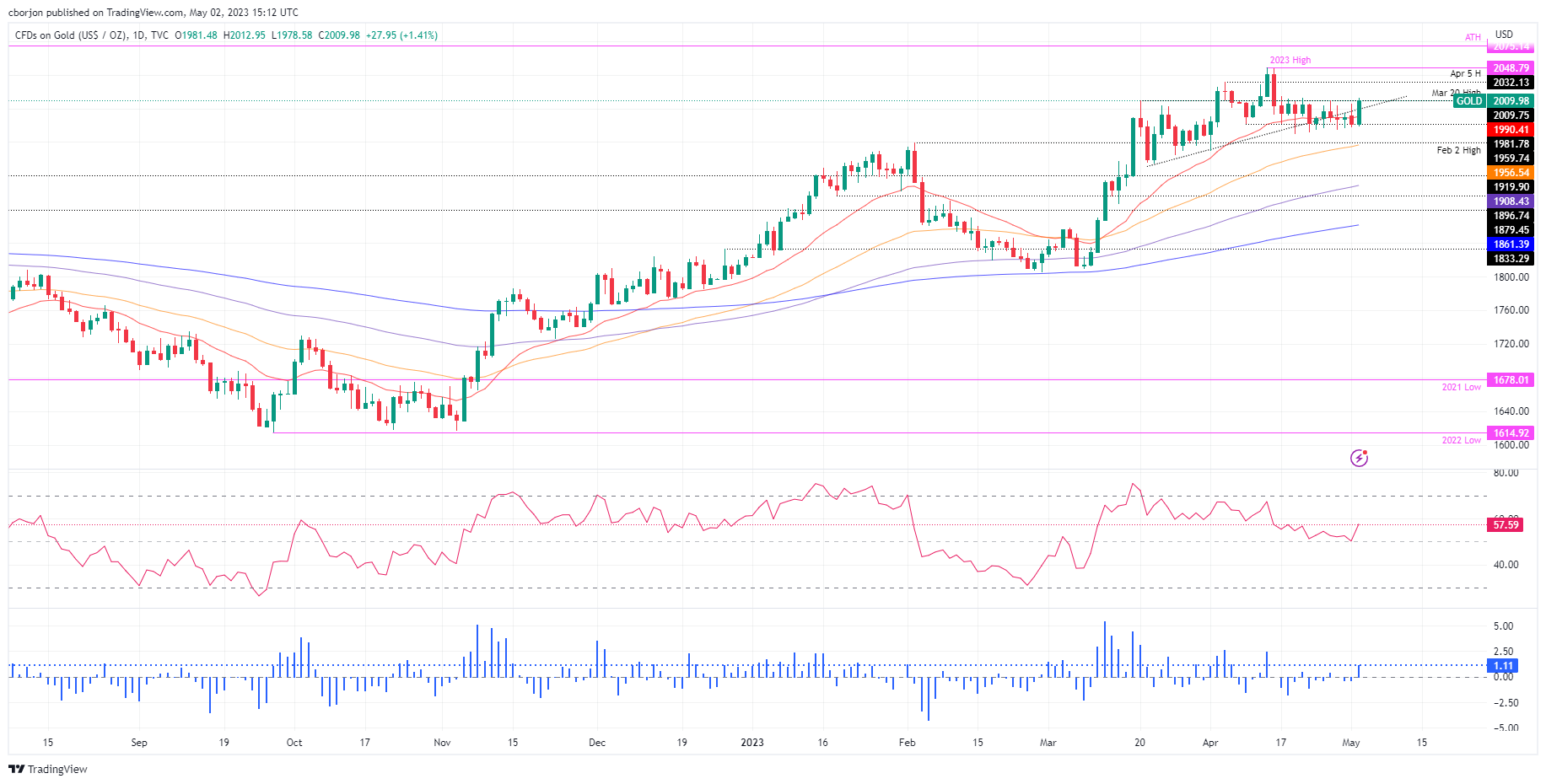
The XAU/USD continued to trade sideways, but the jump above the 20-day EMA at $1990.12 exacerbated a test of the $2000 figure. The Relative Strength Index (RSI) oscillator tested the 50-midline but widened its distance, as it’s aiming up, while the Rate of Change (RoC) confirms that buyers are gathering momentum ahead of the FOMC’s decision. Upwards key resistance levels lie the April 5 high at $2032.13, followed by the YTD high at $2048.79. On the flip side, the $2000 will be the first line of defense for Gold buyers, followed by the 20-day EMA at around $1990.
Author

Christian Borjon Valencia
FXStreet
Markets analyst, news editor, and trading instructor with over 14 years of experience across FX, commodities, US equity indices, and global macro markets.