Gold Price Forecast: XAU/USD juggles around $1,980 ahead of Putin-Zelenskyy peace talks, US CPI
- Gold consolidates the mid-week volatility, holding below $2,000.
- The gold price fell from a significant level on the weekly chart.
- Eyes are now on US CPI data as the next potential catalyst and Ukraine crisis developments.

Update: Gold (XAU/USD) has witnessed a bearish open drive on Thursday, which indicates a carry-forward selling after the risk-on impulse underpinned in the market. The positive undertone is an outcome of a likely ceasefire between Russia and Ukraine. Post the agreement of Ukrainian President Volodymyr Zelenskyy on a diplomatic solution to halt the battering of Ukraine's economy, equities, and risk-sensitive currencies took a sigh of relief. Investors gung ho over risk-perceived assets and dump the safe-haven counters.
Gold prices have fallen sharply from a high near $2,070 on Tuesday. The precious metal has eased almost 6.5% in the last two trading sessions. Meanwhile, the US dollar index (DXY) has plunged in synchronization with the precious metal. The former is settling around 98.00 amid the ongoing uncertainty over the extent of the US Consumer Price Index (CPI) to which it will rise. The US CPI holds significant importance as it will dictate the likely monetary policy action from the Federal Reserve (Fed), which is due next week.
End of Update
Gold suffered heavily amid better risk sentiment on Wednesday. The precious metal fell back below $2,000/oz after it had reached a 19-month high at the start of the week.
Spot gold fell 3.3% to $1,976 per ounce, snapping a rally that took it near the August 2020 all-time high. U.S. gold futures settled down 2.7% at $1,988.20. The reversal was driven by profit-taking as well as a sharp drop in oil prices that gave the green light for buyers to pick up bargains in the stock markets on stocks that had otherwise been hammered by concerns over sanctions on Russia.
Fighting continued as a Russian airstrike badly damaged a children's hospital in the besieged Ukrainian port city of Mariupol on Wednesday. However, risk sentiment improved as oil prices fell heavily after the United Arab Emirates said the OPEC member would support boosting output. Brent oil plunged from $131.50bbls to a low of $105.91bbls. At the start of the week, the price had reached a high of $138.03bbls in a market in disarray due to the supply disruptions caused by sanctions imposed on Russia as a result of the conflict.
Peace talks that could crack the door open to a permanent cease-fire
On Thursday, Foreign Minister Sergey V. Lavrov of Russia is expected to meet his Ukrainian counterpart, Dmytro Kuleba, in Turkey, in the highest-level talks between the two countries since the war began on Feb. 24.
The New York Times reported that ''in recent days, the language has shifted, with the Kremlin signaling that Mr. Putin is no longer bent on regime change in Kyiv. It is a subtle shift, and it may be a head-fake; but it is prompting officials who have scrambled to mediate to believe that Mr. Putin may be seeking a negotiated way out of a war that has become a much bloodier slog than he expected.''
President Recep Tayyip Erdogan of Turkey, whose top diplomat has held a total of 10 calls with Mr. Lavrov and Mr. Kuleba since the start of the war, said on Wednesday that the meeting between Sergey V. Lavrov and Dmytro Kuleba could “crack the door open to a permanent cease-fire.”
Oil price key for gold
The rally in oil has been a massive cause for concern as markets assess whether the global economy is in for either a stagflationary or inflationary shock. ''The war in Ukraine has significant and obvious implications for commodities prices. But, will implications for inflation be more persistent than for growth? Certainly, global central banks fear one channel of self-reinforcing inflation in particular — inflation expectations could be de-anchored if the shock permeates into the world's psyche,'' analysts at TD Securities explained in that regard.
''Direct implications of the conflict on growth are more limited in the US, but indirect implications could be more relevant as ongoing disruptions to supply chains could have a spillover effect, while inflation is also likely to act as a tax on consumers,'' the analysts added.
''If the shock simultaneously dents consumer sentiment, the Fed will have to walk a tight-rope between its unemployment and inflation targets. In turn, for the time being, the market has concluded that the Fed will remain nimble as to not tip the US economy into a recession, but the subsequent rate path and the path for quantitative tightening are less clear.''
''In this context, gold bugs are more likely to benefit from a subsequent rise in central bank demand for gold, having observed the events unfold as potential vulnerabilities for national accounts.''
Gold technical analysis
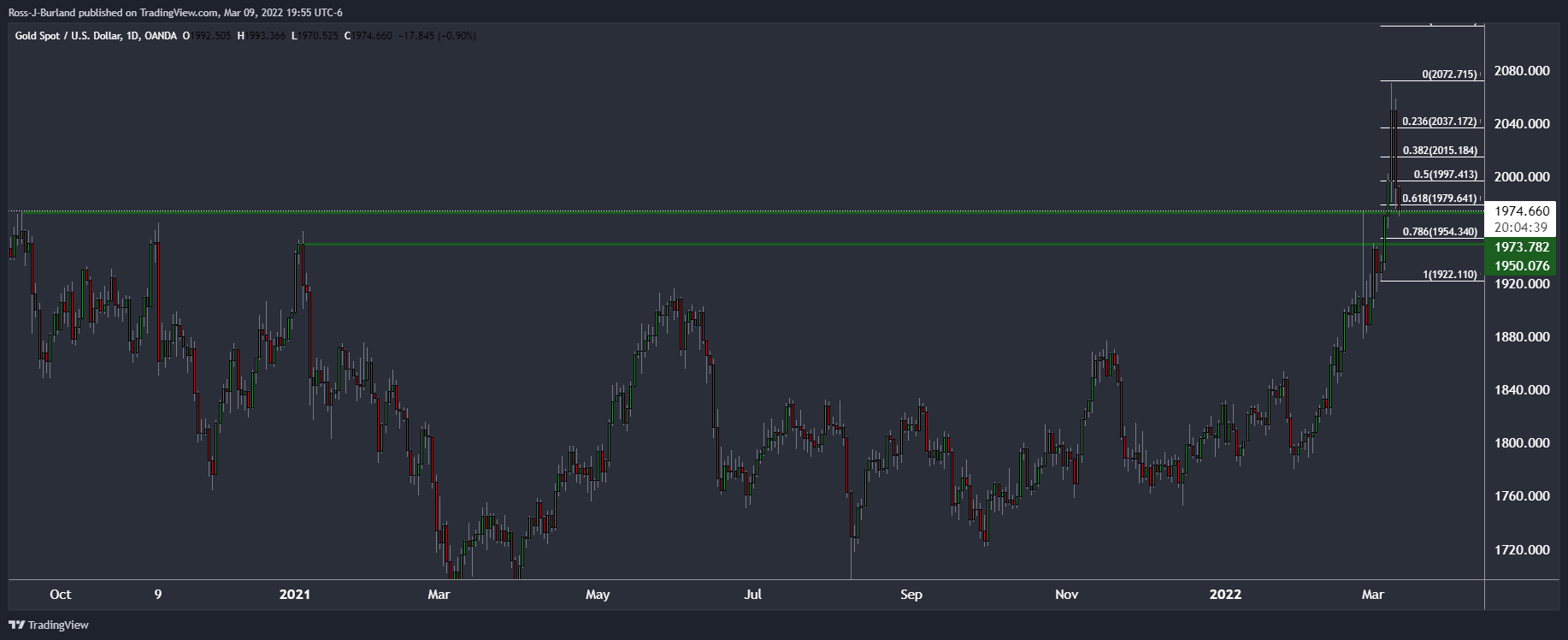
The price of gold has fallen to a familiar area of resistance that is currently acting as support. While the drop was of a magnitude on a single day that could not have been predicted, it did fall from a level previously marked as being significant:
Gold Price Forecast: XAU/USD holds below a key technical -61.8% golden ratio
Gold weekly chart
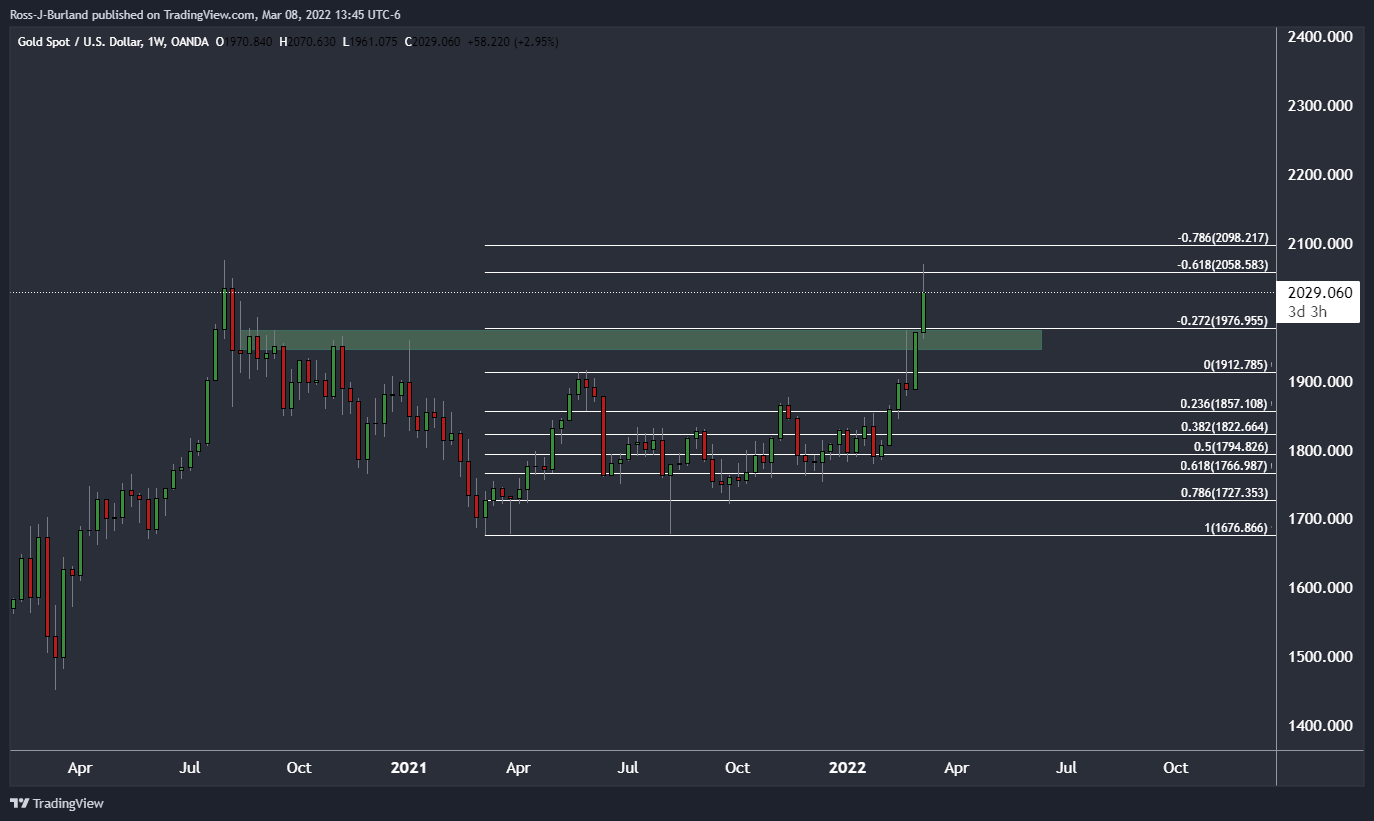
''The weekly chart shows that the price has reached a -61.8% golden ratio of the 2021 range.''
Author

Ross J Burland
FXStreet
Ross J Burland, born in England, UK, is a sportsman at heart. He played Rugby and Judo for his county, Kent and the South East of England Rugby team.