Gold Price Forecast: XAU/USD’s rebound remains capped below $1760 ahead of US ADP
- Gold is attempting a dead cat bounce amid firmer US dollar.
- Fed’s hawkishness and Delta variant concerns boost the greenback.
- Gold Weekly Forecast: Sellers look to retain control following uninspiring rebound

Update: Gold price is bouncing back towards $1760, having found support once again just above the $1750 mark. A fresh leg down in the US Treasury yields, in response to the Delta covid strain fears-led jittery markets, appears to have helped gold price recover some ground in the last hour.
Despite the rebound, the downside remains more compelling for gold price amid unabated US dollar’s demand and a bear pennant confirmed on the daily sticks. The greenback also draws support from Tuesday’s upbeat US CB Consumer Confidence data and hawkish comments from Fed Governor Christopher Waller. Next of relevance for gold price remains the US ADP Nonfarm Payrolls data, which is likely to have a significant impact on the dollar trades, in turn, rocking gold price. The ADP report is likely to show 600K private sector jobs added to the US economy this month.
Gold price is licking its wound following Tuesday’s sharp sell-off to two-month lows of $175. The US dollar extended the recent rally, as risk-off sentiment flared up on the renewed concerns over the coronavirus pandemic and its impact on the global economic recovery, in the face of the rapid spread of the Delta covid variant. The greenback also took advantage of the Fed’s hawkish tilt, as a "very optimistic" Fed Governor Christopher Waller said that the world’s most powerful central bank could resort to QE unwinding as soon as this year while hike rates in late 2022. Gold’s appeal gets diminished amid a firmer dollar.
Attention now turns towards the key US jobs data, with the leading indicator – ADP due for release at 1215 GMT. However, gold’s next direction could be determined by Friday’s all-important US NFP report.
Read: ADP Nonfarm Payrolls Preview: Going contrarian? How to trade this leading indicator
Gold Price: Key levels to watch
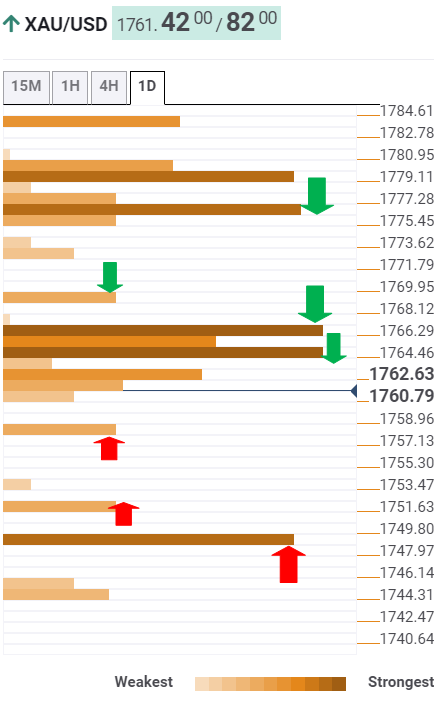
The Technical Confluences Detector shows that gold price is trading below a cluster of power resistance levels, with the immediate one seen at $1764, the previous week’s low.
The confluence of the previous month’s low and SMA5 four-hour at $1766 will be the next barrier for gold bulls.
Further up, the Fibonacci 61.8% one-day at $1769 will guard the upside. If the buying interest ramps up, gold price could advance towards $1776, the convergence of the Fibonacci 61.8% one-week and SMA100 one-hour.
On the flip side, the Fibonacci 23.6% one-day at $1758 could cap immediate decline, below which the two-month lows of $1751 could be retested.
The intersection of the pivot point one-day S1 and pivot point one-week S2 at $1748 will challenge the bearish commitments.
Sellers could then target the Fibonacci 161.8% one week at $1744 should the abovementioned strong support give way.
Here is how it looks on the tool
About Technical Confluences Detector
The TCD (Technical Confluences Detector) is a tool to locate and point out those price levels where there is a congestion of indicators, moving averages, Fibonacci levels, Pivot Points, etc. If you are a short-term trader, you will find entry points for counter-trend strategies and hunt a few points at a time. If you are a medium-to-long-term trader, this tool will allow you to know in advance the price levels where a medium-to-long-term trend may stop and rest, where to unwind positions, or where to increase your position size.
Previous update
Update: Gold traded with a mild negative bias through the early European session, albeit has managed to hold its neck above two-and-half-month lows touched on Tuesday. The US dollar consolidated the previous day's strong gains and remained supported by speculations that the Fed will tighten its monetary policy if price pressures continue to intensify. The market expectations were reaffirmed by Richmond Federal Reserve President Thomas Barkin's comments on Monday, saying that the US central bank has made substantial further progress toward its inflation goal to begin tapering asset purchases. The greenback was further supported by Tuesday's upbeat US Consumer Confidence Index, which soared to a fresh pandemic high in June and pointed to growing optimism above the economy. This, in turn, was seen as a key factor that continued acting as a headwind for dollar-denominated commodities, including gold.
Meanwhile, investors remain worried about the economic impact of the spread of the highly infectious Delta variant of the coronavirus through many Asian countries. Renewed COVID-19 jitters underpinned traditional safe-haven assets and helped limit any deeper losses for gold. Apart from this, a softer tone surrounding the US Treasury bond yields further extended some support to the non-yielding yellow metal. Investors also seemed reluctant to place any aggressive bets, rather preferred to wait on the sidelines ahead of Friday's release of the closely watched US monthly jobs data. The popularly known NFP report could influence the Fed's near-term monetary policy outlook and play a key role in determining the next leg of a directional move for the XAU/USD.
In the meantime, Wednesday's US economic docket – featuring the release of ADP report on private-sector employment, Chicago PMI and Pending Home Sales – might provide some impetus to gold. This, along with the US bond yields, the USD price dynamics and the broader market risk sentiment, will be looked upon for some short-term trading opportunities.
Author

Dhwani Mehta
FXStreet
Residing in Mumbai (India), Dhwani is a Senior Analyst and Manager of the Asian session at FXStreet. She has over 10 years of experience in analyzing and covering the global financial markets, with specialization in Forex and commodities markets.