Gold Price Forecast: XAU/USD still remains capped below 21-DMA as US dollar pumps up
- Gold is trying to make headway towards critical daily resistance.
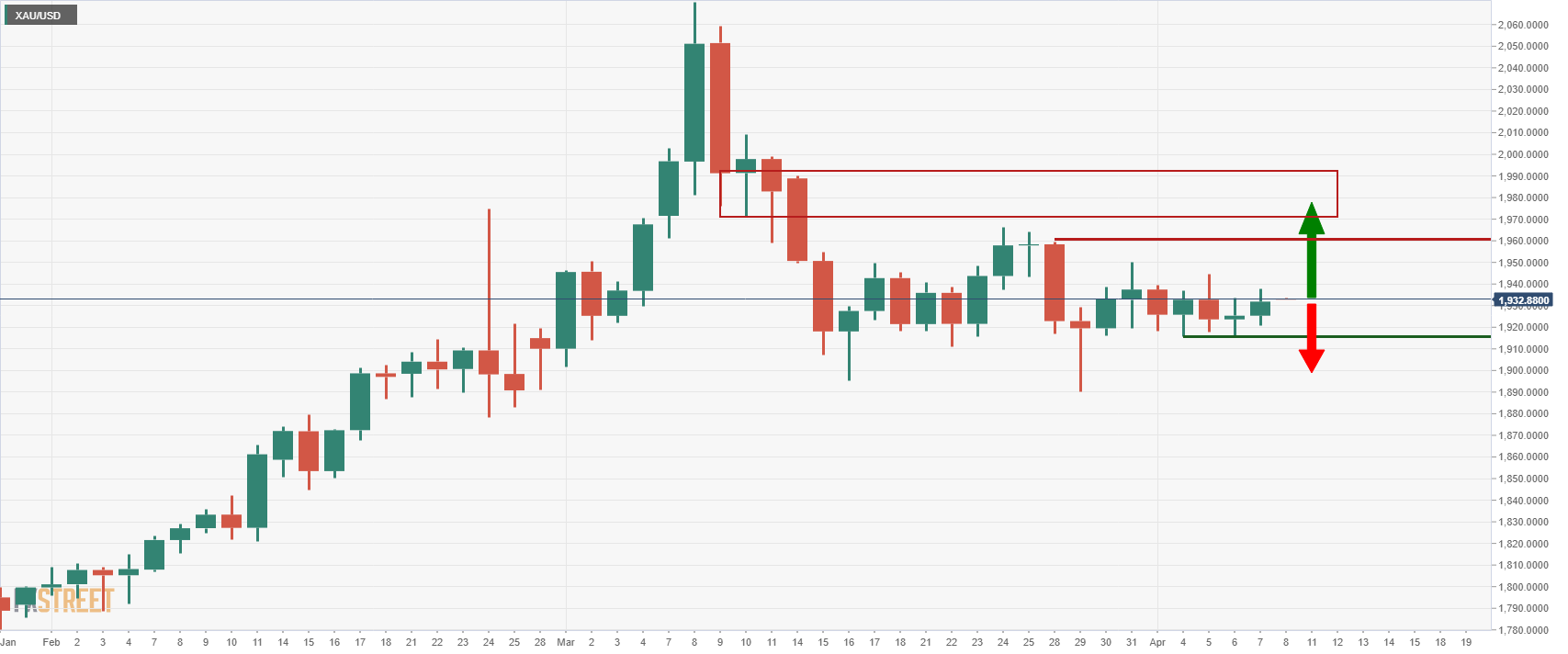
- Bulls need to break above $1,960 and the bears below $1,915 with firm daily closes above or below respectively.
- Inflation recession and war are being weighed vs. the narrative surrounding the Fed.

Update: Gold price is feeling the pull of gravity so far this Friday, having witnessed up and down trading sessions this week, as traders lack a clear directional bias. Gold price is reversing a minor portion of the previous gains, as the US dollar shoots to the moon amid the unrelenting rally in the Treasury yields across the curve. The aggressive Fed’s tightening bets are fuelling the surge in the dollar alongside the yields. Meanwhile, the 21-Daily Moving Average (DMA) at $1,935 also offers stiff resistance to gold bulls. The bright metal, however, benefited on the back of risk-off markets on Thursday, as the West ramped up its punishments against Russia and stoked fears over the global economic growth amid raging inflationary pressures. The Fed sentiment and the Ukraine updates will continue to dominate the gold price action amid a data-dry US economic docket.
Also read: Gold Narrow Range After Yearly Pivot of $2,075
At $1,934.15, the gold price, XAU/USD, is bid in Asia, moving in towards the New York session highs just a few dollars away at $1,937.
The US dollar climbed to nearly two-year highs on Thursday, as investors digested hawkish signals from the Federal Reserve. However, the stronger greenback failed to dent investor appetite as investors worry about a protracted war in Ukraine and the risks of recessions and inflation. With that being said, the narrative surrounding the Federal Reserve is keeping a lid on any breakout attempts.
The dollar index, DXY, hit a fresh 99.903 cycle high in early ASIA, the highest since late May 2020. The greenback was bid for the best part of Thursday as well while US stock indexes mostly rose as investors snapped up beaten-down shares.
The US Treasury's 10-year yield touched a three-year high following hawkish signals from the Federal Reserve that have come in stages throughout the course of the week with expectations of faster policy tightening by the Fed and other central banks.
The 2 year-10 year spread widened also due to the Fed's plans to reduce its balance sheet. The yield on 10-year Treasury notes was higher by 3.8 basis points to 2.647% while the 2-year note yield was losing 4.5 basis points at 2.457%, leaving the 2-10 spread at 18.72 basis points by the close of play on Wall Street.
''The near 27 basis point widening of that spread so far this week is the most for any week back to June 2013,'' Reuters acknowledged. ''Last week the spread tightened 27.5 basis points in the sharpest weekly tightening since September 2011. The yield curve inverted last week, signalling to some investors that a recession may be coming in a year or two.''
In this regard, the yellow metal is picking up a safe haven bid and is on par with the greenback. ''Gold bugs appear to be ignoring a hawkish Fed and embracing a safe-haven asset for protection against the fog of war,'' analysts at TD Securities noted.
''Strong physical demand is also likely both directly and indirectly associated with the war and its inflationary impact. And, while central bank flows have been muted of late, confiscation risks may drive official purchases higher.''
''However,'' the analysts added, ''this set-up also leaves gold vulnerable to a de-escalation in the war or a change in the market's focus as the fear trade subsides, especially given that there are no shorts in sight.''
Gold technical analysis
Bulls need to break above $1,960 and the bears below $1,915 with firm daily closes above or below respectively.
Author

Ross J Burland
FXStreet
Ross J Burland, born in England, UK, is a sportsman at heart. He played Rugby and Judo for his county, Kent and the South East of England Rugby team.

















