Gold Price Forecast: XAU/USD bulls eye United States inflation, efforts to tame Silicon Valley Bank risk
- Gold price retreats from one-month high after rising in the last two consecutive weeks.
- Fears emanating from Silicon Valley Bank drowned United States Treasury bond yields, US Dollar and propel haven demand of XAU/USD.
- Better-than-expected US Nonfarm Payrolls (NFP) failed to impress US Dollar buyers amid Silicon Valley Bank’s fallout.
- US Consumer Price Index, Federal Reserve’s efforts to defend SVB eyed for clearly predicting Gold price.

Gold Price (XAU/USD) pares the daily gains as it retreats from the highest levels in five weeks, marked earlier in the day, to $1,885 by the press time of the early Asian session on Monday. In doing so, the precious metal struggles to extend the previous two-week uptrend as the United States Treasury Department and Federal Reserve (Fed) take action to defend the financial market crisis risk emanating from Silicon Valley Bank. That said, the XAU/USD ignored better than forecast US Nonfarm Payrolls (NFP) to renew the one-month high, before rallying to a five-week top earlier in the day, as the US Dollar traced downbeat Treasury bond yields.
Gold price eases on measures to defend Silicon Valley Bank fallout
United States Treasury Department, Federal Reserve and the Federal Deposit Insurance Corporation (FDIC) took joint actions to tame the risks emanating from the Silicon Valley Bank (SVB) fallout during the weekend and exert downside pressure on Gold prices of late. “Taking decisive actions to protect the US economy by strengthening public confidence in our banking system,” said the US Treasury Department and Federal Reserve (Fed) in joint statements on the action plan to defend the Silicon Valley Bank (SVB). Market sentiment improved after the news release as the US regulators also closed the Signature Bank and announced plans to make depositors whole. While portraying the mood, S&P 500 Futures and the US Treasury bond yields rise after a downbeat close the previous day. It should be noted that the market sentiment roiled on Friday after the SVB spread the risks of another financial crisis.
Also read: US Treasury Department, Fed unveil action plan on Silicon Valley Bank fallout
United States Employment data may weigh on XAU/USD after initial disappointment
On Friday, United States Nonfarm Payrolls (NFP) grew more than 205K expected to 311K in February, versus 504K (revised), while the Unemployment Rate rose to 3.6% for the said month compared to 3.4% expected and prior. Further, the Average Hourly Earnings rose on YoY but eased on monthly basis for February whereas the Labor Force Participation increased during the stated month. Despite mostly upbeat US data, the US Dollar failed to improve as risks from the Silicon Valley Bank (SVB) fallout drowned the US Treasury bond yields. However, the recent US regulators’ actions may redirect the market players towards remembering the upbeat US jobs report and renew the hawkish Fed bets ahead of next week’s Federal Reserve (Fed) monetary policy meeting, which in turn could weigh on the Gold price.
United States Inflation in focus
Looking ahead, the United States Consumer Price Index (CPI) for February, up for publishing on Tuesday, will precede the Retail Sales and preliminary readings of the Michigan Consumer Sentiment Index for March, up for publishing on Wednesday and Friday, to direct Gold price. It’s worth noting that the Federal Reserve (Fed) officials’ two-week ahead of the monetary policy meeting adds importance to the stated data. Should the headline numbers manage to flash inflation risks, the odds of witnessing further XAU/USD declines can’t be ruled out.
Gold price technical analysis
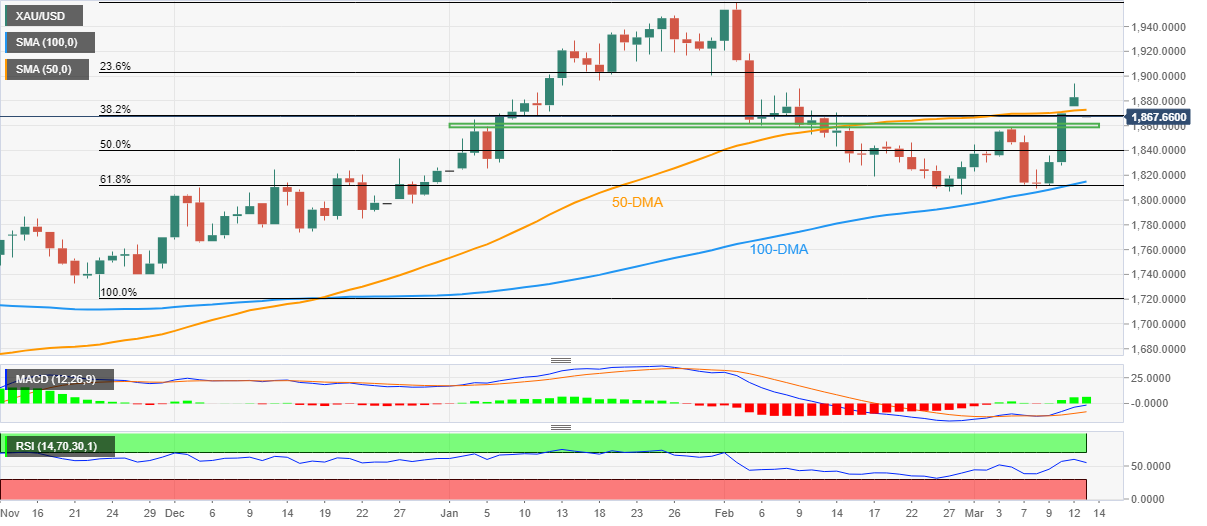
Gold price manages to cheer a sustained bounce off 61.8% Fibonacci retracement level of November 2022 to February 2023 upside of around $1,812, also known as the golden Fibonacci ratio.
Adding strength to the bullish bias surrounding the XAU/USD is a successful upside break of a nine-week-old horizontal hurdle, now immediate support near $1,860, as well as the 50-DMA level surrounding $1,872.
That said, the bullish signals from the Moving Average Convergence and Divergence (MACD) indicator join the upbeat but not overbought appearance of the Relative Strength Index (RSI) line, placed at 14.
With this, the XAU/USD run-up towards the 23.6% Fibonacci retracement level surrounding $1,904, as well as a challenge to the previous monthly top of near $1,960, can’t be ruled out.
On the contrary, Gold sellers may return to the table if the quote struggles to remain beyond the aforementioned horizontal resistance-turned-support of around $1,860. It should be noted that the 50-DMA can restrict the immediate downside near $1,872.
Adding to the downside filters are 50% and 61.8% Fibonacci retracement levels near $1,840 and $1,812. It’s worth noting that the 100-DMA level of $1,810 appears the last defense of the Gold buyers.
To sum up, Gold price gains buyers’ attention ahead of the key United States data but sustained trading beyond $1,871 could help strengthen the bullish bias.
Gold Price: Daily chart
Trend: Further upside expected
Author

Anil Panchal
FXStreet
Anil Panchal has nearly 15 years of experience in tracking financial markets. With a keen interest in macroeconomics, Anil aptly tracks global news/updates and stays well-informed about the global financial moves and their implications.














