BoJ Recap: Not as hawkish as expected

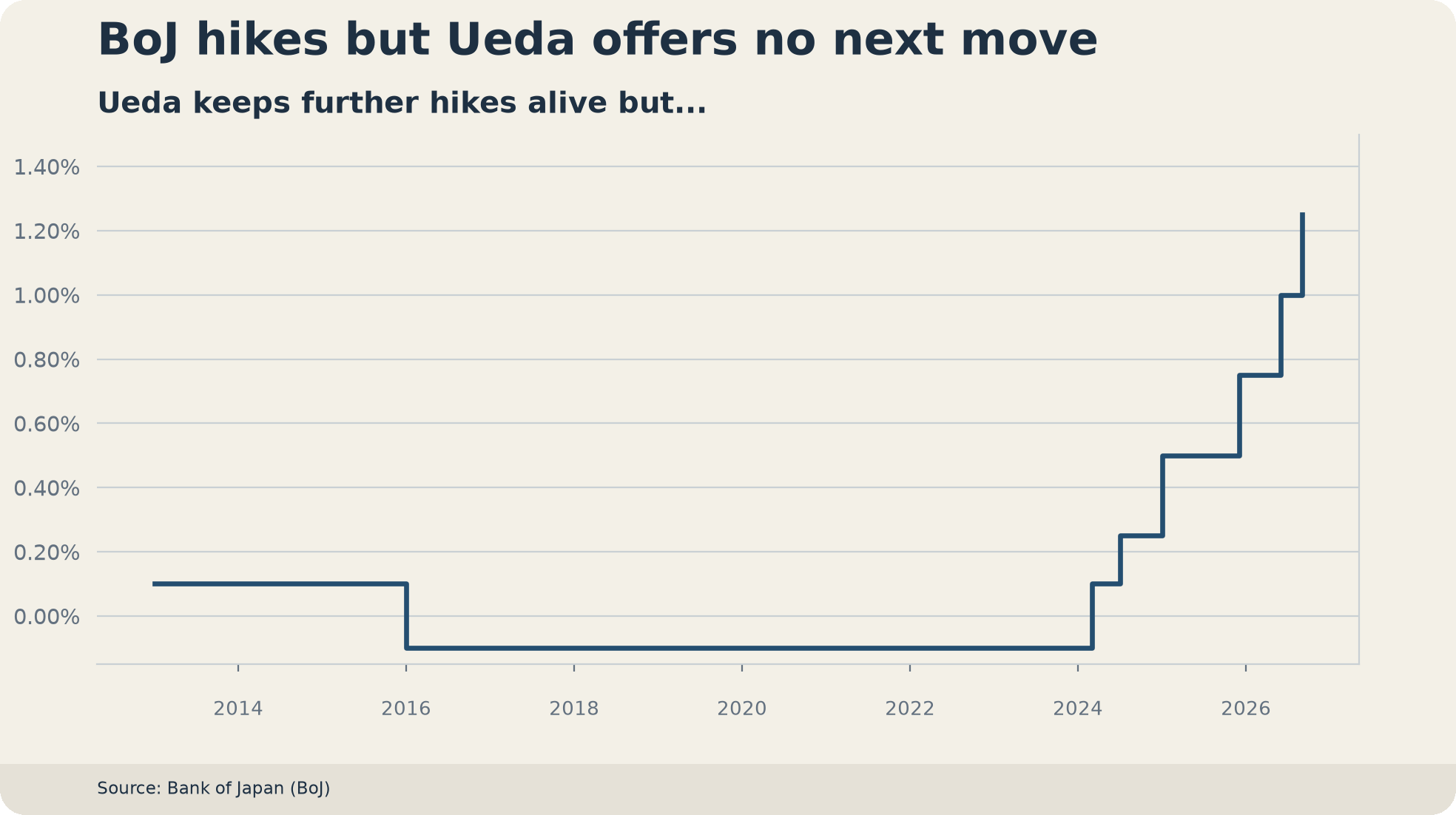
The Bank of Japan (BoJ) raised its short-term interest-rate target to 1.25% from 1.00% in a 7-2 vote, marking another step in the normalisation of monetary policy and widely matching what everyone has been expecting for weeks. Governor Kazuo Ueda said the policy phase had changed as underlying inflation approached 2% but stressed that the timing and pace of further increases would depend on the outlook and accumulated effects of previous hikes.
The decision was opposed by board members Asada and Sato, who argued that consumer-price inflation remained below 2% and that economic and price developments had not accelerated enough to justify another increase. The majority, however, judged that monetary support needed to be reduced to ensure the inflation target was achieved sustainably and stably.
The BoJ said underlying inflation was approaching 2% and that price pressures were becoming more persistent. Wholesale inflation remains elevated because of oil prices, Yen weakness and AI-related demand, while higher business-to-business costs are spreading to consumer prices. Firms are also continuing to pass higher wages through to selling prices, and inflation expectations are rising.
Ueda described the Japanese economy as recovering moderately, albeit with some weakness, while financial conditions remained accommodative. He said the policy phase had changed and that the BoJ would continue to raise rates and adjust the degree of monetary easing in response to economic activity, prices and financial conditions. However, he ruled out any preset timetable, saying it was difficult to determine the terminal rate and that the end point would only become clear retrospectively.
He also identified several risks to the outlook: the Middle East conflict, oil prices, AI-related demand and FX volatility. He said a second phase of price increases linked to the Middle East crisis was already occurring and that the BoJ needed to act pre-emptively if inflation threatened to overshoot 2%. At the same time, policymakers want to avoid the financial damage caused by excessively rapid tightening, meaning large or consecutive hikes would be used only if the risk of an overshoot became significant.
Ueda also stressed that the BoJ was not conducting monetary policy to control the Yen’s level, although exchange-rate movements remained important because of their impact on prices. He said the spring wage negotiations in FY 2027 would be crucial in determining whether trend inflation stabilised around 2%, and he insisted that the bank would maintain its independence and coordinate appropriately with the government.
To sum up
The event’s tone leant hawkish but measured. The BoJ has clearly entered a new phase of policy normalisation, with underlying inflation, wage pass-through and rising expectations providing a stronger case for further tightening. However, Ueda’s emphasis on the accumulated impact of past hikes, the need to avoid excessive speed and the absence of a fixed timetable suggest that future moves will be gradual and heavily data-dependent.
Bank of Japan FAQs
The Bank of Japan (BoJ) is the Japanese central bank, which sets monetary policy in the country. Its mandate is to issue banknotes and carry out currency and monetary control to ensure price stability, which means an inflation target of around 2%.
The Bank of Japan embarked in an ultra-loose monetary policy in 2013 in order to stimulate the economy and fuel inflation amid a low-inflationary environment. The bank’s policy is based on Quantitative and Qualitative Easing (QQE), or printing notes to buy assets such as government or corporate bonds to provide liquidity. In 2016, the bank doubled down on its strategy and further loosened policy by first introducing negative interest rates and then directly controlling the yield of its 10-year government bonds. In March 2024, the BoJ lifted interest rates, effectively retreating from the ultra-loose monetary policy stance.
The Bank’s massive stimulus caused the Yen to depreciate against its main currency peers. This process exacerbated in 2022 and 2023 due to an increasing policy divergence between the Bank of Japan and other main central banks, which opted to increase interest rates sharply to fight decades-high levels of inflation. The BoJ’s policy led to a widening differential with other currencies, dragging down the value of the Yen. This trend partly reversed in 2024, when the BoJ decided to abandon its ultra-loose policy stance.
A weaker Yen and the spike in global energy prices led to an increase in Japanese inflation, which exceeded the BoJ’s 2% target. The prospect of rising salaries in the country – a key element fuelling inflation – also contributed to the move.
Author

Pablo Piovano
FXStreet
Born and bred in Argentina, Pablo has been carrying on with his passion for FX markets and trading since his first college years.