|

Gold Price Forecast: XAU/USD bears move in as the NFP dust settles

  • Gold price rallied to session highs on the US NFP data that missed expectations on the headline.
  • Gold bears are moving as the dust settles on the front side of the daily bearish trendline. 

Gold price rallied on the knee-jerk and relatively benign Nonfarm Payrolls outcome. Although the data showed a contraction in the headline from the prior month with large revisions to the downside for the prior, the Unemployment Rate was 0.1% lower compared to last month which is another positive in a series of robust US numbers of late. Nevertheless, XAU/USD popped to a high of $1,928.40 from a low of $1.920. 

Meanwhile, 15 minutes after the data, the Gold price is falling and traded back below $1,920. 

Nonfarm Payrolls 

Nonfarm Payrolls (NFP) in the US rose 209,000 in June, the US Bureau of Labor Statistics reported on Friday. This reading came in below the market expectation of 225,000. May's increase of 339,000 got revised lower to 306,000.

The Unemployment Rate edged lower to 3.6% from 3.7% as expected and the annual wage inflation, as measured by the Average Hourly Earnings, stood unchanged at 4.4%, compared to analysts' estimate of 4.2%. Finally, the Labor Force Participation Rate held steady at 62.6%, while the Unemployment Rate fell 0.1% to 6.9% from 6.7%.

All in all, the data continues to back a robust labour market and accompanies the May JOLTS job openings came in at 9.824 mln vs. 9.9 mln expected and a revised 10.32 mln (was 10.1 mln) in April. Also,  Continuing claims came in at 1.72 mln vs. 1.737 mln expected and a revised 1.733 mln (was 1.742 mln) last week. This was the lowest since mid-February. The ADP reported its private sector jobs estimate at 497k vs. 240k expected and a revised 267k (was 278k) in May.

However, November Fed hike odds dropped to 39% from 45% after Nonfarm Payrolls.

Gold technical analysis
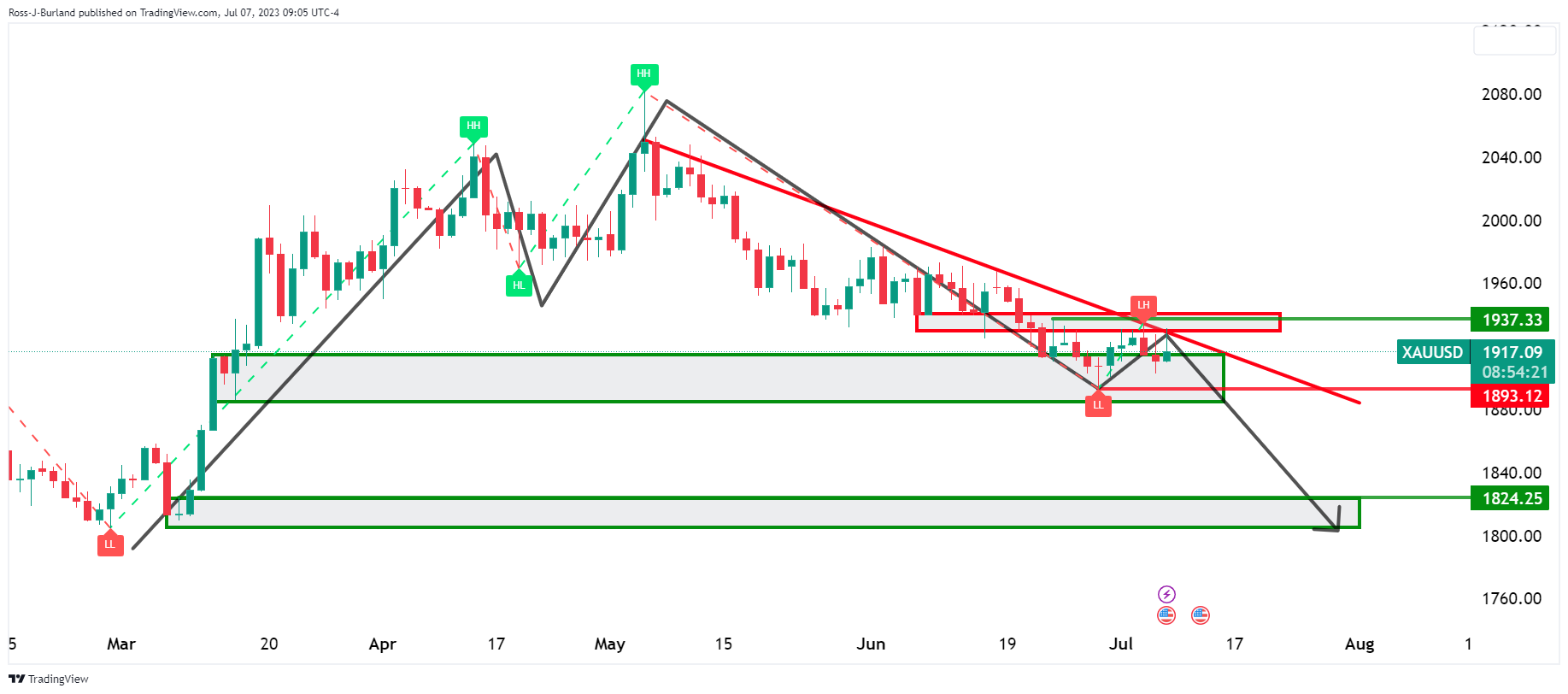
Nevertheless, from a daily perspective, the price is on the front side of the bearish trend and the data has done little to shift the bearish bias so far. Bears look for a break of $1,893 that guards a run to $1,824.25.

Author

Ross J Burland

Ross J Burland, born in England, UK, is a sportsman at heart. He played Rugby and Judo for his county, Kent and the South East of England Rugby team.


More from Ross J Burland
Share:

Editor's Picks

AUD/USD bulls regain control above 0.6950 amid USD retreat

AUD/USD regains traction and extends the previous day's bounce from the weekly low, aiming for 0.7000 in Asia on Friday. The overnight pullback in US bond yields keeps the US Dollar below an 18-month high, which in turn offers some support to the pair. Meanwhile, hawkish RBA expectations also keep the major underpinned.

USD/JPY holds gains near 158.00 after Japan's weak Household Spending data

USD/JPY clings to gains around 158.00 after data showed on Friday that Japan's Household Spending fell for the ninth straight month, undermining the Japanese Yen. Meanwhile, the US Dollar remains depressed as the overnight fall in US bond yields counters a hawkish Fed and geopolitical uncertainties, could cap any downside in the pair.

Gold remains range-bound below $4,200

Gold has given up some ground after an initial bullish attempt to reach weekly highs, returning to below the $4,200 mark per troy ounce on Friday. The US Dollar’s strong upside momentum, combined with rising US Treasury yields across the curve, seems to keep further gains in the yellow metal under scrutiny.

Has Bitcoin really escaped the macro forces it was built to fight?
Over 17 years ago, Satoshi Nakamoto designed Bitcoin (BTC) on the back of a global financial crisis as an alternative to the global monetary system outside the control of central banks, governments and traditional intermediaries. This raises a key question: has Bitcoin really become independent of the macroeconomic forces it was built to challenge?
The Euro is not the sick man of Europe. France's bond market is
EUR/USD remains under pressure, near the 17-month low of 1.1161 reached on Monday. The pair has lost more than 7% since its yearly peak, as concerns over France's public finances increasingly weigh on the single currency. But behind the weakness of the Euro (EUR), the problem does not necessarily lie with the European economy as a whole.
Has Bitcoin really escaped the macro forces it was built to fight?
Over 17 years ago, Satoshi Nakamoto designed Bitcoin (BTC) on the back of a global financial crisis as an alternative to the global monetary system outside the control of central banks, governments and traditional intermediaries. This raises a key question: has Bitcoin really become independent of the macroeconomic forces it was built to challenge?














