Gold Price Forecast: XAU/USD steadies below $1,800 despite upbeat yields
- Gold is being held up by critical support on the daily chart.
- The week ahead and key events could move the needle as bulls ad bears battle it out
- XAU/USD poised for further losses on Fed's hawkish stance

Update: Gold (XAU/USD) fades bounce off intraday low around $1,786 during a sluggish Asian session on Monday.
The bright metal struggles to extend Friday’s losses around a six-week low as market players remain divided over the Fed’s next moves amid a light calendar and a one-week-long absence of Chinese traders. Also challenging the market is the US Senate’s readiness to pass a law to sanction Russia.
Even so, firmer US Treasury yields and mildly offered stock futures portray the risk-off mood, exerting downside pressure on gold prices.
It should be noted, however, that the US Dollar Index (DXY) keeps Friday’s pullback and puts a floor under the XAU/USD prices.
Moving on, a light calendar and cautious mood ahead of Friday’s key US jobs report may test gold traders. However, there prevails little room for the buyers to enter.
End of update.
The price of gold, XAU/USD, ended the week on the front foot and was correcting from the lows of last week's bearish run from $1,780, moving in on the prior day's support near $1,800. Trading around Friday's close near $1,791, the yellow metal is on thin ice, technically, as it balances upon critical daily trendline support for the open.
Risk appetite improved on Friday. World stocks rallied with corporate earnings taking up the spotlight which was a positive focus and welcoming distraction from the geopolitical turmoil and Federal Reserve tightening concerns. Economic data also helped to ease inflation worries, which left the US dollar in consolidation and US yields on the backfoot.
US Treasury yields fell across the curve on Friday as the Fed's favoured inflation gauge, the core personal consumption expenditure price index (PCE), stayed within expectations. In the 12 months through December, the PCE increased 5.8%. That was the largest advance since 1982 and followed a 5.7% year-on-year increase in November. Nevertheless, the 2-year and the 10-year yield curve steepened to as much as 65.10 basis points after hitting its narrowest spread since November 2020 on Thursday.
The outcome was significant because the Federal Reserve on Wednesday indicated it is likely to raise rates in March when it also reaffirmed plans to end its pandemic-era bond purchases at the same time. This would clear the way for launching a significant reduction in its asset holdings which has the markets on edge, which had been weighing on stocks and supporting the US dollar.
''The Fed's hawkish tone is sapping risk appetite from the market, but safe-haven flows also remain subdued despite rising risks of a conflict in Ukraine, leaving investors with few avenues toward refuge,'' analysts at TD Securities explained. ''We expect that the precious metals complex will struggle to attract capital in this context.'' This is said after gold recorded its biggest weekly loss since August.
The week ahead
Meanwhile, the week ahead could be a critical one for gold considering the lineup of US events that include the US Nonfarm Payrolls jobs data and US ISM numbers.
''More regional surveys for January will be released early next week, so expectations could change, but the surveys already released point to declines in both ISM indexes,'' analysts at TD Securities said, ''Weakening can likely be explained in large part by temporary fallout from Omicron, but a fading of the boost from fiscal stimulus is probably causing some slowing as well.''
With regards to the jobs data, the analysts explained, ''the recovery in employment was probably temporarily interrupted by the Omicron-led surge in COVID cases. Many of the employees who had to isolate likely continued to be paid, and thus remained on payrolls, but many were likely not paid. The report will probably show continued strength in wage gains. The report will include the annual revision to the data.''
Gold technical analysis
Analysts at ANZ Bank argued that gold looks vulnerable for further losses, having broken below its key moving averages to trade below $1,800/oz.
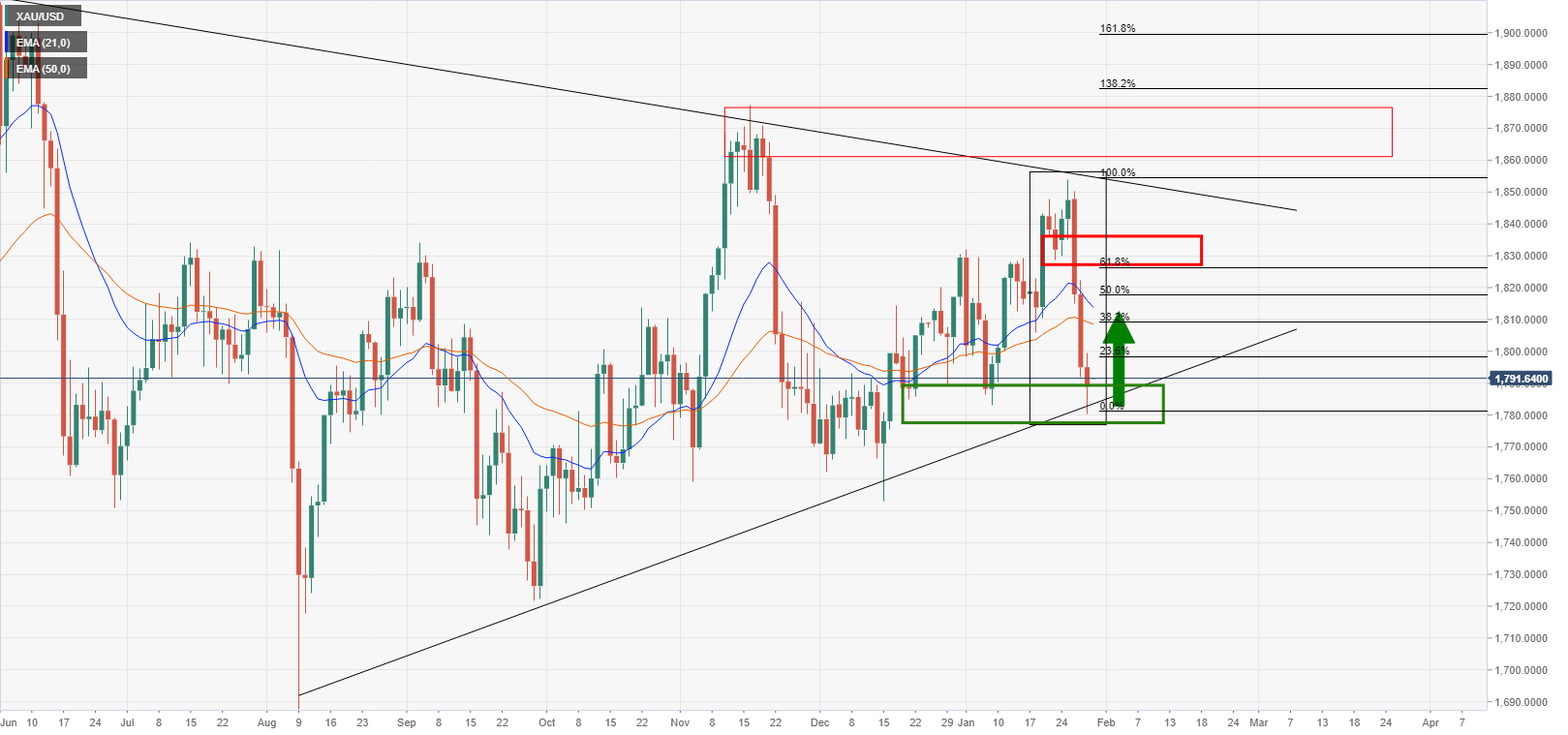
With that being said, the price could be on the verge of a significant upside correction for the sessions ahead considering the price has run into a wall of support as illustrated above near $1,780. The 21 and 50-day EMAs coincide with a 38.2% ratio and a 50% mean reversion thereafter which could draw in the price towards $1,810/820.
Author

Ross J Burland
FXStreet
Ross J Burland, born in England, UK, is a sportsman at heart. He played Rugby and Judo for his county, Kent and the South East of England Rugby team.