Gold Price Forecast: XAU/USD eases off two-month highs near $1820 as Treasury yields rebound
- Gold bulls take the lead with the focus on more patent rhetoric from central banks.
- Bulls are relishing within a lower yield environment and the focus is on the $1,830s.
- XAU/USD turns bullish on falling bond yields, technical breakout

Update: Gold price is retreating from a fresh two-month high of $1819, reached in the last hour. The pullback in gold price comes on the back of a firm rebound staged by the US Treasury yields across the curve. Meanwhile, a cautious market mood could likely limit the retreat in gold price. The market’s repricing of the Fed’s rate hike expectations fuelled the last week’s upsurge in the metal above the $1800 mark. Gold bulls even shrugged off a big beat on the US NFP figures released last Friday.
Gold traders now await the US CPI release due this week for fresh trading impulse, Ahead of that Fed Chair Jerome Powell’s speeches will be closely followed for any hints on the rate hike guidance.
Gold on Friday made an impressive rally as US yields crumbled on the back of the market's shift towards risk-on sentiment following a series of central banks that are in harmony with their patient rhetoric in respect to rate hikes. XAU/USD rallied from a low of $1,785.06 to a high of $1,818.36 and ended the day 1.47% higher.
The yellow metal relished in a risk-on environment on Friday as US stocks lapped up the benefit of not only a more relaxed tone towards central bank tightening but on a solid US Nonfarm Payrolls report that cemented the prospects of a firm recovery in the US jobs sector. The outcome was a welcomed relief for the start of the last quarter and came in contrast to what some economists had predicted for the final stage of the year.
NFP was solid
There was a 531k rise in Oct's US jobs market. We also saw an upward revision to Sept (312k vs 194k) that showed that a solid and dynamic labour market recovery is in place and that US economic activity is reaccelerating. ''For the transitory inflation argument to hold,'' however, ''it will be necessary for the participation rate to rise, and put downward pressure on wages,'' analysts at ANZ Bank explained. Nevertheless, the analysts argued that ''it was a very strong payrolls report and one that signals that the "transitory" dogma will be quite seriously challenged. If repeated in coming months, an accelerated taper seems probable.''
The most key for the precious metals markets on Friday, US Treasury yields fell despite stronger than expected employment payrolls data. Traders for the second straight day pushed out cash rate expectations on the view that central banks may be slower to move on inflation. This has seen the US 10-year yield crumble from a restest of the daily counter-trendline into the 1.4550% territory. The more central bank sensitive yield, the 2-year fell a whopping 5.37% on the day on Friday. ''This should see local rates markets start the week under some buying pressure,'' analysts at ANZ Bank argued.
Meanwhile, analysts at TD Securities explained that the central bank reiterated that its tools cannot help ease the temporary supply constraints that have ultimately driven inflation higher. ''In this context, data beats could result in a higher inflation risk premium, but the jury is still out on the Fed's reaction.'' The analysts also explained that ''market pricing for Fed hikes may also still be distorted by the terrible liquidity in Treasuries following the recent positioning washout.''
''In this context, while the breadth of traders' short positions is not extreme by any means, position sizing is bloated considering the number of participants short, which leaves the hawks vulnerable to a squeeze. An ongoing CTA buying program could also help the yellow metal break through the $1800/oz range that has contained its nascent rally.''
For the week ahead, the main economic event next week will be the release of the October Consumer Price Index in the US, where 5.8% YoY is expected (4.3% core). However, for the start of the week, the central bank theme will likely dominate and yields will be the focus.
Gold technical analysis
From a 4-hour perspective, the price of gold has been firmly bid but should profit-taking ensue by the weaker hands, then a correction would be the most likely trajectory to start the week off.
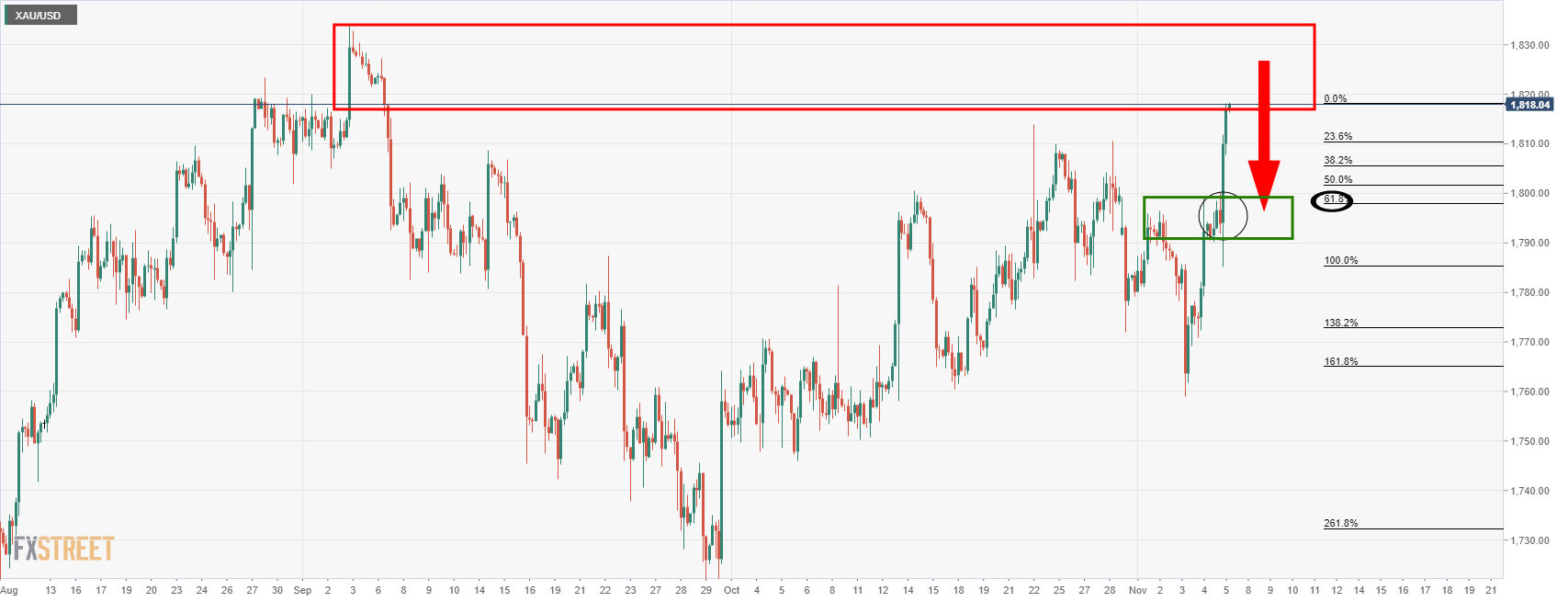
The price is meeting a resistance area, but as it stands, a 61.8% Fibonacci retracement has a confluence with the prior resistance just below $1,800 which could be expected to attract a retest in the coming sessions. With that being said, a continuation to the upside opens risk to $1,830 for the near term.
Author

Ross J Burland
FXStreet
Ross J Burland, born in England, UK, is a sportsman at heart. He played Rugby and Judo for his county, Kent and the South East of England Rugby team.