Gold Price Forecast: XAU/USD justifies options market's bearish bias below $1,800
- Gold stays mildly bid above two-month-old support, extends the latest rebound.
- US Treasury yields, inflation expectations fall amid mixed signals from Fed, pre-NFP trading lull.
- Omicron sneaks into the US, Biden administration weighs on extending mask mandate.
- Gold Price Forecast: Still depressed despite the better market mood

Update: Gold (XAU/USD) pares intraday losses around $1,775, down 0.12% on a day ahead of Thursday’s European session. In addition to the market’s rush for traditional safe-havens like the US government bonds and Japanese yen (JPY), the bearish bias of the options market also weighs on the gold prices of late.
Gold's one-month risk reversal, which measures the spread between call and put prices, dropped to -0.775 figures for November versus October’s figure of +1.575, the highest levels marked since June 2019.
Adding to the downside bias is the latest pick-up in the US Dollar Index (DXY) while tracking the pause in the US 10-year Treasury yields at the lowest levels in two months. The reason could be linked to the first Omicron cases in the United Arab Emirates (UAE) and the US, as well as the indecision over the Fed versus ECB drama.
That said, US second-tier data and coronavirus updates will join the central bankers’ speeches to entertain traders. Though, nothing more important than Friday’s US jobs report.
End of update.
Gold (XAU/USD) defends short-term key support despite multiple failures to cross the 200-DMA, easing to $1,780 during Thursday’s Asian session.
The yellow metal snapped a two-day downtrend the previous day amid the US dollar pullback and softer yields. However, fears emanating from the South African variant of the coronavirus seem to challenge the bold buyers of late.
That said, global markets cheered mixed comments from Fed Chair Jerome Powell and World Health Organization’s (WHO) cautious optimism to portray risk-on mood the previous day.
The World Health Organization (WHO) tried calming the virus woes with statements defending the current vaccines and marking less severe impacts of the COVID-19 strain. On the other hand, Federal Reserve (Fed) Chairman Jerome Powell reiterated his inflation fears but also said he still believes inflation will come down “meaningfully” in the second half of 2022, during testimony against a Senate Commission. Recently, Federal Reserve Bank of New York President John C. Williams said, per New York Times, that Omicron could prolong supply and demand mismatches, causing some inflation pressures to last.
It should be noted that the first Omicron case in the US pushed President Joe Biden’s administration to extend the rules for wearing a mask in public transit. “US President Joe Biden's administration will extend requirements for travelers to wear masks on airplanes, trains and buses and at airports and train stations through mid-March to address ongoing COVID-19 risks,” said Reuters quoting anonymous sources.
Talking about data, US ADP Employment Change and ISM Manufacturing PMI details for November ticked above market consensus of 525K and 61.0 respectively to 534K and 61.1 in that order.
Against this backdrop, Wall Street benchmarks and the US Treasury yields dropped, weighing down the US inflation expectations measured by the 10-year breakeven inflation rate per the St. Louis Federal Reserve (FRED) data. However, the S&P 500 Futures print mild gains by the press time.
Given the mixed concerns and the market’s wait for Friday’s key US jobs report, gold prices are likely to trade range-bound. Though, virus updates and second-tier US data may entertain the traders.
Read: US nonfarm payrolls take center stage after Powell’s hawkishness
Technical analysis
With a bounce off an ascending trend line from October contrasting the lower lows of the RSI, gold buyers brace for further upside past the 200-DMA while relying on the technical formation called hidden bullish divergence.
In doing so, tops marked during late October and the last week, around $1,814-16, gain major attention before the key $1,834 hurdle comprising July and September highs.
During the quote’s run-up past $1,834, the $1,850 level may offer an intermediate halt before driving the gold bulls to November’s peak of $1,877.
On the flip side, the stated support line near $1,771 precedes an upward sloping trend line from September close to $1,760 to challenge the short-term downside of the metal.
However, a clear break of the $1,760 level will not hesitate to challenge September’s low of $1,721 and the $1,700 threshold before the gold bears run out of steam around the yearly bottom of $1,687.
Gold: Daily chart
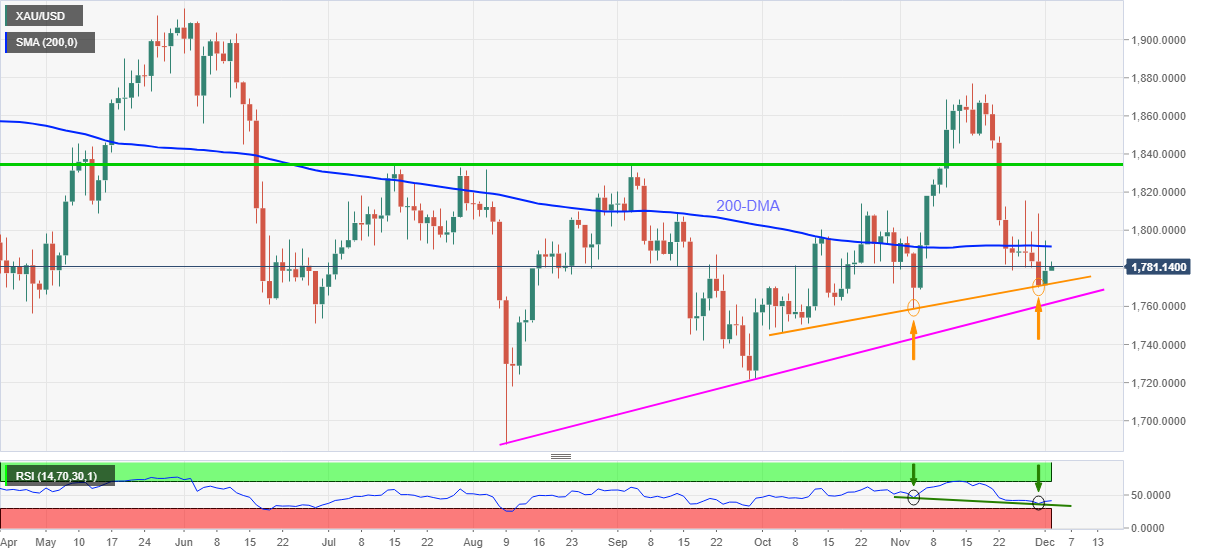
Trend: Further recovery expected
Author

Anil Panchal
FXStreet
Anil Panchal has nearly 15 years of experience in tracking financial markets. With a keen interest in macroeconomics, Anil aptly tracks global news/updates and stays well-informed about the global financial moves and their implications.

















