Gold slides on sold US Dollar after upbeat JOLTS data
- Gold drops to $3,348 after JOLTS report shows tight labor market.
- US job openings jump in April, boosting the US Dollar and weighing on non-yielding Gold.
- Traders await key labor data, including ADP and NFP, to gauge Fed’s policy path.
- Trump’s tariff threats persist, but possible Xi call and Fed’s Bostic favoring patience ease tension.

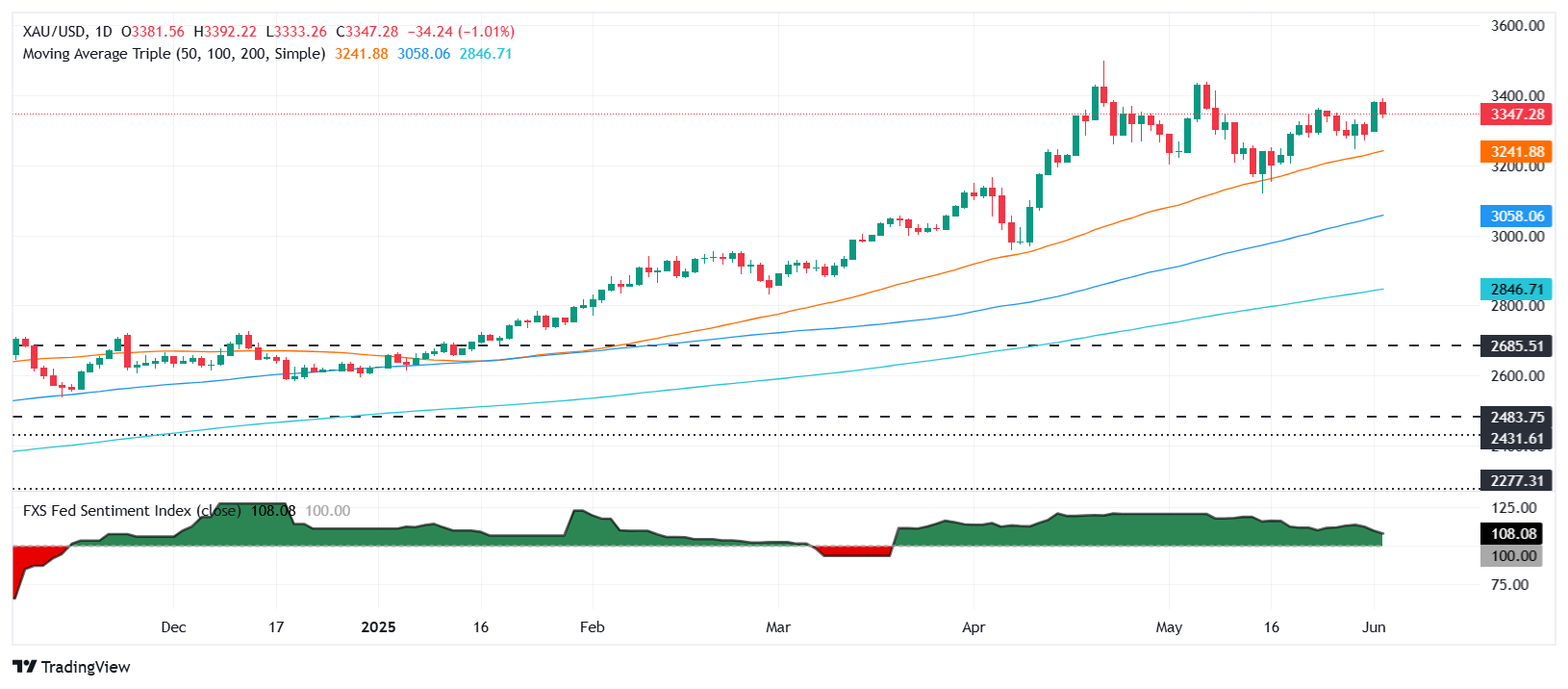
Gold price trims some of its Monday gains as it edges down over 0.80% on Tuesday following jobs data from the United States (US), which reveals that the labor market remains tight. At the same time, the overall strength of the Greenback weighed on the non-yielding metal. The XAU/USD trades at $3,348 after hitting a daily high of $3,392.
Investors' mood turned optimistic following the release of the latest US Job Openings & Labor Turnover Survey (JOLTS), which showed that job vacancies rose sharply in April. The data was positive, ahead of a busy week with jobs data releases awaited. On Wednesday, the Automatic Data Processing (ADP) National Employment Change for May is expected to improve, followed by Friday’s Nonfarm Payroll numbers.
Bullion prices retreated on rumors of a possible call between US President Donald Trump and his counterpart, Chinese President Xi Jinping. Last week, Trump announced that China had violated a trade agreement reached in Switzerland. He then doubled down on worldwide steel and aluminum tariffs, which were set to increase from 25% to 50% and take effect on June 4.
The European Commission is pressuring the United States to lower tariffs. Conversely, the Trump administration urged trading partners to submit revised offers by Wednesday to speed up trade talks.
Atlanta Fed President Raphael Bostic said that the best monetary policy approach now entails “patience,” and he still sees just one rate cut this year.
Gold daily market movers: US Dollar stages a comeback, pushes Gold lower
- Gold price disappoints traders as the US Dollar recovers. The US Dollar Index (DXY), which tracks the Greenback’s value against a basket of six currencies, rises 0.52% to 99.22.
- US Treasury bond yields are rising, with the US 10-year Treasury note yielding up two basis points to 4.462%. US real yields have followed suit and are also climbing by two basis points to 2.132%.
- US JOLTS Job Openings in April rose by 7.39 million, from a revised 7.2 million in March. Economists estimated a decrease to 7.10 million vacancies.
- High tensions between the US and China could spur another leg-up in Gold prices. Trump’s decision to raise tariffs on base metals could be inflation prone, increasing precious metals’ appeal. On the other hand, an agreement between Washington and Beijing will likely result in easing tensions and lower Bullion prices.
- Money markets suggest that traders are pricing in 48.5 basis points of easing toward the end of the year, according to Prime Market Terminal data.
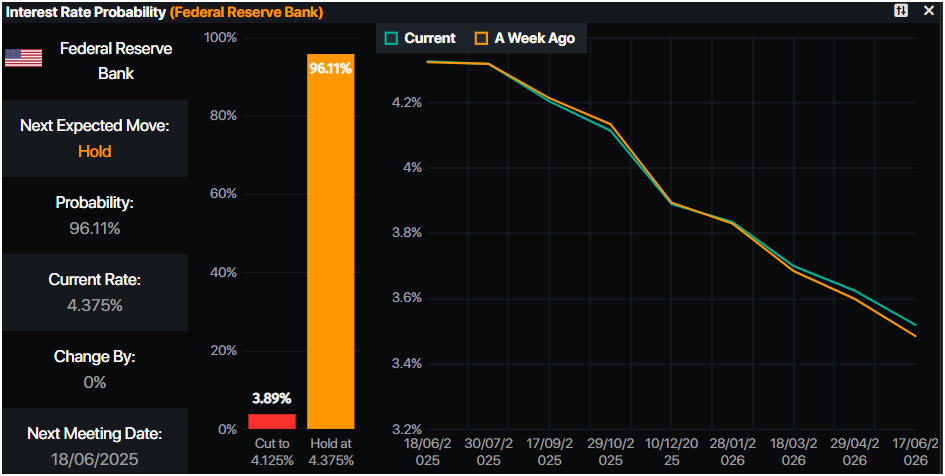
Source: Prime Market Terminal
XAU/USD technical outlook: Gold surges past $3,350 with bulls targeting $3,400
Gold price uptrend remains intact despite retreating somewhat from around $3,400. Due to XAU/USD’s overall bias, the ongoing leg down could be an excellent opportunity for buyers, who may target $3,400. Once surpassed, this level clears the path to test key resistance levels.
The first support level to emerge is the May 7 peak at $3,438. A breach of the latter exposes $3,450 as a psychological level, followed by the all-time high (ATH) at $3,500.
Conversely, if Gold falls beneath $3,300, sellers could send XAU/USD on a tailspin toward testing the 50-day Simple Moving Average (SMA) at $3,235, followed by the April 3 high turned support at $3,167.
Fed FAQs
Monetary policy in the US is shaped by the Federal Reserve (Fed). The Fed has two mandates: to achieve price stability and foster full employment. Its primary tool to achieve these goals is by adjusting interest rates. When prices are rising too quickly and inflation is above the Fed’s 2% target, it raises interest rates, increasing borrowing costs throughout the economy. This results in a stronger US Dollar (USD) as it makes the US a more attractive place for international investors to park their money. When inflation falls below 2% or the Unemployment Rate is too high, the Fed may lower interest rates to encourage borrowing, which weighs on the Greenback.
The Federal Reserve (Fed) holds eight policy meetings a year, where the Federal Open Market Committee (FOMC) assesses economic conditions and makes monetary policy decisions. The FOMC is attended by twelve Fed officials – the seven members of the Board of Governors, the president of the Federal Reserve Bank of New York, and four of the remaining eleven regional Reserve Bank presidents, who serve one-year terms on a rotating basis.
In extreme situations, the Federal Reserve may resort to a policy named Quantitative Easing (QE). QE is the process by which the Fed substantially increases the flow of credit in a stuck financial system. It is a non-standard policy measure used during crises or when inflation is extremely low. It was the Fed’s weapon of choice during the Great Financial Crisis in 2008. It involves the Fed printing more Dollars and using them to buy high grade bonds from financial institutions. QE usually weakens the US Dollar.
Quantitative tightening (QT) is the reverse process of QE, whereby the Federal Reserve stops buying bonds from financial institutions and does not reinvest the principal from the bonds it holds maturing, to purchase new bonds. It is usually positive for the value of the US Dollar.
Author

Christian Borjon Valencia
FXStreet
Markets analyst, news editor, and trading instructor with over 14 years of experience across FX, commodities, US equity indices, and global macro markets.