Gold sinks on solid US jobs report but clings to weekly gains
- XAU/USD falls after strong NFP data cuts rate cut hopes, but holds weekly gain above 1.30%.
- US adds 139K jobs in May; Unemployment Rate steady at 4.2%, boosting US Dollar and Treasury yields.
- Fed cut expectations fade as traders reassess outlook ahead of June 17–18 FOMC meeting.

Gold price extended its losses for the second consecutive day on Friday but is poised to finish the week with gains of over 1.30% after the latest Nonfarm Payrolls report in the United States (US) was solid, pressuring traders to trim their bets that the Federal Reserve (Fed) will ease monetary policy. At the time of writing, the XAU/USD trades at $3,322, down 0.84%.
The US Bureau of Labor Statistics (BLS) revealed that the labor market remains resilient as the Unemployment Rate figures remained unchanged compared to April. In the meantime, Wall Street recovers some of its Thursday losses amid the ongoing feud between US President Donald Trump and Tesla CEO Elon Musk, spurred by the House of Representatives' approval of the US debt ceiling increase.
Bullion prices took a hit as the buck showed signs of life, climbing 0.49% as depicted by the US Dollar Index (DXY). The move was sponsored by investors adjusting their estimates of the Fed rate cut and higher US Treasury bond yields.
Although Gold is taking a hit, heightened tensions between Russia and Ukraine and the prolonged conflict between Israel and Hamas could still drive prices higher.
Next week, the US economic docket will be absent of Fed speakers as they enter the blackout period ahead of the June 17-18 meeting. Traders would be eyeing Consumer Price Index (CPI) figures, followed by the Producer Price Index (PPI) and the University of Michigan Consumer Sentiment.
Daily digest market movers: Gold drops as soaring US yields underpin the US Dollar
- The US 10-year Treasury yield surges over nine-and-a-half basis points to 4.484%. US real yields have followed suit and are also up for the same amount at 2.196%, a headwind for Bullion prices.
- May US Nonfarm Payrolls print surpassed forecasts of 130K, rose by 139K but missed April’s downwardly revised 147K. Although the labor market is cooling, it remains in great condition as the US economy decelerates.
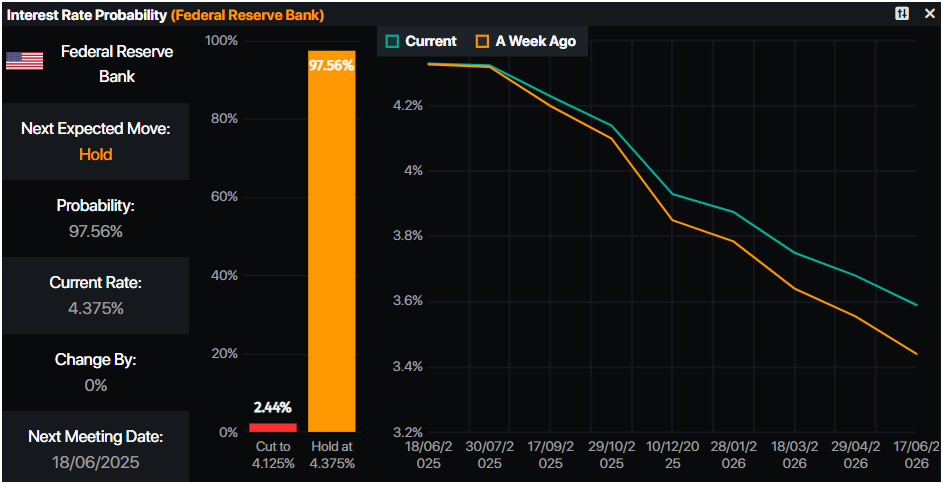
- The Unemployment Rate stood at 4.2%, and along with the jobs report, sparked a repricing of interest rates, with less than two expected cuts by the Fed toward the end of 2025.
- Metals Focus said, “Central banks worldwide are set to buy 1,000 metric [tonnes] of Gold in 2025, marking a fourth straight year of massive purchases as they shift reserves away from [US D]ollar assets.”
- The de-escalation of US-Sino trade war tensions could exert downward pressure on Gold, which so far has gained over 26% in the year.
- Money markets suggest that traders are pricing in 44.5 basis points of easing toward the end of the year, according to Prime Market Terminal data.
Source: Prime Market Terminal
XAU/USD technical outlook: Gold remains bullish despite losing some ground below $3,360
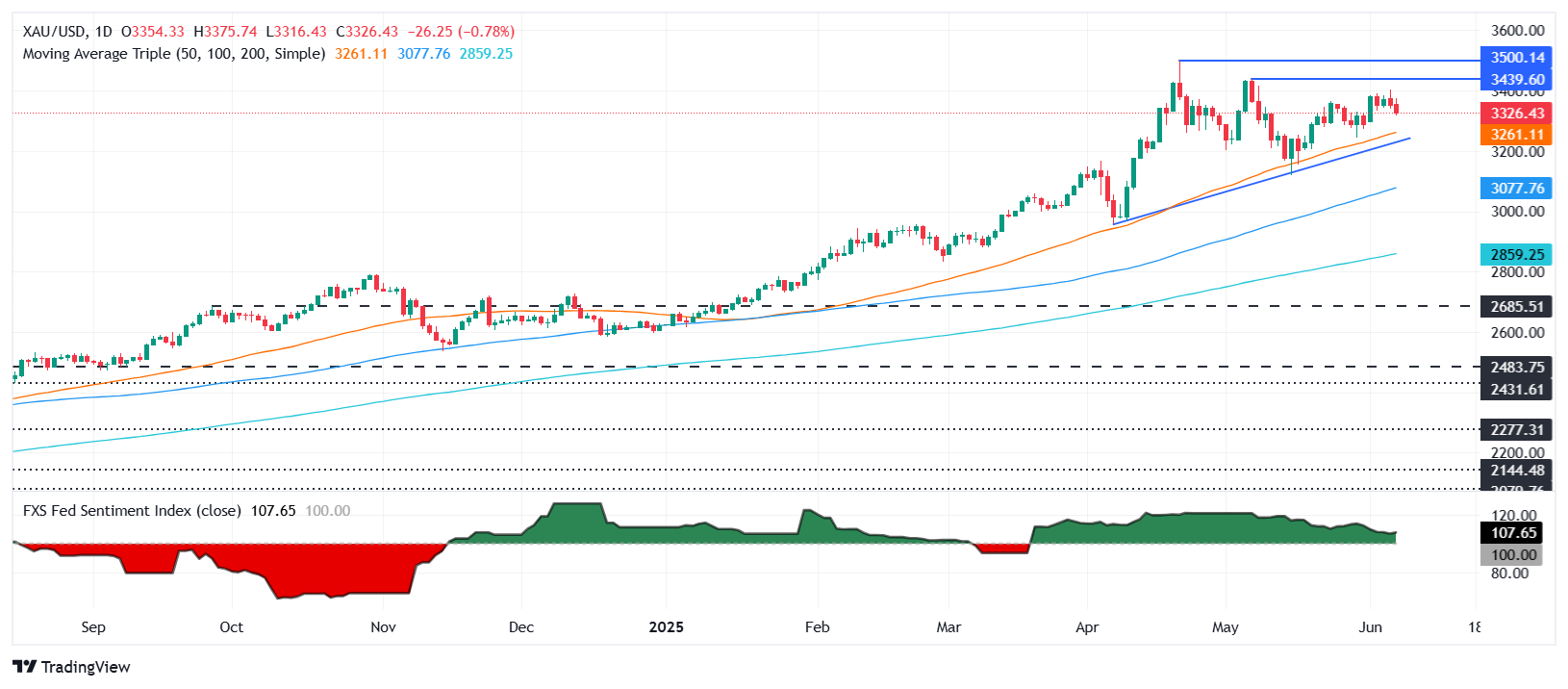
Gold price consolidates after the XAU/USD has fallen to a four-day low of $3,316 but holds above $3,300, which is seen as a crucial floor that, if cleared, could open the path to test $3,250.
The Relative Strength Index (RSI) shifted bearish, indicating that XAU/USD could extend its losses; however, the overall trend favors the bulls.
If Gold stays above $3,300, this could pave the way to test the current week’s peak of $3,403 hit on June 5, followed by the $3,450 mark. If surpassed, up next lies the all-time high at $3,500.
On the other hand, if Gold falls below $3,300, sellers could send XAU/USD on a tailspin, testing the 50-day Simple Moving Average (SMA) at $3,235, followed by the April 3 high, which has since turned into support at $3,167.
Fed FAQs
Monetary policy in the US is shaped by the Federal Reserve (Fed). The Fed has two mandates: to achieve price stability and foster full employment. Its primary tool to achieve these goals is by adjusting interest rates. When prices are rising too quickly and inflation is above the Fed’s 2% target, it raises interest rates, increasing borrowing costs throughout the economy. This results in a stronger US Dollar (USD) as it makes the US a more attractive place for international investors to park their money. When inflation falls below 2% or the Unemployment Rate is too high, the Fed may lower interest rates to encourage borrowing, which weighs on the Greenback.
The Federal Reserve (Fed) holds eight policy meetings a year, where the Federal Open Market Committee (FOMC) assesses economic conditions and makes monetary policy decisions. The FOMC is attended by twelve Fed officials – the seven members of the Board of Governors, the president of the Federal Reserve Bank of New York, and four of the remaining eleven regional Reserve Bank presidents, who serve one-year terms on a rotating basis.
In extreme situations, the Federal Reserve may resort to a policy named Quantitative Easing (QE). QE is the process by which the Fed substantially increases the flow of credit in a stuck financial system. It is a non-standard policy measure used during crises or when inflation is extremely low. It was the Fed’s weapon of choice during the Great Financial Crisis in 2008. It involves the Fed printing more Dollars and using them to buy high grade bonds from financial institutions. QE usually weakens the US Dollar.
Quantitative tightening (QT) is the reverse process of QE, whereby the Federal Reserve stops buying bonds from financial institutions and does not reinvest the principal from the bonds it holds maturing, to purchase new bonds. It is usually positive for the value of the US Dollar.
Author

Christian Borjon Valencia
FXStreet
Markets analyst, news editor, and trading instructor with over 14 years of experience across FX, commodities, US equity indices, and global macro markets.