Gold price erases earlier losses after China replies on Trump's tariffs
- Gold price unable to break back above $3,100 as market rout continues for a second day.
- China retaliates and issues 34% tariff on all US goods.
- Gold pressured by more profit-taking and looking for support to bounce off from.

Gold price (XAU/USD) is trying to reclaim $3,100 and is at that level at the time of writing with the price action back to being flat on the day. Bullion was able to avoid a complete meltdown by paring back Thursday’s losses, which were at one point over 2.50%, by closing off at only a loss of -0.65% just above $3,115. The earlier selling pressure is starting to fade after China imposed 34% tariffs on all US goods as from April 10th.
Meanwhile, the focus this Friday will shift to the United States (US) economic data with the Nonfarm Payrolls (NFP) release. Expectations for the Nonfarm Payrolls range from 80,000 to 200,000, with the consensus view at 135,000. Federal Reserve (Fed) Chairman Jerome Powell might soothe markets with comments just thereafter, while investors are adding to the conviction that the central bank might cut interest rates four times by the end of this year.
Daily digest market movers: Spiral out of control
- China replies to the US imposed tariffs by issuing its own tariffs on US goods, at 34% as of April 10th.
- Gold stands to benefit this year from an increasingly volatile trade, macroeconomic and geopolitical environment, having surged almost 18% this year, Bloomberg reports.
- The CME FedWatch tool sees chances for an interest rate cut in May standing at 33.2% and growing. A cut in June is still the most plausible outcome, with only a 9.4% chance for rates to remain at current levels. In the overall yield curve since Thursday, markets are betting on three or even four markets.
- More and more scenarios are coming out for the possibility of the US sliding into a period of stagflation. In that case, Bullion would emerge as the winner, Reuters reports. The Atlanta Fed GDPNow Index currently stands at -2.84%.
Gold Price Technical Analysis: Up or down
It is pretty normal that the Gold price rally was due to some profit-taking. This opens the door for opportunities, as the rally is not done yet. However, the tailwind for the next leg in the rally will change from tariff angst now to recession or stagflation fears.
Looking up, the daily Pivot Point at $3,112 must be reclaimed before aiming to revisit the all-time high at $3,167. That might be the limit on Friday, with the R1 resistance just above it at $3,170 and reinforcing this area as a strong barrier for further gains. There are very slim chances that the R2 resistance at $3,226 would be visited this Friday.
On the downside, the S1 support at $3,057 makes sense as the first support, seeing the bounce it triggered on Thursday. Further down, the $3,000 level is being exposed this Friday as the S2 support only comes in just below it at $2,998.
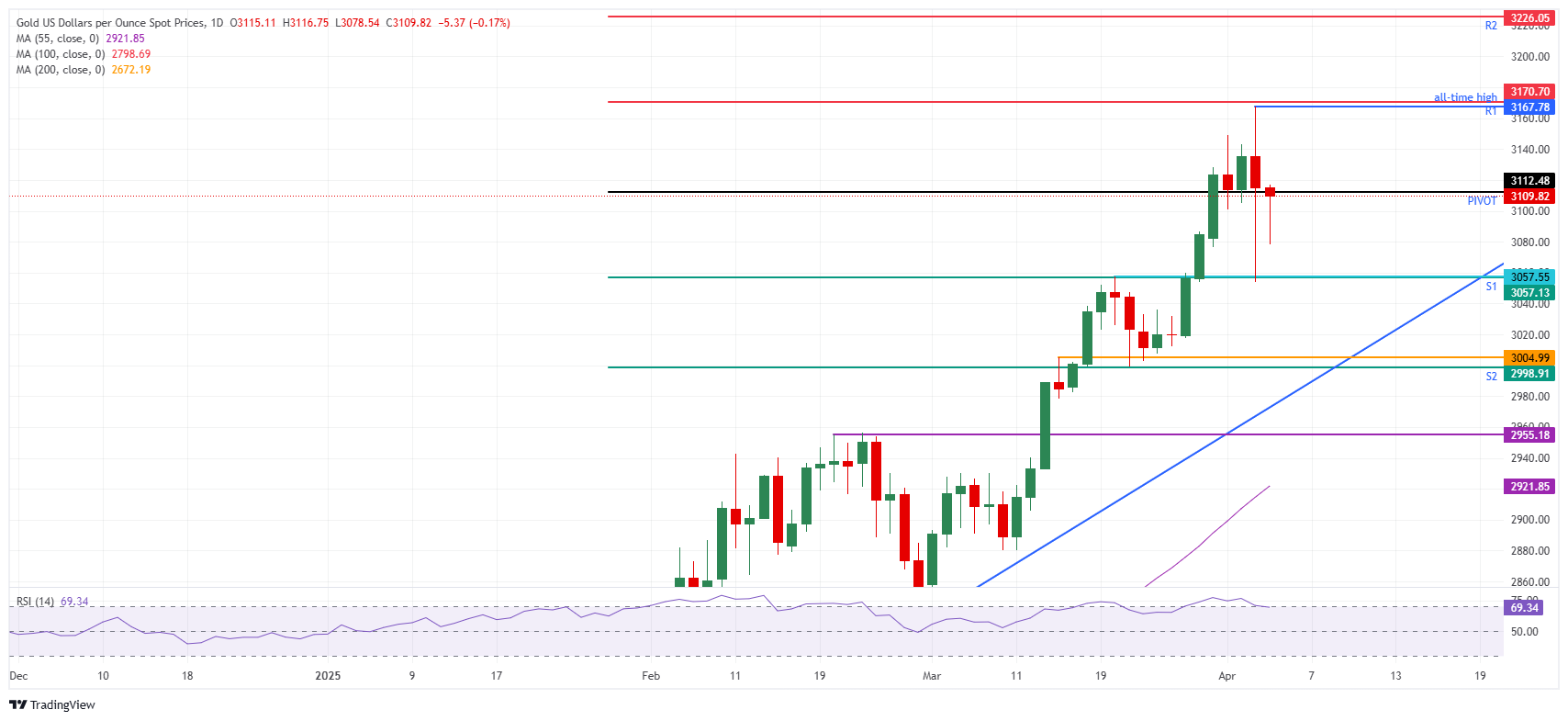
XAU/USD: Daily Chart
Employment FAQs
Labor market conditions are a key element to assess the health of an economy and thus a key driver for currency valuation. High employment, or low unemployment, has positive implications for consumer spending and thus economic growth, boosting the value of the local currency. Moreover, a very tight labor market – a situation in which there is a shortage of workers to fill open positions – can also have implications on inflation levels and thus monetary policy as low labor supply and high demand leads to higher wages.
The pace at which salaries are growing in an economy is key for policymakers. High wage growth means that households have more money to spend, usually leading to price increases in consumer goods. In contrast to more volatile sources of inflation such as energy prices, wage growth is seen as a key component of underlying and persisting inflation as salary increases are unlikely to be undone. Central banks around the world pay close attention to wage growth data when deciding on monetary policy.
The weight that each central bank assigns to labor market conditions depends on its objectives. Some central banks explicitly have mandates related to the labor market beyond controlling inflation levels. The US Federal Reserve (Fed), for example, has the dual mandate of promoting maximum employment and stable prices. Meanwhile, the European Central Bank’s (ECB) sole mandate is to keep inflation under control. Still, and despite whatever mandates they have, labor market conditions are an important factor for policymakers given its significance as a gauge of the health of the economy and their direct relationship to inflation.
BRANDED CONTENT
Not all brokers provide the same benefits for Gold trading, making it essential to compare key features. Knowing each broker’s strengths will help you find the ideal fit for your trading strategy. Explore our detailed guide on the best Gold brokers.
Author

Filip Lagaart
FXStreet
Filip Lagaart is a former sales/trader with over 15 years of financial markets expertise under its belt.

















