Gold price sees US session push Bullion to $3,125
- Gold price sprints higher, out of the sub-$3,000 region to $3,125 on Thursday.
- President Trump announced a 90-day pause on reciprocal tariffs overnight, as negotiations get underway.
- Gold could hit a fresh all-time high later in the day if rally persists until the US trading session.

Gold price (XAU/USD) is printing a stellar return on Thursday, moving around $3,120 at the time of writing. Since Tuesday morning, the precious metal has rallied nearly 5.00%. The main driver for the rally came from United States (US) President Donald Trump, who announced a 90-day pause to higher tariffs on 56 countries and the European Union, which will now be taxed at the 10% baseline rate.
Trump also hiked levies on China to 125%, effective immediately, after the Asian country announced plans to retaliate with an 84% tariff on all US imports to take effect on Thursday. Those moves are exacerbating concerns that the world’s two biggest economies will keep the trade war escalating. The People’s Bank of China (PBOC), China’s central bank, weakened the Yuan (CNY) for the sixth straight session, despite US Treasury Secretary Scott Bessent’s warning the country not to do so on Tuesday. It looks like Beijing will use the country’s currency as a negotiation tool, as it did in the last trade war.
Daily digest market movers: Rate cut expectations shift
- The constant back-and-forth of the US administration’s tariff plan has shaken the entire world, as investors scramble to find direction and certainty. That’s generally been supportive for Gold, which is up 18% this year. The yellow metal has also been bolstered by hopes for more Federal Reserve monetary easing and central bank buying, Bloomberg reports.
- The CME FedWatch tool shows that the chances of an interest rate cut by the Federal Reserve (Fed) in May have decreased to only 19,5% compared with 44.6% seen on Tuesday. For June, the chances of lower borrowing costs are 75.3%.
- Gold is quickly getting back toward recent highs, with today’s boost coming along with a report that Chinese leaders are meeting to discuss stimulus measures. However, there is a bigger picture favoring Gold, which is that other financial assets are failing to retain their value as a safe haven. The precious metal dipped after the 2008 Global Financial Crisis (GFC) and then started a multi-year climb that is still going on. Long-term investors and even central banks are making Bullion a core holding through all market conditions, Reuters reports.
Gold Price Technical Analysis: Look at the pivots
The precious metal recovers a two-day loss with a similar sharp move on the back of comments from President Trump and the 90-day delay on tariffs. A delay is just a pause and does not guarantee that deals will be made with all countries. Tensions will brew up again if certain significant trade agreements do not materialize ahead of that 90-day deadline.
The first cap of the R1 resistance at $3,131 is being tested when writing, followed by the current all-time high of $3,167. Just above there, the R2 resistance at $3,180 will come in as a hard cap on the topside.
On the downside, the daily Pivot Point comes in at $3,050 on Thursday, with the March 10 high pivotal level at $3,057. If this area does not hold as support, bears can target the S1 support at $3,002, with the March 14 high at $3,004 and the $3,000 psychological level making this area a strong support zone.
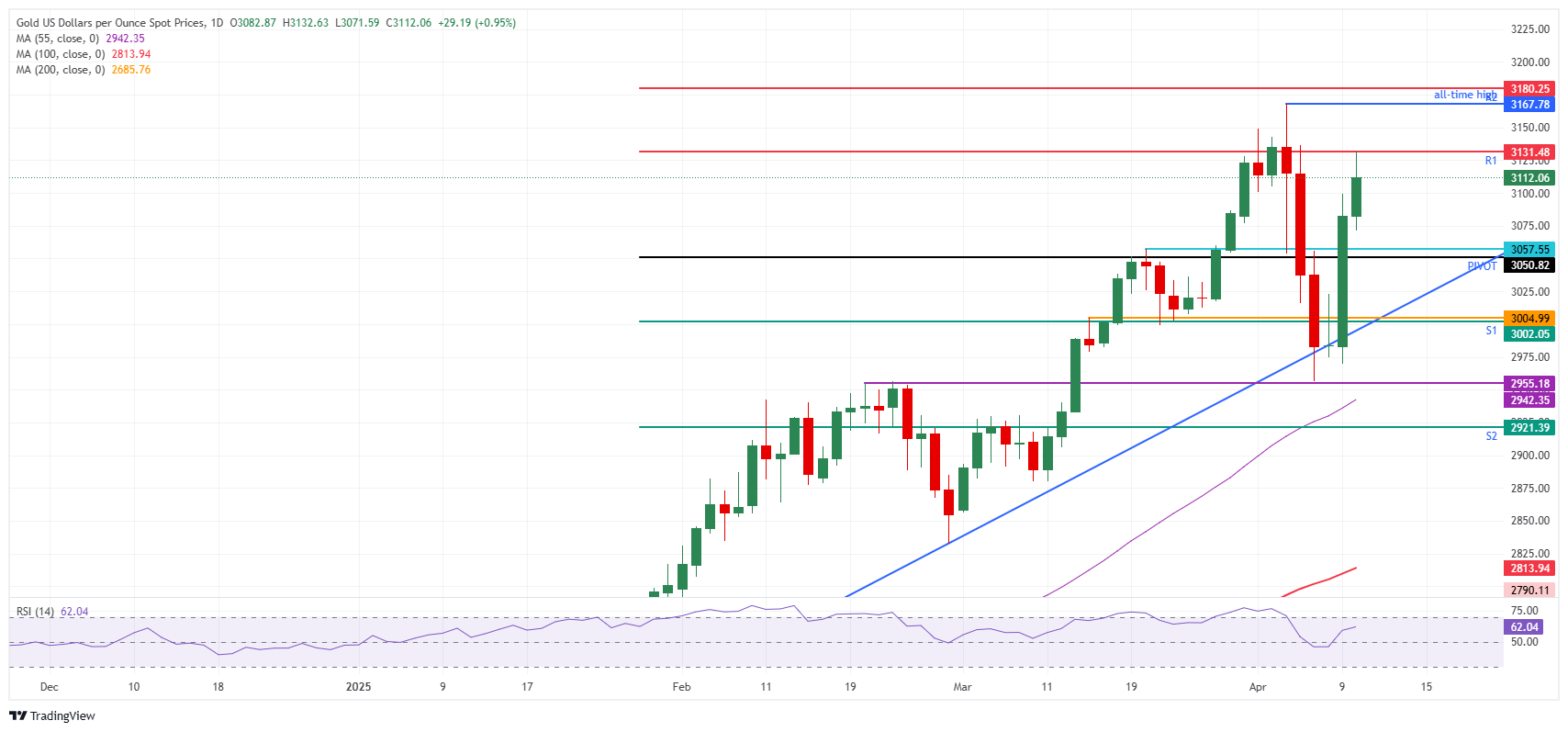
XAU/USD: Daily Chart
Tariffs FAQs
Tariffs are customs duties levied on certain merchandise imports or a category of products. Tariffs are designed to help local producers and manufacturers be more competitive in the market by providing a price advantage over similar goods that can be imported. Tariffs are widely used as tools of protectionism, along with trade barriers and import quotas.
Although tariffs and taxes both generate government revenue to fund public goods and services, they have several distinctions. Tariffs are prepaid at the port of entry, while taxes are paid at the time of purchase. Taxes are imposed on individual taxpayers and businesses, while tariffs are paid by importers.
There are two schools of thought among economists regarding the usage of tariffs. While some argue that tariffs are necessary to protect domestic industries and address trade imbalances, others see them as a harmful tool that could potentially drive prices higher over the long term and lead to a damaging trade war by encouraging tit-for-tat tariffs.
During the run-up to the presidential election in November 2024, Donald Trump made it clear that he intends to use tariffs to support the US economy and American producers. In 2024, Mexico, China and Canada accounted for 42% of total US imports. In this period, Mexico stood out as the top exporter with $466.6 billion, according to the US Census Bureau. Hence, Trump wants to focus on these three nations when imposing tariffs. He also plans to use the revenue generated through tariffs to lower personal income taxes.
BRANDED CONTENT
Not all brokers provide the same benefits for Gold trading, making it essential to compare key features. Knowing each broker’s strengths will help you find the ideal fit for your trading strategy. Explore our detailed guide on the best Gold brokers.
Author

Filip Lagaart
FXStreet
Filip Lagaart is a former sales/trader with over 15 years of financial markets expertise under its belt.

















