Gold price keeps the red amid mildly positive USD; downside remains cushioned
- Gold price kicks off the new week on a softer note amid the emergence of some USD buying.
- Rising bets for a September Fed rate cut cap the USD and help limit losses for the commodity.
- Geopolitical risks and a weaker risk tone further lend support to the safe-haven precious metal.

Gold price (XAU/USD) maintains its offered tone through the first half of the European session, though it lacks follow-through selling and remains close to a one-week high touched earlier this Monday. The US Dollar (USD) kicks off the new week on a positive note and reverses a part of Friday's weaker-than-expected US jobs data-inspired slump amid a modest bounce in the US Treasury bond yields. This turns out to be a key factor undermining demand for the commodity.
The upside for the USD, however, remains capped in the wake of the growing acceptance that the Federal Reserve (Fed) will resume its rate-cutting cycle in September, which, in turn, is seen acting as a tailwind for the non-yielding Gold price. Apart from this, a generally weaker risk tone, amid trade-related uncertainties and the risk of a further escalation of geopolitical risks, acts as a tailwind for the safe-haven precious metal and warrants some caution for aggressive bearish traders.
Daily Digest Market Movers: Gold price bulls remain on the sidelines amid modest USD bounce
- Weaker-than-expected US jobs data released on Friday boosted expectations for a Federal Reserve interest rate cut in September. This, along with fresh tariff announcements, pushed the Gold price sharply higher to a one-week top.
- The headline US Nonfarm Payrolls report showed that the economy added 73K new jobs in July, as against the 110K expected. Furthermore, readings for May and June were revised lower, pointing to further signs of a cooling US labor market.
- Other details of the report showed that the Unemployment Rate ticked higher to 4.2% from 4.1% in June, while the Labor Force Participation Rate edged down to 62.2% from 62.3%. Finally, Average Hourly Earnings rose to 3.9% from 3.8%.
- Meanwhile, US President Donald Trump ordered the firing of the head of the Bureau of Labor Statistics hours after the dismal employment details. Moreover, Fed Governor Adriana Kugler resigned from her position on the central bank’s board.
- This comes amid relentless political pressure on the Fed to lower borrowing costs and revives fears about the central bank's independence. This might keep a lid on any meaningful US Dollar recovery and benefit the non-yielding yellow metal.
- Trump ordered the deployment of two nuclear submarines near Russia in response to provocative comments from former Russian President Dmitry Medvedev, saying that each new ultimatum by Trump would be seen as a threat and a step towards war.
- This raises the risk of a further escalation of geopolitical tensions amid the protracted Russia-Ukraine war. This might turn out to be another factor lending some support to the safe-haven commodity and help limit any further depreciation.
- Traders now look forward to the release of US Factory Orders data, which, along with Fed rate-cut expectations, will drive the USD demand. Apart from this, the broader risk sentiment should provide some impetus to the XAU/USD pair.
Gold price seems poised to appreciate further while above the 100-SMA pivotal support on H4
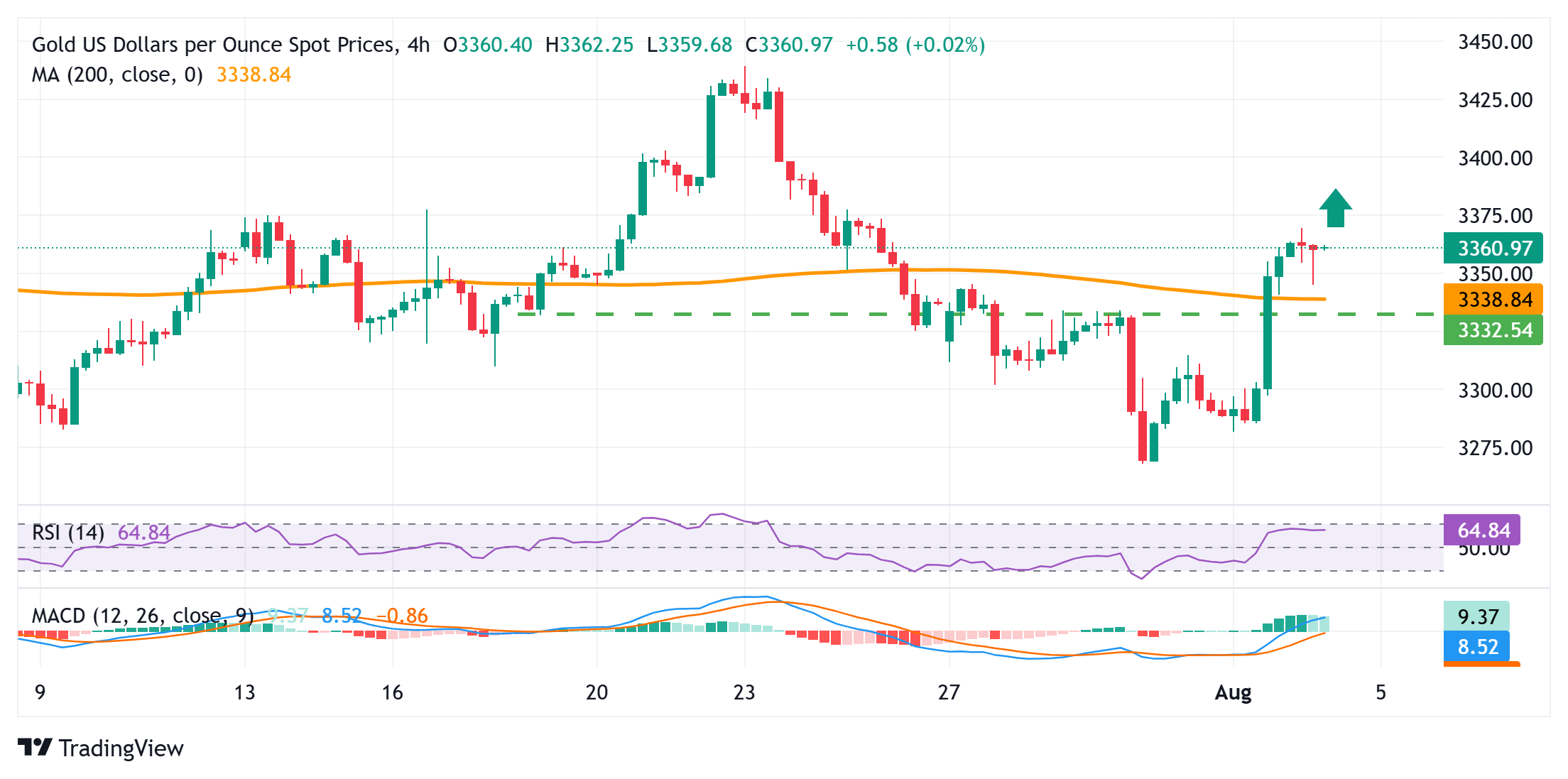
From a technical perspective, Friday's breakout through the $3,335 horizontal barrier and a subsequent strength beyond the 100-period Simple Moving Average (SMA) on the 4-hour chart favors the XAU/USD bulls. Moreover, oscillators on the said chart have been gaining positive traction and back the case for the emergence of some dip-buying around the commodity. Hence, it will be prudent to wait for strong follow-through selling before confirming that the positive move witnessed over the past two days has run out of steam before positioning for deeper losses.
In the meantime, weakness below the 100-period SMA on the 4-hour chart, currently pegged near the $3,340-3,338 area, could attract fresh buyers near the $3,322-3,320 region. This, in turn, should help limit the downside for the Gold price near the $3,300 mark. The latter should act as a pivotal point, which, if broken, might shift the bias in favor of the XAU/USD bears.
On the flip side, momentum beyond the Asian session peak, around the $3,369-3,370 region, will reaffirm the positive bias and allow the Gold price to reclaim the $3,400 round figure. The momentum could extend further towards the next relevant hurdle around the $3,434-3,435 area, above which the XAU/USD could aim to challenge the all-time peak, around the $3,500 psychological mark touched in April.
Tariffs FAQs
Tariffs are customs duties levied on certain merchandise imports or a category of products. Tariffs are designed to help local producers and manufacturers be more competitive in the market by providing a price advantage over similar goods that can be imported. Tariffs are widely used as tools of protectionism, along with trade barriers and import quotas.
Although tariffs and taxes both generate government revenue to fund public goods and services, they have several distinctions. Tariffs are prepaid at the port of entry, while taxes are paid at the time of purchase. Taxes are imposed on individual taxpayers and businesses, while tariffs are paid by importers.
There are two schools of thought among economists regarding the usage of tariffs. While some argue that tariffs are necessary to protect domestic industries and address trade imbalances, others see them as a harmful tool that could potentially drive prices higher over the long term and lead to a damaging trade war by encouraging tit-for-tat tariffs.
During the run-up to the presidential election in November 2024, Donald Trump made it clear that he intends to use tariffs to support the US economy and American producers. In 2024, Mexico, China and Canada accounted for 42% of total US imports. In this period, Mexico stood out as the top exporter with $466.6 billion, according to the US Census Bureau. Hence, Trump wants to focus on these three nations when imposing tariffs. He also plans to use the revenue generated through tariffs to lower personal income taxes.
Author

Haresh Menghani
FXStreet
Haresh Menghani is a detail-oriented professional with 10+ years of extensive experience in analysing the global financial markets.