Gold shines bright and hits three-day high despite Fed hawkish commentary
- Gold gains more than 0.30% despite pressure from high US Treasury yields.
- Hawkish remarks from Fed officials, including Governor Michelle Bowman, temper Gold's rise.
- XAU/USD traders are eyeing the release of US core PCE inflation data.

Gold price was modestly up late in the North American session, registering gains of around 0.15% amid high US Treasury bond yields that make it less appealing to hold the non-yielding metal. Consequently, the Greenback erased its previous losses, capping Gold’s rally. The XAU/USD trades at $2,357, above its opening price by 0.28%.
Wall Street trades with losses, while the 10-year Treasury note yield climbs sharply to its highest level since the beginning of May. This spurred a jump in real yields, which usually correlate inversely to Gold prices, putting a lid on the yellow metal’s advance.
Federal Reserve (Fed) officials crossed the wires on Tuesday, delivering a hawkish message. On the data front, the Conference Board (CB) Consumer Confidence improved in May, but recession fears have resurfaced.
Ahead in the week, traders are bracing for the expected release of April’s Personal Consumption Expenditures (PCE) Price Index - the Federal Reserve’s (Fed) preferred measure of inflation. The core figure is expected at 2.8% YoY, while headline PCE is foreseen to increase by 0.3% MoM.
Daily digest market movers: Gold price waxes, wanes around $2,350
- Gold prices stay in the green yet trade off three-day highs reached at $2,364 amid elevated US Treasury yields.
- US 10-year Treasury note yields 4.538%, rising seven basis points and underpinning the Greenback. The US Dollar Index (DXY), which tracks the buck’s performance against a basket of peers, trades at 104.61, up 0.03%.
- Fed Governor Michelle Bowman said she would have supported either waiting to slow the quantitative tightening pace or a more tapered slowing in balance sheet run-off.
- Lastly, Minneapolis Fed President Neel Kashkari stated that he doesn't believe anyone has ruled out further rate increases and added that he anticipates no more than two rate cuts in 2024.
- The US Conference Board Consumer Confidence improved in May after three months of declines, rising to 102.0 from 97.0, exceeding estimates of 95.9.
- Despite improving, Dana Peterson, Chief Economist at The Conference Board, wrote, “a possible resurgence in recession concerns.”
- Americans' perceptions of the likelihood of US recession over the next 12 months rose again in May.
- Fed funds rate futures estimate just 25 basis points of interest rate cuts in 2024, according to data provided by the Chicago Board of Trade (CBOT).
Technical analysis: Gold price stays firm as buyers lose momentum
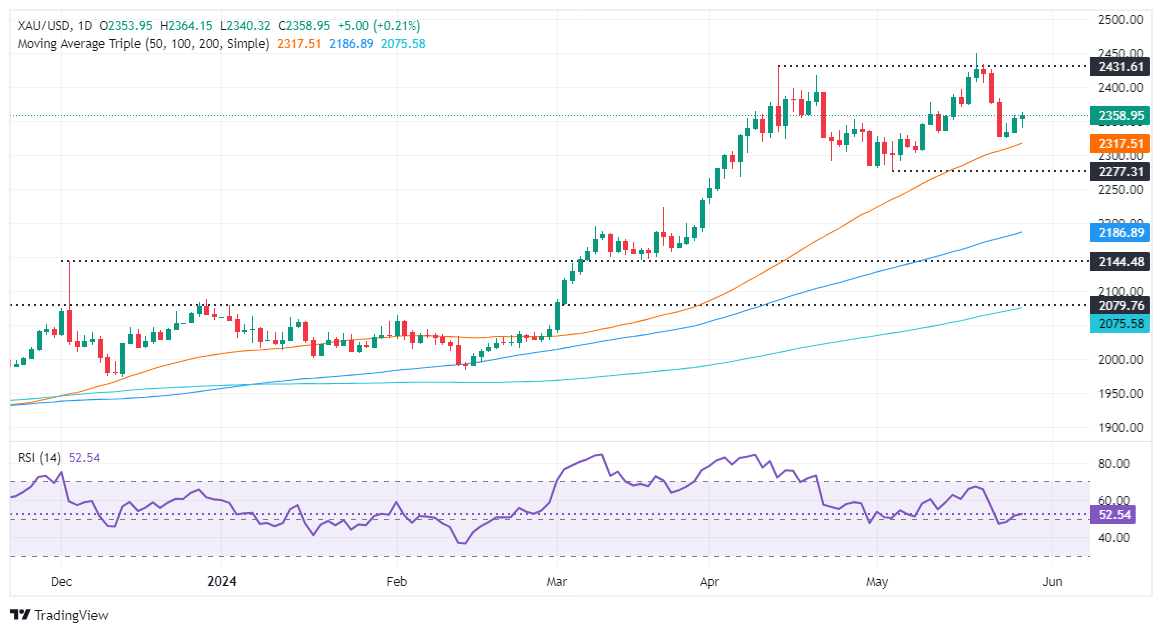
Gold’s uptrend remains in place, yet the rally is showing signs of exhaustion, with momentum beginning to fade. The Relative Strength Index (RSI) shows that buyers are in charge yet losing momentum as the RSI flattens.
Therefore, if XAU/USD fails to cling to gains above $2,350, that would exert downward pressure on the yellow metal, exposing key support levels.
The first support would be the psychological $2,350 figure. Once cleared, the next stop would be the May 8 low of $2,303, followed by the May 3 cycle low of $2,277.
On the other hand, if XAU/USD stays above $2,350, further gains lie overhead. Up next would be the $2,400 mark, followed by the year-to-date high of $2,450 and then the $2,500 mark.
Gold FAQs
Gold has played a key role in human’s history as it has been widely used as a store of value and medium of exchange. Currently, apart from its shine and usage for jewelry, the precious metal is widely seen as a safe-haven asset, meaning that it is considered a good investment during turbulent times. Gold is also widely seen as a hedge against inflation and against depreciating currencies as it doesn’t rely on any specific issuer or government.
Central banks are the biggest Gold holders. In their aim to support their currencies in turbulent times, central banks tend to diversify their reserves and buy Gold to improve the perceived strength of the economy and the currency. High Gold reserves can be a source of trust for a country’s solvency. Central banks added 1,136 tonnes of Gold worth around $70 billion to their reserves in 2022, according to data from the World Gold Council. This is the highest yearly purchase since records began. Central banks from emerging economies such as China, India and Turkey are quickly increasing their Gold reserves.
Gold has an inverse correlation with the US Dollar and US Treasuries, which are both major reserve and safe-haven assets. When the Dollar depreciates, Gold tends to rise, enabling investors and central banks to diversify their assets in turbulent times. Gold is also inversely correlated with risk assets. A rally in the stock market tends to weaken Gold price, while sell-offs in riskier markets tend to favor the precious metal.
The price can move due to a wide range of factors. Geopolitical instability or fears of a deep recession can quickly make Gold price escalate due to its safe-haven status. As a yield-less asset, Gold tends to rise with lower interest rates, while higher cost of money usually weighs down on the yellow metal. Still, most moves depend on how the US Dollar (USD) behaves as the asset is priced in dollars (XAU/USD). A strong Dollar tends to keep the price of Gold controlled, whereas a weaker Dollar is likely to push Gold prices up.
Author

Christian Borjon Valencia
FXStreet
Markets analyst, news editor, and trading instructor with over 14 years of experience across FX, commodities, US equity indices, and global macro markets.

















