Gold price extends its steady intraday descent amid some profit-taking
- Gold price retreats from a record high as traders opt to take some profits off the table.
- Worries over Trump’s tariff plans should limit losses for the safe-haven precious metal.
- Bets that the Fed would cut rates further could also act as a tailwind for the XAU/USD.

Gold price (XAU/USD) retreats further from the all-time peak touched the previous day and drops to the $2,929 region during the first half of the European session on Tuesday. In the absence of any fresh fundamental trigger, the intraday downfall could be attributed to some profit-taking and is likely to remain limited. Worries about the potential economic fallout from US President Donald Trump's protectionist trade policies and their impact on the global economy might continue to act as a tailwind for the safe-haven bullion.
Meanwhile, bets that the Federal Reserve (Fed) would cut interest rates further this year failed to assist the US Dollar (USD) to build on the overnight bounce from the lowest level since December 10. This could further lend support to the non-yielding Gold price and help limit deeper losses. Hence, it will be prudent to wait for strong follow-through selling before confirming that the XAU/USD has topped out. Traders now look forward to the US macro data and speeches by influential FOMC members for short-term impetuses.
Gold price bulls have the upper hand amid trade war fears, Fed rate cut bets
- The US Dollar moves away from over a two-month low touched on Monday and prompts some profit-taking around the Gold price on Tuesday amid slightly overbought conditions on the daily chart.
- US President Donald Trump said on Monday that tariffs on Canadian and Mexican imports are "on time and on schedule" and that reciprocal tariffs on other countries will also go ahead as planned.
- This raises the risk of a further escalation of trade tensions and fuels concerns about their impact on the global economy, which might continue to act as a tailwind for the safe-haven precious metal.
- The recent weaker US macro data reaffirmed bets for two quarter-percentage-points rate reduction by the Federal Reserve this year and might contribute to limiting losses for the non-yielding bullion.
- Meanwhile, Chicago Fed President Austan Goolsbee said late Monday that the US central bank has to take a wait-and-see stance, and needs more clarity before going back to cutting interest rates.
- According to the latest data released by the World Gold Council (WGC), physically backed gold exchange-traded funds (ETFs) registered the largest weekly inflow since March 2022 last week.
- Traders now look to the US economic docket – featuring the Conference Board's Consumer Confidence Index and Richmond Manufacturing Index. This, along with Fedspeaks, might influence the USD.
- The focus, however, will remain glued to the release of the US Personal Consumption Expenditure (PCE) Price Index on Friday, which could provide cues about the Fed's rate-cut path.
Gold price approaches $2,920 support zone; bullish potential seems intact
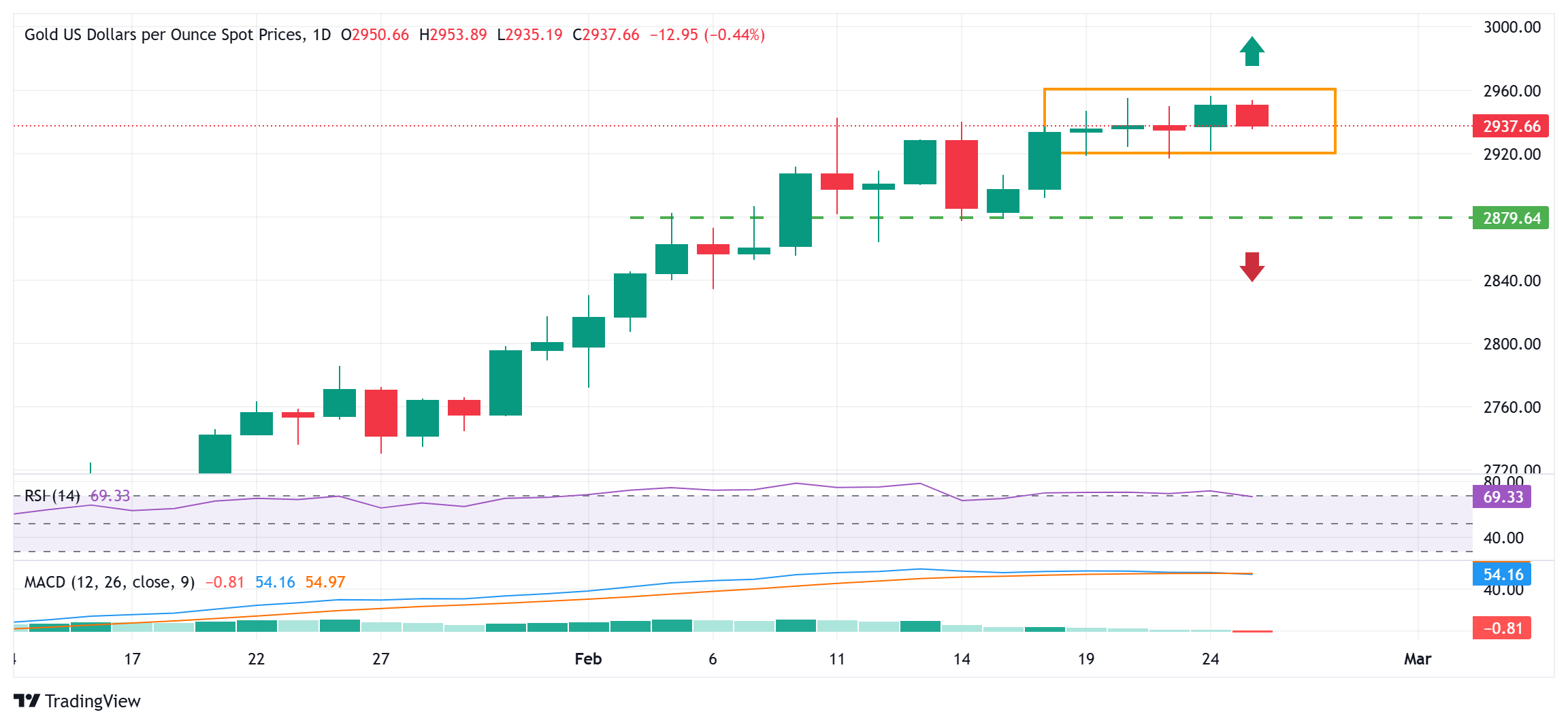
The range-bound price action witnessed over the past week or so might still be categorized as a bullish consolidation phase on the back of the recent strong move up to the record high. That said, the daily Relative Strength Index (RSI) remains close to the 70 mark and makes it prudent to wait for some near-term consolidation or a modest pullback before positioning for any further gains. Nevertheless, the bias seems tilted firmly in favor of bulls and suggests that the path of least resistance for the Gold price remains to the upside.
Meanwhile, any corrective slide might continue to attract some dip-buyers around the $2,920-2,915 region, or the lower end of a multi-day-old trading range. This is followed by the $2,900 mark and support near the $2,880 region, which if broken decisively could drag the Gold price to the $2,860-2,855 area en route to the $2,834 zone. The XAU/USD could extend the downfall and eventually drop to the $2,800 round-figure mark.
Fed FAQs
Monetary policy in the US is shaped by the Federal Reserve (Fed). The Fed has two mandates: to achieve price stability and foster full employment. Its primary tool to achieve these goals is by adjusting interest rates. When prices are rising too quickly and inflation is above the Fed’s 2% target, it raises interest rates, increasing borrowing costs throughout the economy. This results in a stronger US Dollar (USD) as it makes the US a more attractive place for international investors to park their money. When inflation falls below 2% or the Unemployment Rate is too high, the Fed may lower interest rates to encourage borrowing, which weighs on the Greenback.
The Federal Reserve (Fed) holds eight policy meetings a year, where the Federal Open Market Committee (FOMC) assesses economic conditions and makes monetary policy decisions. The FOMC is attended by twelve Fed officials – the seven members of the Board of Governors, the president of the Federal Reserve Bank of New York, and four of the remaining eleven regional Reserve Bank presidents, who serve one-year terms on a rotating basis.
In extreme situations, the Federal Reserve may resort to a policy named Quantitative Easing (QE). QE is the process by which the Fed substantially increases the flow of credit in a stuck financial system. It is a non-standard policy measure used during crises or when inflation is extremely low. It was the Fed’s weapon of choice during the Great Financial Crisis in 2008. It involves the Fed printing more Dollars and using them to buy high grade bonds from financial institutions. QE usually weakens the US Dollar.
Quantitative tightening (QT) is the reverse process of QE, whereby the Federal Reserve stops buying bonds from financial institutions and does not reinvest the principal from the bonds it holds maturing, to purchase new bonds. It is usually positive for the value of the US Dollar.
Author

Haresh Menghani
FXStreet
Haresh Menghani is a detail-oriented professional with 10+ years of extensive experience in analysing the global financial markets.