Gold price bulls remain on the sidelines near one-week high ahead of US NFP report
- Gold price reverses a modest intraday slide, though it lacks bullish conviction.
- Fed rate cut bets cap the USD and support the commodity ahead of the US NFP.
- A US-Vietnam trade deal undermines demand for the safe-haven precious metal.

Gold price (XAU/USD) struggles to capitalize on its modest intraday bounce from the vicinity of the $3,340 area and holds steady near the top end of the weekly range through the first half of the European session. Traders seem reluctant and opt to wait for the release of the US Nonfarm Payrolls (NFP) report for cues about the Federal Reserve's (Fed) rate-cut path. This, in turn, will play a key role in influencing the near-term US Dollar (USD) demand and provide some meaningful impetus to the non-yielding yellow metal.
In the meantime, the growing market conviction that the Fed will resume its rate-cutting cycle as early as this month keeps the USD bulls on the defensive. This, along with persistent trade-related uncertainties, acts as a tailwind for the Gold price, though the optimism over a trade agreement between the US and Vietnam caps the upside. Hence, it will be prudent to wait for strong follow-through buying before positioning for an extension of the XAU/USD pair's goodish recovery from over a one-month low touched earlier this week.
Daily Digest Market Movers: Gold price extends the range play as traders await US NFP report
- President Donald Trump announced on Wednesday that the United States has struck a trade agreement with Vietnam. The US will impose a lower, 20% tariff on goods imported from the Southeast Asian nation, and the deal will give the US tariff-free access to Vietnam’s markets.
- Meanwhile, negotiators from the US and India are pushing to land a tariff-reducing deal ahead of Trump's July 9 deadline. The developments boost investors' confidence and prompt some profit-taking around the safe-haven Gold price following a three-day winning streak.
- However, Trump has indicated no signs of extending the negotiation deadline despite stalled discussions with Japan, another key trade partner. This keeps trade-related uncertainties in play, which, in turn, might continue to offer some support to the precious metal.
- On the economic data front, the Automatic Data Processing (ADP) reported that US private payrolls fell for the first time in more than two years during June. In fact, the US private-sector employment unexpectedly declined by 33K compared to the downwardly revised rise of 29K.
- This comes on top of Tuesday's Job Openings and Labor Turnover Survey, or JOLTS report, and underscores a deteriorating trend in the US labor market. Moreover, a sluggish hiring environment might force the Federal Reserve (Fed) to start cutting interest rates again as early as this month.
- In fact, traders are currently pricing in nearly a 25% chance of a rate cut by the Fed at the July 29-30 monetary policy meeting. Moreover, a 25 basis point rate cut in September is all but certain, and expectations for two rate reductions by the end of this year are also high.
- Dovish Fed expectations should keep a lid on the US Dollar's attempted recovery from a three-and-a-half-year low and contribute to limiting losses for the non-yielding yellow metal. Traders might also opt to wait for the release of the US Nonfarm Payrolls (NFP) report.
Gold price seems poised to reclaim the $3,400 mark amid a bullish technical setup
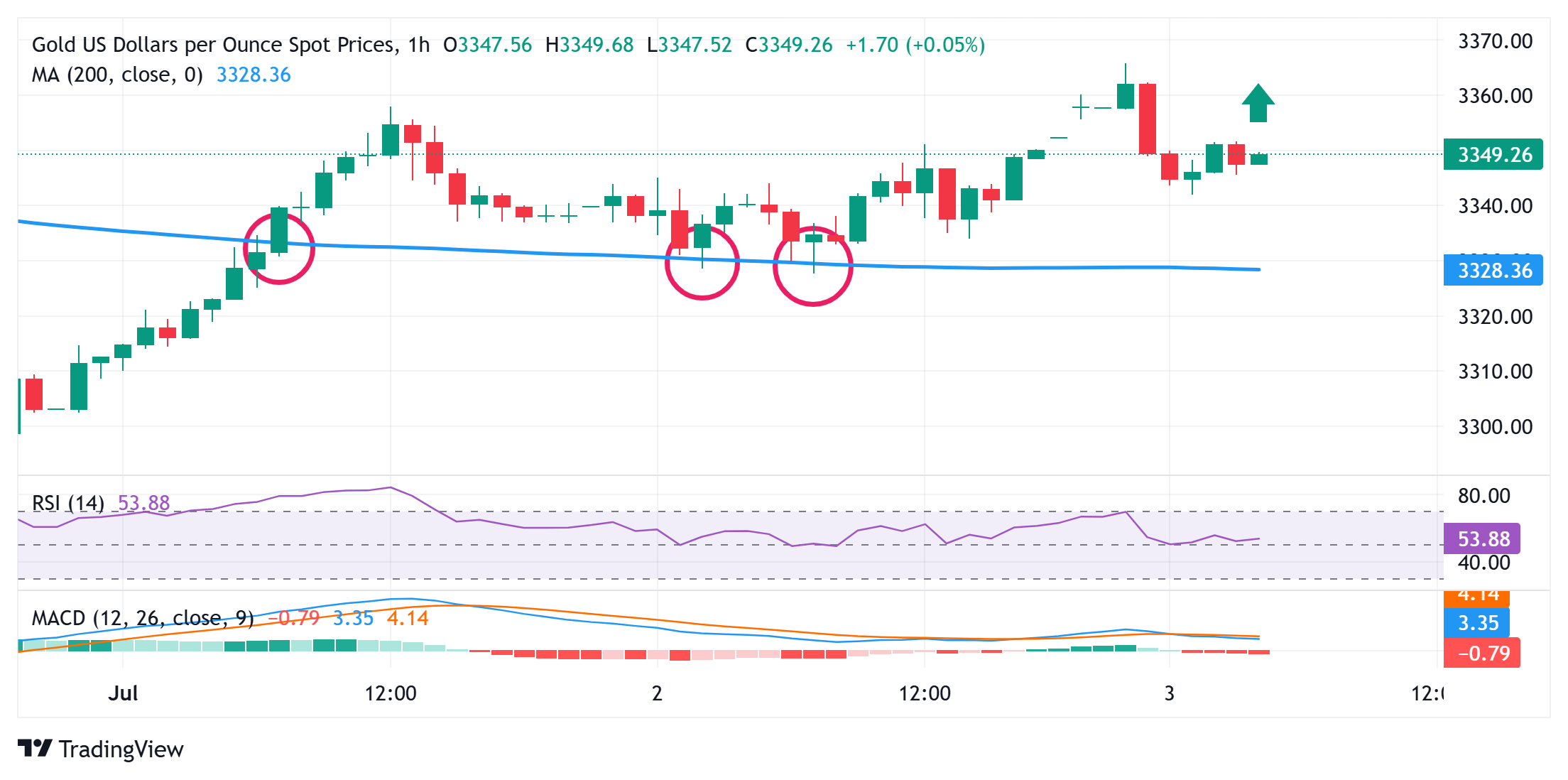
From a technical perspective, this week's breakout above the 200-hour Simple Moving Average (SMA) was seen as a key trigger for the XAU/USD bulls. Moreover, oscillators on the daily chart have again started gaining positive traction and suggest that the path of least resistance for the Gold price is to the upside. Hence, any subsequent slide might still be seen as a buying opportunity and remain cushioned near the $3,330-3,329 region (200-hour SMA). A convincing break below, however, might prompt some technical selling and drag the commodity further towards the $3,300 round figure.
On the flip side, the $3,363-$3,365 zone, or over a one-week high touched on Wednesday, now seems to act as an immediate hurdle, above which the Gold price could aim to reclaim the $3,400 mark. A sustained strength beyond the latter would negate any near-term negative outlook and lift the XAU/USD pair to the next relevant hurdle near the $3,435-$3,440 region.
Economic Indicator
Nonfarm Payrolls
The Nonfarm Payrolls release presents the number of new jobs created in the US during the previous month in all non-agricultural businesses; it is released by the US Bureau of Labor Statistics (BLS). The monthly changes in payrolls can be extremely volatile. The number is also subject to strong reviews, which can also trigger volatility in the Forex board. Generally speaking, a high reading is seen as bullish for the US Dollar (USD), while a low reading is seen as bearish, although previous months' reviews and the Unemployment Rate are as relevant as the headline figure. The market's reaction, therefore, depends on how the market assesses all the data contained in the BLS report as a whole.
Read more.Next release: Thu Jul 03, 2025 12:30
Frequency: Monthly
Consensus: 110K
Previous: 139K
Source: US Bureau of Labor Statistics
America’s monthly jobs report is considered the most important economic indicator for forex traders. Released on the first Friday following the reported month, the change in the number of positions is closely correlated with the overall performance of the economy and is monitored by policymakers. Full employment is one of the Federal Reserve’s mandates and it considers developments in the labor market when setting its policies, thus impacting currencies. Despite several leading indicators shaping estimates, Nonfarm Payrolls tend to surprise markets and trigger substantial volatility. Actual figures beating the consensus tend to be USD bullish.
Author

Haresh Menghani
FXStreet
Haresh Menghani is a detail-oriented professional with 10+ years of extensive experience in analysing the global financial markets.