Gold price dips on Friday but is set for weekly gains amid strong US Dollar
- Gold retreats for second day as traders lock in gains and US Dollar firms.
- Fed officials adopt cautious tone, indicating no hurry to cut rates due to uncertainty from Trump's tariffs.
- Geopolitical risks escalate as Israel intensifies attacks in Gaza, ending a two-month ceasefire and heightening market tension.

Gold price retreats for the second straight day yet is poised to finish the week in the green amid broad US Dollar (USD) strength and traders booking profits ahead of the weekend. The XAU/USD trades at $3,019, down 0.81%.
Market mood remains downbeat, yet US equities are trimming some of their previous losses. Bullion remains defensive as the Greenback seems to have found its foot with the US Dollar Index (DXY) standing at 104.05, up 0.24%.
The lack of a catalyst keeps traders focused on the main driver of the markets, President Donald Trump's trade policies. Aside from this, even Federal Reserve (Fed) officials crossing the newswires haven’t impacted Gold prices.
New York Fed President John Williams commented that the central bank’s 2% target is not for debate or discussion, adding that the current modestly restrictive monetary policy is “entirely appropriate.” Later, Chicago Fed President Austan Goolsbee stated that when there is a lot of uncertainty, you must wait for things to clear up.
Policymakers' comments added to Powell saying that the Fed is in no rush to cut interest rates. This indicates that officials remain comfortable with the level of rates. Nevertheless, they stated they remain uncertain about the economy’s response to recently applied tariffs on certain products imported to the US.
On Wednesday, Fed officials updated their projections about interest rates, foreseeing two rate cuts in 2025 while revising the economy downward.
Regarding geopolitics, Israel announced an escalation of hostilities in Gaza to pressure the release of the remaining hostages, effectively abandoning a two-month ceasefire and launching an attack against Hamas.
Daily digest market movers: Gold bulls take a breather as rally pauses
- US Treasury yields are rising, weighing on Bullion prices. The US 10-year T-note yield is up one basis point to 4.246%.
- US real yields, as measured by the US 10-year Treasury Inflation-Protected Securities yield that correlates inversely to Gold prices, rises almost 2 bps at 1.918%.
- The Summary of Economic Projections revealed that Fed officials anticipate two rate cuts in 2025, keeping the fed funds rate forecast at 3.9%, unchanged from December’s projections. The PCE Price Index — the Fed’s preferred inflation gauge — and the Unemployment Rate were revised higher, while GDP growth is now projected to fall below 2%, signaling a slowdown linked to President Donald Trump’s trade policies.
- The money market has priced in 72 basis points of Fed easing in 2025, which has sent US Treasury yields plunging alongside the American currency.
XAU/USD technical outlook: Gold price conquers $3,000, set to end week above that level
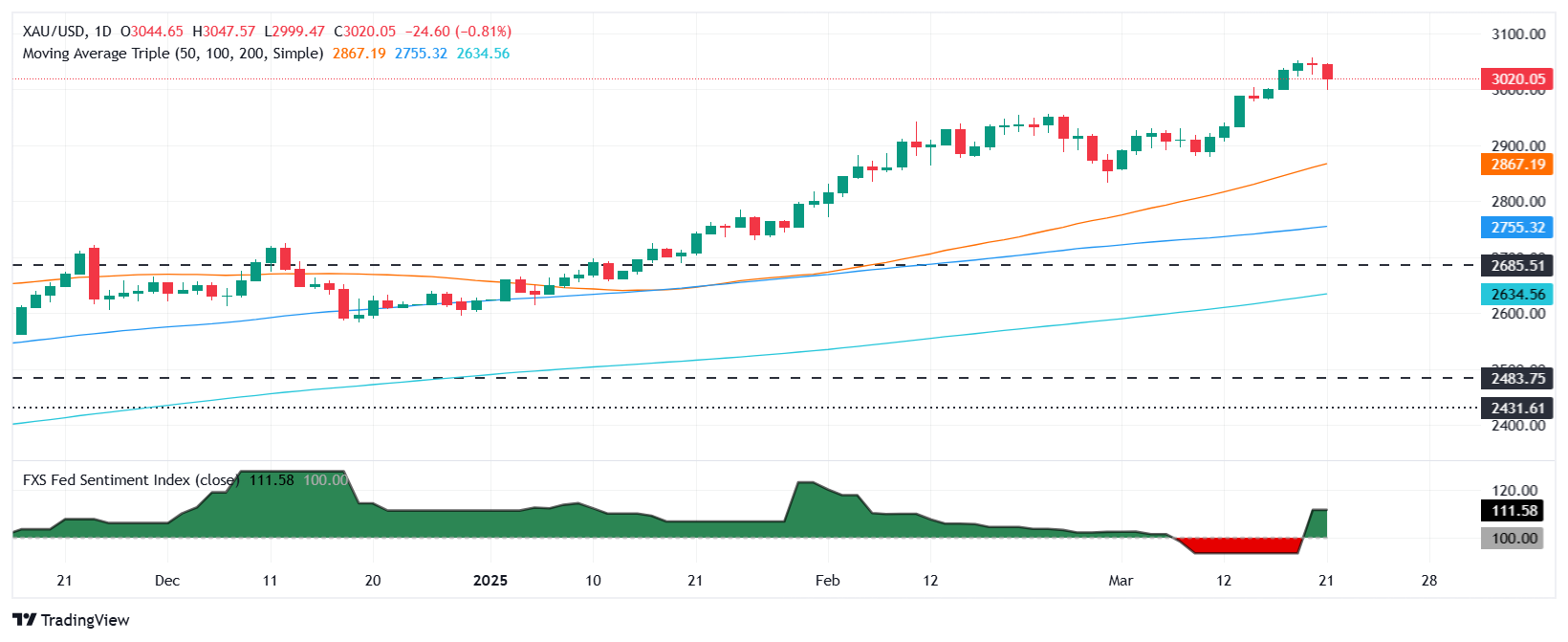
Gold price trends remain upward though. It could be set for a pullback unless buyers push the price above Friday’s open of $3,043. Momentum remains bearish as depicted by the Relative Strength Index (RSI) falling sharply for the second straight day, clearing the index’s previous through. This hints that bears are in charge.
If XAU/USD drops below $3,020, the next support would be the $3,000 mark. Once surpassed, the next area of interest would be the February 20 daily high at $2,954, followed by the $2,900 mark.
Conversely, a rally above $3,050 could open the door for a rally toward the $3,100 resistance zone.
Gold FAQs
Gold has played a key role in human’s history as it has been widely used as a store of value and medium of exchange. Currently, apart from its shine and usage for jewelry, the precious metal is widely seen as a safe-haven asset, meaning that it is considered a good investment during turbulent times. Gold is also widely seen as a hedge against inflation and against depreciating currencies as it doesn’t rely on any specific issuer or government.
Central banks are the biggest Gold holders. In their aim to support their currencies in turbulent times, central banks tend to diversify their reserves and buy Gold to improve the perceived strength of the economy and the currency. High Gold reserves can be a source of trust for a country’s solvency. Central banks added 1,136 tonnes of Gold worth around $70 billion to their reserves in 2022, according to data from the World Gold Council. This is the highest yearly purchase since records began. Central banks from emerging economies such as China, India and Turkey are quickly increasing their Gold reserves.
Gold has an inverse correlation with the US Dollar and US Treasuries, which are both major reserve and safe-haven assets. When the Dollar depreciates, Gold tends to rise, enabling investors and central banks to diversify their assets in turbulent times. Gold is also inversely correlated with risk assets. A rally in the stock market tends to weaken Gold price, while sell-offs in riskier markets tend to favor the precious metal.
The price can move due to a wide range of factors. Geopolitical instability or fears of a deep recession can quickly make Gold price escalate due to its safe-haven status. As a yield-less asset, Gold tends to rise with lower interest rates, while higher cost of money usually weighs down on the yellow metal. Still, most moves depend on how the US Dollar (USD) behaves as the asset is priced in dollars (XAU/USD). A strong Dollar tends to keep the price of Gold controlled, whereas a weaker Dollar is likely to push Gold prices up.
Author

Christian Borjon Valencia
FXStreet
Markets analyst, news editor, and trading instructor with over 14 years of experience across FX, commodities, US equity indices, and global macro markets.
















