Gold price bounces off daily low after China denies negotiations on tariffs; keeps the red just above $3,300
- Gold price attracts fresh sellers on Friday as a positive risk tone undermines safe-haven assets.
- The emergence of some USD buying further exerts downward pressure on the precious metal.
- Geopolitics, trade-related uncertainties, and Fed rate cut bets limit losses for the XAU/USD pair.

Gold price (XAU/USD) recovers slightly from the daily low and climbs back above the $3,300 mark in the last hour, though it retains the negative bias through the first half of the European session on Friday. China's Foreign Ministry denied any ongoing negotiations with the US on tariffs, keeping a lid on the optimism in the markets and lending some support to the safe-haven precious metal. Apart from this, the protracted Russia-Ukraine war keeps the geopolitical risk premium in play and helps limit the downside for the bullion.
Moreover, the prospects for a more aggressive policy easing by the Federal Reserve (Fed) warrant some caution before placing aggressive bearish bets around the non-yielding Gold price. Investors, however, remain hopeful about the potential de-escalation of trade tensions between the world's two largest economies, which remains supportive of a generally positive tone around the equity markets. This, along with a modest US Dollar (USD) strength, is holding back traders from placing fresh bullish bets around the XAU/USD pair.
Daily Digest Market Movers: Gold price could draw support from US-China trade deal uncertainty, geopolitical risks
- Investors remain hopeful over the potential de-escalation of the US-China trade war, which acts as a headwind for the safe-haven Gold price on Friday. In fact, US President Donald Trump said on Thursday that trade talks between the US and China are underway.
- Moreover, China reportedly is mulling to suspend its 125% tariff on some US imports. China's Foreign Minister, however, claimed that no trade negotiations have taken place, underscoring the uncertainty and acting as a tailwind for the precious metal.
- The US Dollar draws some support from mostly upbeat US macro data released on Thursday. In fact, the US Department of Labor reported that Initial Jobless Claims increased modestly to 222,000 for the week ending 19 April and pointed to continued labor market resilience.
- The US Census Bureau reported that Durable Goods Orders surged 9.2% in March, beating the 2% forecast and marking a third consecutive rise. Transportation equipment also rose for a third month, surging 27%.
- Meanwhile, a duo of Federal Reserve officials discussed the willingness for potential interest rate cuts soon. In fact, Cleveland Fed President Beth Hammack stated that a rate cut as soon as June could be possible if clear and convincing data on economic direction is obtained.
- Separately, Fed Governor Christopher Waller said in a Bloomberg interview that he would support rate cuts if tariffs start weighing on the job market. Moreover, traders are still pricing in the possibility that the Fed will lower borrowing costs at least three times by the end of this year.
- On the geopolitical front, a Russian missile attack on Ukraine’s capital Kyiv killed at least twelve people and injured dozens. This was one of the deadliest strikes since Russia launched its full-scale invasion more than three years ago and keeps the geopolitical risk premium in play.
- Traders now look forward to the release of the revised Michigan US Consumer Sentiment Index. Apart from this, trade-related developments might influence the USD, which, along with the broader risk sentiment, might produce short-term trading opportunities around the XAU/USD pair.
Gold price shows resilience below 38.2% Fibo. level; weekly swing low around the $3,260 area holds the key for bulls
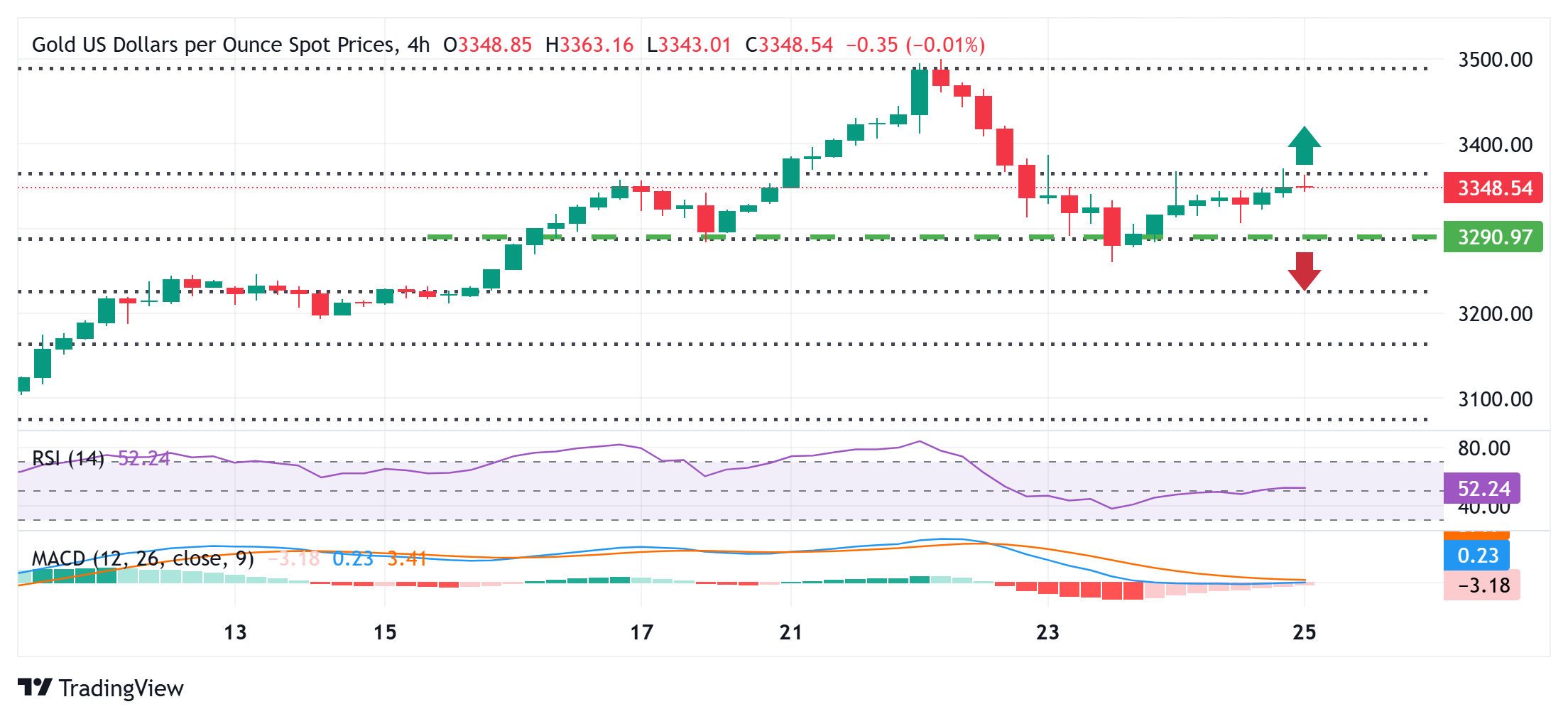
From a technical perspective, a goodish rebound from the weekly low touched on Wednesday stalls near the 23.6% Fibonacci retracement level of the latest leg up from the vicinity of the mid-$2,900s or the monthly swing low. The said barrier is pegged near the $3,368-3,370 region, which should now act as a key pivotal point. Given that oscillators on the daily chart are holding comfortably in positive territory, a sustained strength beyond should allow the Gold price to reclaim the $3,400 mark. The subsequent move up is likely to extend further towards the $3,425-3,427 intermediate hurdle, above which bulls could make a fresh attempt to conquer the $3,500 psychological mark.
On the flip side, weakness below the $3,3300 mark, nearing the 38.2% Fibo. level, might have already set the stage for a slide towards the weekly swing low, around the $3,260 area. A convincing break below the latter should pave the way for the resumption of this week's rejection slide from the $3,500 mark, or the all-time peak. The Gold price could then accelerate the fall towards the 50% retracement level, around the $3,225 region, en route to the $3,200 mark. Some follow-through selling will suggest that precious metal has topped out and shift the near-term bias in favor of bearish traders.
US-China Trade War FAQs
Generally speaking, a trade war is an economic conflict between two or more countries due to extreme protectionism on one end. It implies the creation of trade barriers, such as tariffs, which result in counter-barriers, escalating import costs, and hence the cost of living.
An economic conflict between the United States (US) and China began early in 2018, when President Donald Trump set trade barriers on China, claiming unfair commercial practices and intellectual property theft from the Asian giant. China took retaliatory action, imposing tariffs on multiple US goods, such as automobiles and soybeans. Tensions escalated until the two countries signed the US-China Phase One trade deal in January 2020. The agreement required structural reforms and other changes to China’s economic and trade regime and pretended to restore stability and trust between the two nations. However, the Coronavirus pandemic took the focus out of the conflict. Yet, it is worth mentioning that President Joe Biden, who took office after Trump, kept tariffs in place and even added some additional levies.
The return of Donald Trump to the White House as the 47th US President has sparked a fresh wave of tensions between the two countries. During the 2024 election campaign, Trump pledged to impose 60% tariffs on China once he returned to office, which he did on January 20, 2025. With Trump back, the US-China trade war is meant to resume where it was left, with tit-for-tat policies affecting the global economic landscape amid disruptions in global supply chains, resulting in a reduction in spending, particularly investment, and directly feeding into the Consumer Price Index inflation.
Author

Haresh Menghani
FXStreet
Haresh Menghani is a detail-oriented professional with 10+ years of extensive experience in analysing the global financial markets.
















