Gold price buying remains unabated; fresh record high and counting
- Gold price continues to attract safe-haven flows amid trade jitters and geopolitical risks.
- Bets that the Fed will cut rates several times this year further benefit the yellow metal.
- A modest USD bounce and the risk-on mood might cap the upside for the XAU/USD pair.

Gold price (XAU/USD) builds on its steady intraday ascent through the first half of the European session on Tuesday and hits a fresh all-time peak, around the $3,019 region in the last hour. The precious metal continues to attract safe-haven flows amid the uncertainty over US President Donald Trump’s policies, US recession fears, and geopolitical risks. Moreover, expectations that the Federal Reserve (Fed) will lower borrowing costs several times this year further push the non-yielding yellow metal higher for the second straight day – also marking the fifth day of a positive move in the previous six.
Meanwhile, the global risk sentiment remains well supported by the optimism over China's stimulus measures and hopes for a Ukraine peace deal. Adding to this, a modest US Dollar (USD) bounce from a multi-month low, amid some repositioning trade ahead of the key central bank, might hold back bulls from placing fresh bets around the Gold price. Investors might also opt to wait for the outcome of the highly-anticipated two-day FOMC meeting on Wednesday before placing fresh bets. Nevertheless, the fundamental backdrop suggests that the path of least resistance for the XAU/USD is to the upside.
Daily Digest Market Movers: Gold price bulls seem unaffected by positive risk tone and modest USD bounce
- The Israel Defense Forces (IDF) said it is carrying out "extensive strikes" in the Gaza Strip and targeting what it called "terror targets" belonging to Hamas. This comes after talks to extend the Gaza ceasefire failed to reach an agreement at meetings in Qatar, raising the risk of further escalation of geopolitical tensions in the region.
- Concerns about the economic slowdown resurfaced after US Treasury Secretary Scott Bessent said on Sunday there were no guarantees that the U.S. economy will avoid recession this year. This further underpins demand for traditional safe-haven assets and lifts the Gold price to a fresh all-time peak during the Asian session on Tuesday.
- On the economic data front, the US Census Bureau reported on Monday that US Retail Sales rose by 0.2% in February vs the downwardly revised decline of 1.2% the prior month. The reading fell short of expectations for a 0.7% growth, signaling consumer caution and lifting bets that the Federal Reserve will resume its rate-cutting cycle.
- The Fed funds futures suggest that the US central bank could lower borrowing costs by 25 basis points each at the June, July, and October monetary policy meetings. This might cap the attempted US Dollar recovery from its lowest level since October 2024 touched on Monday and is further seen acting as a tailwind for the non-yielding yellow metal.
- Meanwhile, US President Donald Trump expressed optimism that Russia and Ukraine will be able to come to a ceasefire and ultimately a peace deal. This comes ahead of the Trump-Putin peace talks on Tuesday, which, along with the optimism led by China's stimulus measures announced over the weekend, remains supportive of the upbeat market mood.
- Traders now look to Tuesday's US economic docket – featuring the release of Building Permits, Housing Starts, and Industrial Production data. The focus, however, will remain glued to the outcome of a two-day FOMC meeting on Wednesday, which will drive the USD demand in the near term and provide a fresh directional impetus to the XAU/USD pair.
Gold price needs to consolidate before the next leg up amid slightly overbought RSI on the daily chart
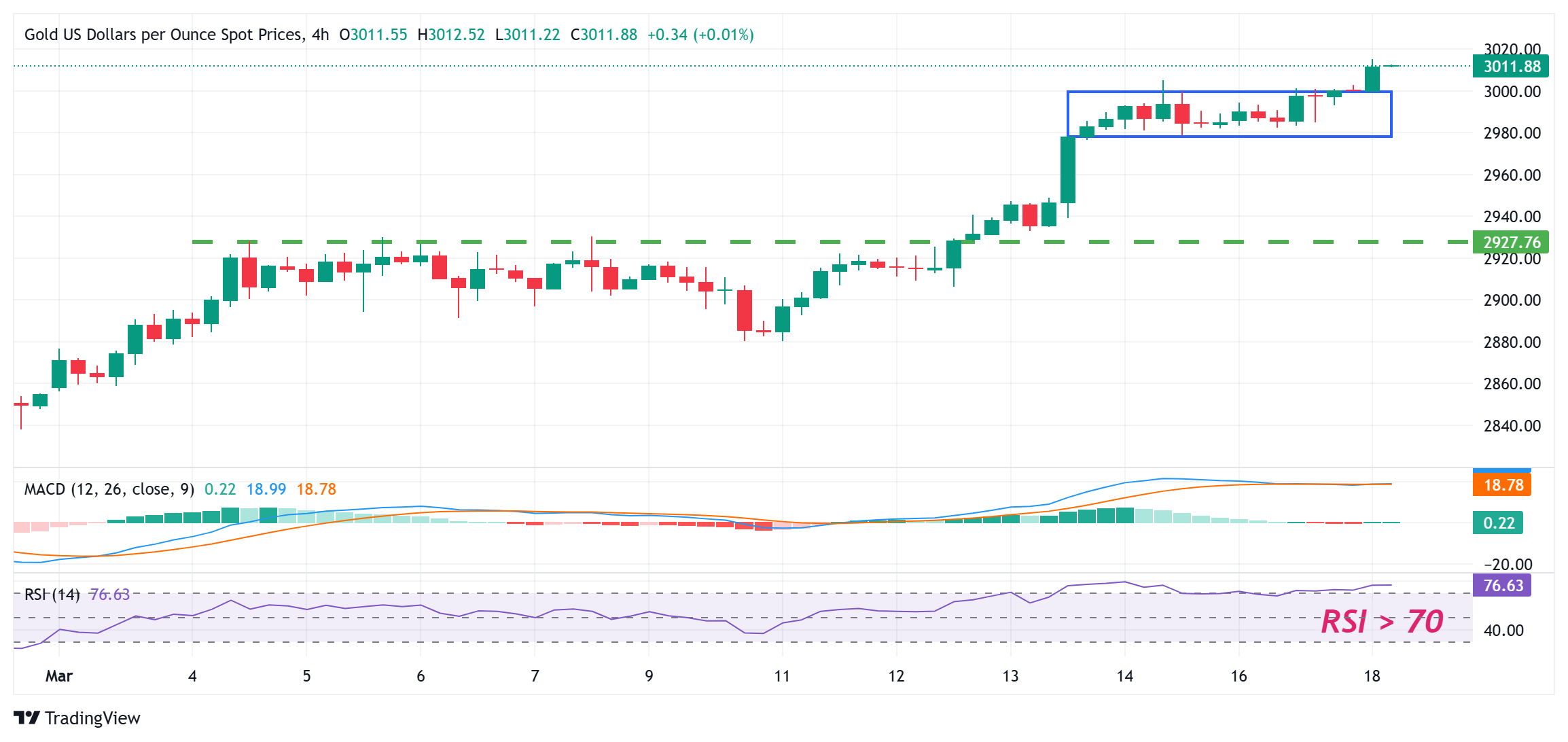
From a technical perspective, acceptance above the $3,000 psychological mark could be seen as a fresh trigger for bullish traders. That said, the daily Relative Strength Index (RSI) on the daily chart has started flashing slightly overbought conditions. This makes it prudent to wait for some near-term consolidation or a modest pullback before positioning for an extension of the recent well-established uptrend witnessed over the past three months or so.
Meanwhile, any corrective slide below the $2,980-2,978 immediate support could be seen as a buying opportunity and remain limited near the $2,956 resistance breakpoint. A convincing break below the latter, however, might prompt some technical selling and drag the Gold price to the $2,930-2,928 horizontal zone en route to the $2,900 round figure and last week's swing low, around the $2,880 region.
Interest rates FAQs
Interest rates are charged by financial institutions on loans to borrowers and are paid as interest to savers and depositors. They are influenced by base lending rates, which are set by central banks in response to changes in the economy. Central banks normally have a mandate to ensure price stability, which in most cases means targeting a core inflation rate of around 2%. If inflation falls below target the central bank may cut base lending rates, with a view to stimulating lending and boosting the economy. If inflation rises substantially above 2% it normally results in the central bank raising base lending rates in an attempt to lower inflation.
Higher interest rates generally help strengthen a country’s currency as they make it a more attractive place for global investors to park their money.
Higher interest rates overall weigh on the price of Gold because they increase the opportunity cost of holding Gold instead of investing in an interest-bearing asset or placing cash in the bank. If interest rates are high that usually pushes up the price of the US Dollar (USD), and since Gold is priced in Dollars, this has the effect of lowering the price of Gold.
The Fed funds rate is the overnight rate at which US banks lend to each other. It is the oft-quoted headline rate set by the Federal Reserve at its FOMC meetings. It is set as a range, for example 4.75%-5.00%, though the upper limit (in that case 5.00%) is the quoted figure. Market expectations for future Fed funds rate are tracked by the CME FedWatch tool, which shapes how many financial markets behave in anticipation of future Federal Reserve monetary policy decisions.
Author

Haresh Menghani
FXStreet
Haresh Menghani is a detail-oriented professional with 10+ years of extensive experience in analysing the global financial markets.