Gold price clings to intraday gains near weekly top ahead of US CPI report
- Gold price regains positive traction following the previous day’s range-bound price moves.
- Trade-related uncertainties and geopolitical risks underpin the safe-haven precious metal.
- A modest USD strength might cap the XAU/USD ahead of the critical US inflation figures.

Gold price (XAU/USD) climbs to the top end of the weekly range during the first half of the European session on Wednesday amid a combination of supporting factors. A federal appeals court's ruling that US President Donald Trump's “Liberation Day” tariffs could remain in effect while it reviews a lower court decision to block them adds a layer of uncertainty in the markets. This, along with the growing acceptance that the Federal Reserve (Fed) will cut interest rates further in 2025, acts as a tailwind for the non-yielding yellow metal.
However, the latest optimism over a positive outcome from the high-stakes US-China trade negotiations holds back traders from placing fresh bullish bets around the Gold price. Furthermore, the emergence of some US Dollar (USD) buying could contribute to capping the bullion. Investors also seem reluctant and might opt to wait for the release of the latest consumer inflation figures in order to determine the next leg of a directional move. This, in turn, warrants some caution before positioning for an extension of the intraday move-up.
Daily Digest Market Movers: Gold price bulls shrug off modest USD strength, positive trade development
- US President Donald Trump received a favorable update on Tuesday as a federal appeals court ruled that his “Liberation Day” tariffs can temporarily stay in effect. Last month, the US Court of International Trade blocked the implementation of Trump's tariffs, saying that the method used to enact them was unlawful.
- The latest development comes as the US and China, following two days of talks in London, agreed on a framework to implement the Geneva Consensus and ease trade tensions. US Commerce Secretary Howard Lutnick indicated the deal should resolve issues between the two countries surrounding rare earths and magnets.
- Russia continues with its strikes on Ukraine’s northeastern city of Kharkiv after rejecting an unconditional ceasefire earlier this month. Moreover, Israel continues to bombard the Gaza Strip relentlessly, keeping geopolitical risks in play and driving safe-haven flows toward the Gold price on Wednesday.
- The stronger-than-expected US Nonfarm Payrolls report released last Friday pointed to a still resilient labor market, forcing investors to scale back their bets for an imminent interest rate cut by the Federal Reserve. Markets, however, are still pricing in the possibility of two rate reductions by the end of this year.
- The US Dollar, however, remains confined to a familiar range, just above its lowest level since April 22, which it touched last week, as investors await more cues about the Fed's rate-cut path. Hence, the focus remains glued to the release of the US Consumer Price Index (CPI) report later during the North American session.
- This will be followed by the US Producer Price Index (PPI) on Thursday, which will play a key role in influencing the near-term USD price dynamics and provide some meaningful impetus to the commodity. In the meantime, the supportive fundamental backdrop should act as a tailwind for the XAU/USD.
Gold price constructive technical setup backs the case for a further near-term appreciating move
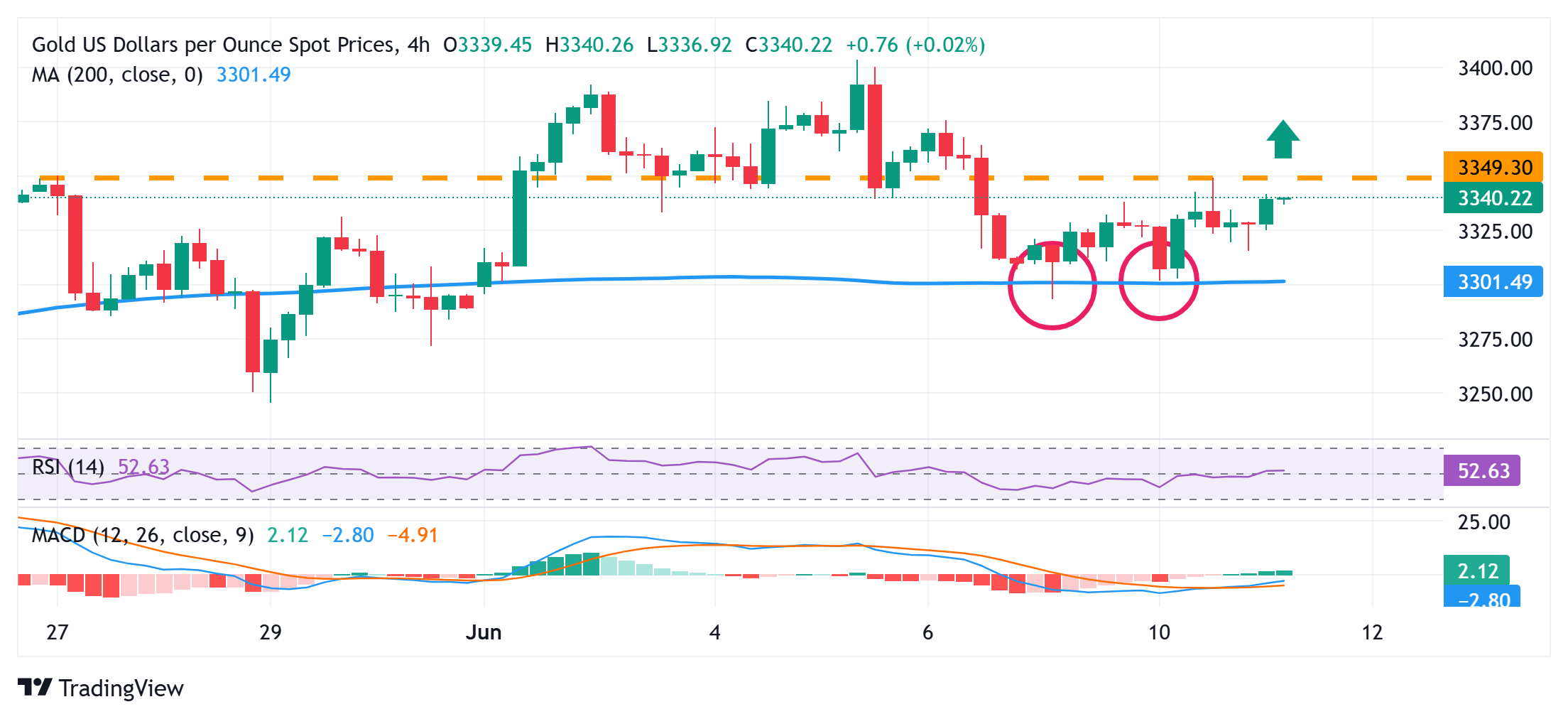
From a technical perspective, the overnight bounce from the vicinity of the 200-period Simple Moving Average (SMA) on the 4-hour chart and the subsequent move up favor the XAU/USD bulls. Adding to this, oscillators on the said chart have again started gaining positive traction and back the case for further intraday move-up. A further strength beyond the $3,352-3,353 immediate hurdle will reaffirm the bullish outlook and lift the Gold price towards the $3,377-3,378 intermediate hurdle en route to the $3,400 round figure.
On the flip side, weakness back below the $3,323-3,322 area might continue to attract some buyers and find decent support near the $3,300 round figure. Some follow-through selling, leading to a subsequent fall below the $3,288-3,287 zone (200-period SMA on the 4-hour chart), might shift the bias in favor of bearish traders and drag the Gold price to the monthly swing low, around the $3,245 region. The XAU/USD could extend the corrective decline further and eventually drop to the $3,200 neighborhood.
Economic Indicator
Consumer Price Index (YoY)
Inflationary or deflationary tendencies are measured by periodically summing the prices of a basket of representative goods and services and presenting the data as The Consumer Price Index (CPI). CPI data is compiled on a monthly basis and released by the US Department of Labor Statistics. The YoY reading compares the prices of goods in the reference month to the same month a year earlier.The CPI is a key indicator to measure inflation and changes in purchasing trends. Generally speaking, a high reading is seen as bullish for the US Dollar (USD), while a low reading is seen as bearish.
Read more.Next release: Wed Jun 11, 2025 12:30
Frequency: Monthly
Consensus: 2.5%
Previous: 2.3%
Source: US Bureau of Labor Statistics
The US Federal Reserve (Fed) has a dual mandate of maintaining price stability and maximum employment. According to such mandate, inflation should be at around 2% YoY and has become the weakest pillar of the central bank’s directive ever since the world suffered a pandemic, which extends to these days. Price pressures keep rising amid supply-chain issues and bottlenecks, with the Consumer Price Index (CPI) hanging at multi-decade highs. The Fed has already taken measures to tame inflation and is expected to maintain an aggressive stance in the foreseeable future.
Author

Haresh Menghani
FXStreet
Haresh Menghani is a detail-oriented professional with 10+ years of extensive experience in analysing the global financial markets.