Gold price retreats sharply from over two-week top, fails ahead of $3,400
- Gold price pulls back from a two-week high amid reports of Ukraine ceasefire talks.
- Trump’s fresh tariff threats and rising September Fed rate cut bets support the commodity.
- The USD drops to a two-week low and contributes to limiting losses for XAU/USD.

Gold price (XAU/USD) retreats sharply from the vicinity of the $3,400 mark, or over a two-week top touched during the early European session, and currently trades with modest intraday gains. A Kremlin aide reportedly told media that an agreement has been reached in principle to hold a bilateral summit between the US and Russia in the coming days to discuss a ceasefire. This, in turn, boosts investors' appetite for riskier assets and turns out to be a key factor undermining the safe-haven precious metal.
However, US President Donald Trump's fresh tariff threats act as a tailwind for the Gold price. Apart from this, the prevalent US Dollar (USD) selling bias, fueled by the growing acceptance that the Federal Reserve (Fed) will resume its rate-cutting cycle in September, should contribute to limiting losses for the non-yielding yellow metal. Hence, it will be prudent to wait for some follow-through selling before confirming that the XAU/USD pair's recent move up witnessed over the past week or so has run out of steam.
Daily Digest Market Movers: Gold price attracts intraday selling on Trump-Putin summit news
- The Russian news agency IFAX reported this Thursday, citing Kremlin aide Yuri Ushakov, that an agreement has been made to hold a meeting between Russian President Vladimir Putin and US President Donald Trump in the coming days.
- US President Donald Trump on Wednesday signed an executive order imposing an additional 25% tariff on Indian imports as "punishment" for buying oil from Russia, taking the total tariffs to 50%. Furthermore, reports suggest that Trump could impose an extra 15% tariff on all Japanese imports.
- Moreover, Trump had announced earlier this week that US tariffs on semiconductor and pharmaceutical imports would be unveiled within the next week or so. This revives concerns about the potential economic fallout from a global trade war and boosts the safe-haven Gold price on Thursday.
- Traders have been pricing in the possibility of more interest rate cuts than previously expected by the Federal Reserve this year. The bets were lifted by the weaker-than-expected US Nonfarm Payrolls report released last Friday and Tuesday's disappointing US ISM Services PMI print.
- According to the CME Group's FedWatch Tool, market participants see over a 90% chance that the US central bank will lower borrowing costs at the next monetary policy meeting in September. Moreover, the Fed is expected to deliver at least two 25-basis-point rate cuts by the end of this year.
- Dovish Fed expectations fail to assist the US Dollar in registering any meaningful recovery from a one-week low touched on Wednesday and further benefit the non-yielding yellow metal. However, a positive risk tone, tracking overnight gains on Wall Street, caps gains for the precious metal.
- Traders now look forward to the US Weekly Initial Jobless Claims, due for release later during the North American session. This, along with speeches from influential FOMC members, would drive the USD demand and produce short-term trading opportunities around the XAU/USD pair.
Gold price once again fails near the $3,400 mark; the 200-SMA on H4 holds the key for bulls
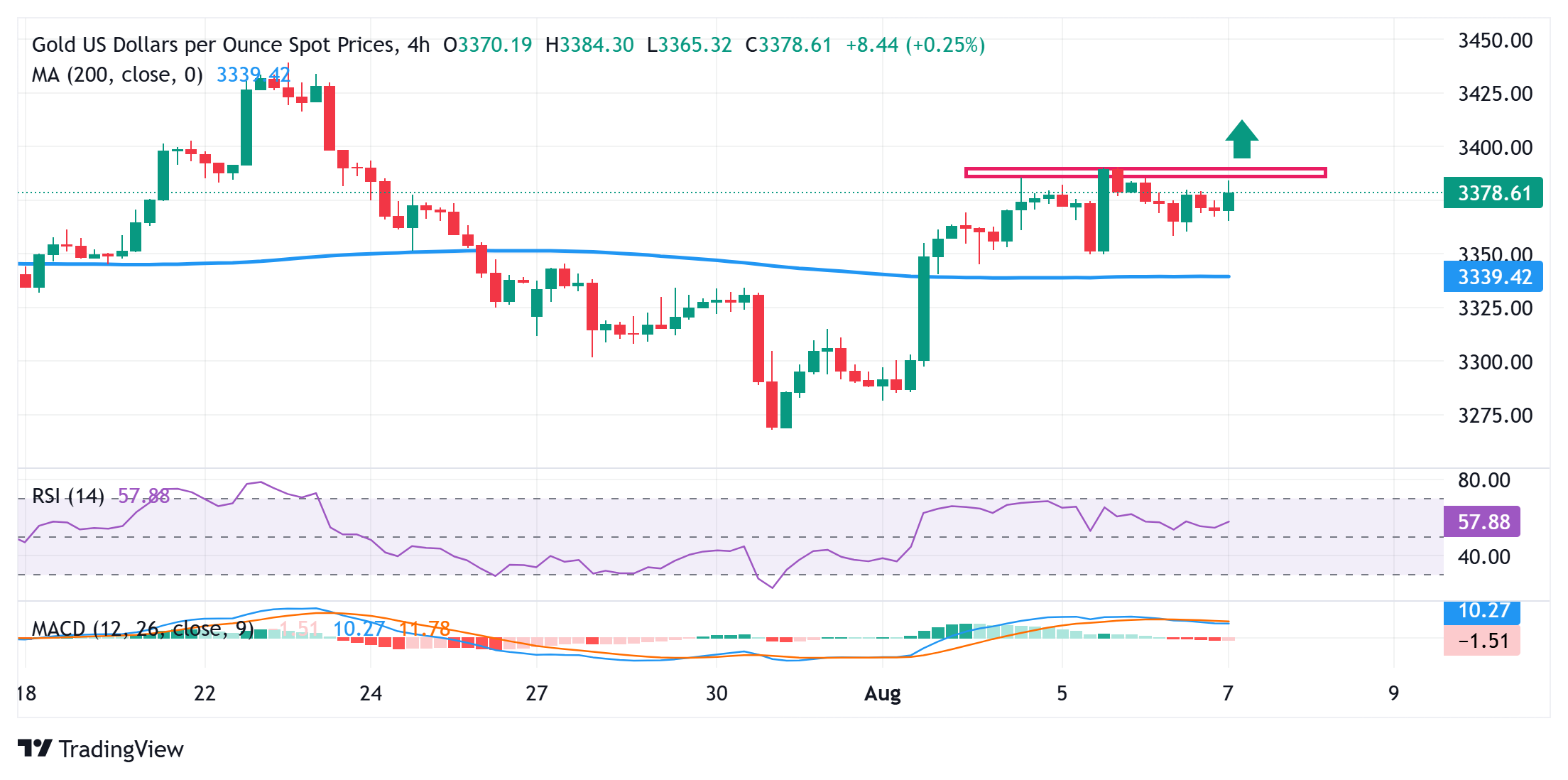
From a technical perspective, the commodity has been struggling to capitalize on the recent strength beyond the $3,380-3,385 region. Moreover, mixed oscillators on the daily chart warrant caution for the XAU/USD bulls. That said, this week's bounce from the 200-period Simple Moving Average (SMA) on the 4-hour chart backs the case for a further appreciating move. Some follow-through buying beyond the $3,400 mark will reaffirm the constructive outlook and lift the Gold price to the $3,420-3,422 intermediate hurdle en route to the $3,434-3,435 supply zone. A strength move beyond the latter would set the stage for a move towards retesting the all-time peak, around the $3,500 psychological mark touched in April.
On the flip side, any corrective pullback might continue to find decent support near the $3,350 area. This is closely followed by the 200-period SMA on the 4-hour chart, which, if broken decisively, might prompt some technical selling and drag the Gold price to the $3,315 intermediate support en route to the $3,300 round figure. Acceptance below the latter would expose the $3,268 region, or a one-month low touched last week.
Risk sentiment FAQs
In the world of financial jargon the two widely used terms “risk-on” and “risk off'' refer to the level of risk that investors are willing to stomach during the period referenced. In a “risk-on” market, investors are optimistic about the future and more willing to buy risky assets. In a “risk-off” market investors start to ‘play it safe’ because they are worried about the future, and therefore buy less risky assets that are more certain of bringing a return, even if it is relatively modest.
Typically, during periods of “risk-on”, stock markets will rise, most commodities – except Gold – will also gain in value, since they benefit from a positive growth outlook. The currencies of nations that are heavy commodity exporters strengthen because of increased demand, and Cryptocurrencies rise. In a “risk-off” market, Bonds go up – especially major government Bonds – Gold shines, and safe-haven currencies such as the Japanese Yen, Swiss Franc and US Dollar all benefit.
The Australian Dollar (AUD), the Canadian Dollar (CAD), the New Zealand Dollar (NZD) and minor FX like the Ruble (RUB) and the South African Rand (ZAR), all tend to rise in markets that are “risk-on”. This is because the economies of these currencies are heavily reliant on commodity exports for growth, and commodities tend to rise in price during risk-on periods. This is because investors foresee greater demand for raw materials in the future due to heightened economic activity.
The major currencies that tend to rise during periods of “risk-off” are the US Dollar (USD), the Japanese Yen (JPY) and the Swiss Franc (CHF). The US Dollar, because it is the world’s reserve currency, and because in times of crisis investors buy US government debt, which is seen as safe because the largest economy in the world is unlikely to default. The Yen, from increased demand for Japanese government bonds, because a high proportion are held by domestic investors who are unlikely to dump them – even in a crisis. The Swiss Franc, because strict Swiss banking laws offer investors enhanced capital protection.
Author

Haresh Menghani
FXStreet
Haresh Menghani is a detail-oriented professional with 10+ years of extensive experience in analysing the global financial markets.