Gold Price Analysis: XAU/USD’s downside more compelling amid strong resistance levels – Confluence Detector

Gold (XAU/USD) attempts another bounce on Tuesday, although remains within the familiar rage of $1820-$1850, as the focus now shifts towards Wednesday’s FOMC decision.
Gold finds its feet, benefiting from the downbeat market mood, as the growth in coronavirus infections and fresh lockdowns offset the optimism driven by the vaccine inoculations. Meanwhile, increased odds of about $1 trillion covid relief package likely to be reached before the X-mas/ New Year holiday also lend support to the XAU bulls.
How is gold positioned technically?
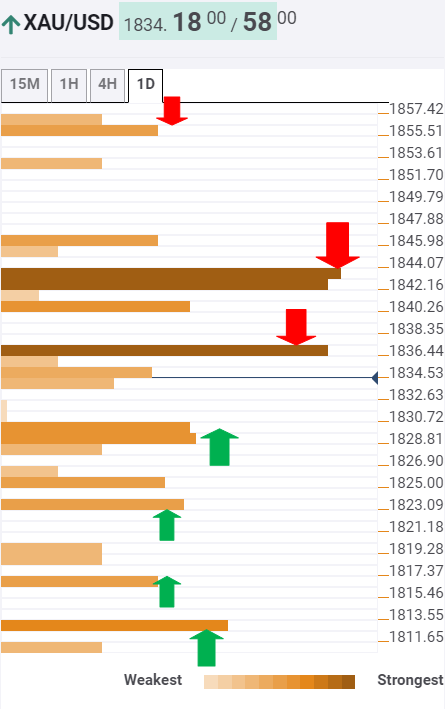
The Technical Confluences Indicator shows that the XAU/USD pair is closing in on a powerful resistance at $1837, which is the Bollinger Band one-day Middle.
On a break above the latter, the bulls could challenge the $1840 level, which is the confluence of the Pivot Point one-day R1 and SMA10 one-day.
Further up, a dense cluster of healthy resistance levels awaits at $1843, where the previous day high coincides with the Fibonacci 38.2% one-month, SMA50 four-hour and Fibonacci 61.8% one-week.
Recapturing the abovementioned strong barrier is critical to extending the recovery towards $1855, the Fibonacci 38.2% one-week.
On the flip side, the spot is likely to meet initial demand at $1829, the convergence of the SMA100 and 5 four-hour, Bollinger Band one-hour Middle and Previous High on four-hour.
The next soft downside caps are seen around $1825/$1823, which is the previous week low and Fibonacci 23.6% one-day.
Sellers would then target the $11816 support, the Pivot Point one-week S1. Meanwhile, the Fibonacci 23.6% one-month at $1812.50 will be the level to beat for the bears.
Here is how it looks on the tool
About Confluence Detector
The TCI (Technical Confluences Indicator) is a tool to locate and point out those price levels where there is a congestion of indicators, moving averages, Fibonacci levels, Pivot Points, etc. Knowing where these congestion points are located is very useful for the trader, and can be used as a basis for different strategies.
Author

Dhwani Mehta
FXStreet
Residing in Mumbai (India), Dhwani is a Senior Analyst and Manager of the Asian session at FXStreet. She has over 10 years of experience in analyzing and covering the global financial markets, with specialization in Forex and commodities markets.














