|

Gold Price Analysis: XAU/USD faces critical resistance at $1,718 after the NFP – Confluence Detector

Gold has been on the back foot after Federal Reserve Chair Jerome Powell seemed reluctant to intervene and lower bond yields. Higher returns on US debt make the yieldless precious metal less attractive to investors. However, markets seem to have stabilized after US Nonfarm Payrolls rose by 379,000. 

In the meantime, here is how XAU/USD is positioned on the charts.

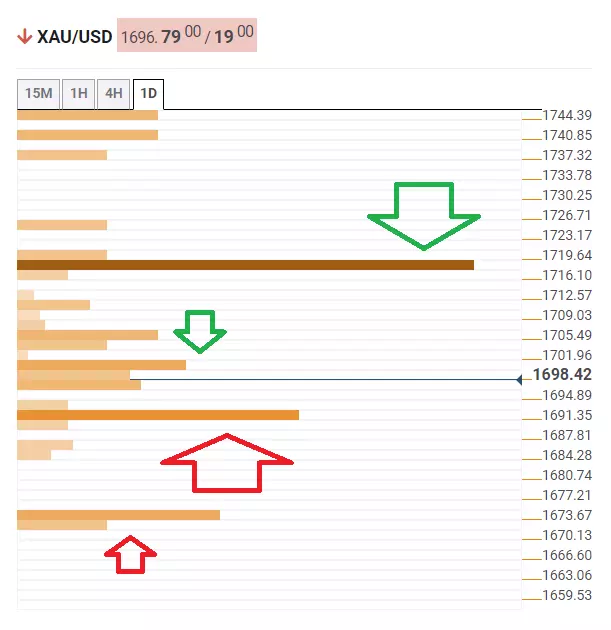
The Technical Confluences Detector is showing that gold faces some resistance at around $1,700. Apart from being a round number, that level is also the convergence of the Bollinger Band one-day Lower, the Simple Moving Average 100-15m, the previous 4h-high, and the BB 1h-Upper. 

Critical resistance awaits at $1,718, which is a cluster of lines including the Pivot Point one-day Resistance 1, the previous monthly low, and the SMA 100-1h. 

Support awaits at $1,691, which is the confluence of the previous daily low, the PP one-week S1, and the previous 4h-low. 

Further down, the downside target is $1,673, which is the meeting point of the PP one-month S1 and the PP one-day S2.  

XAU/USD resistance and support levels
Confluence Detector

The Confluence Detector finds exciting opportunities using Technical Confluences. The TC is a tool to locate and point out those price levels where there is a congestion of indicators, moving averages, Fibonacci levels, Pivot Points, etc. Knowing where these congestion points are located is very useful for the trader, and can be used as a basis for different strategies.

Learn more about Technical Confluence

Author

Yohay Elam

Yohay Elam

FXStreet

Yohay is in Forex since 2008 when he founded Forex Crunch, a blog crafted in his free time that turned into a fully-fledged currency website later sold to Finixio.


More from Yohay Elam
Share:

Editor's Picks

USD/JPY hovers below 160.50 intervention zone ahead of FOMC decision

USD/JPY remains below the 160.50 intervention zone in the Asian session on Wednesday. Despite the BoJ's rate hike to its highest level since 1995, Japan's borrowing costs remain significantly lower than the US, undermining the Japanese Yen. However, thpair US Dollar remains on the back foot amid the optimism over the US-Iran peace deal and ahead of the Fed policy decision, weighing on the pair.

AUD/USD holds steady above 0.7050; looks to Fed for fresh impetus

AUD/USD is consolidating above mid-0.7000s in the Asian session on Wednesday as traders await the outcome of a two-day FOMC meeting due later in the day. In the meantime, the optimism over an interim peace deal between the US and Iran keeps the US Dollar bulls on the defensive. This, along with the RBA's hawkish pause on Tuesday, acts as a tailwind for the pair.

Gold buyers lack conviction as Fed policy decision looms

Gold is holding its five-day winning streak near $4,350 in Asian trading on Wednesday, but remains within this week’s familiar range. Traders look forward to the all-important US Federal Reserve monetary policy decision for a clear directional impetus.


Bitcoin holds $65,000 as Uniswap and Worldcoin extend rally
Bitcoin (BTC) is experiencing headwinds above $65,000 following the Bank of Japan’s rate hike to 1% on Tuesday. Still, Uniswap (UNI) and Worldcoin (WLD) continue to rally amid rising retail interest, while Bitcoin’s recovery grows heavy. Bitcoin edges higher at press time on Wednesday, inching closer to $66,000 as it maintains a mixed near-term tone following the recent rebound from $60,000.
The most important event will be the Fed meeting with Mr. Warsh now in charge

The most important event will be the Fed meeting on Wednesday, with Mr. Warsh now in charge. As more than one analyst points out, the case for holding rates the same is strengthened by the Iran deal and the prospect of the Strait re-opening, although nobody thinks Warsh can marshal enough doves to do a cut this time.

Why a hawkish RBA is no longer enough to lift the Australian Dollar

The Reserve Bank of Australia delivered more than what markets expected: a hawkish hold that should have supported the Aussie. But markets widely ignored it, focusing instead on slowing economic growth and proving that central bank messaging alone isn’t always enough to drive currencies.