|

Gold Price Analysis: XAU/USD eyes key $1803 support amid US dollar strength – Confluence Detector

Gold (XAU/USD) remains under pressure while below the $1850 level, with the $1800 support back in sight amid a lack of new developments on the US fiscal stimulus. Renewed US-China tensions combined with fresh coronavirus lockdowns dent risk appetite, boosting the haven demand for the US dollar across the board.

The rebound in the US Treasury yields and surge in the platinum group metals (PGM) further weigh on gold prices. How is the bright metal positioned on the charts?

Gold Price Chart: Key resistances and supports

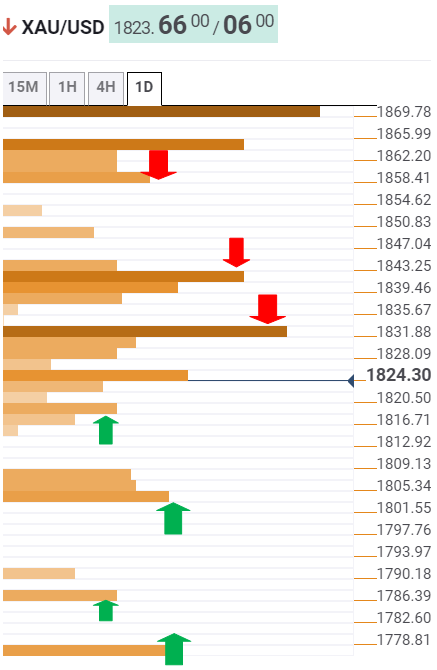
The Technical Confluences Indicator shows that gold could meet initial support at $1818, which is the Fibonacci 38.2% one-week.

The previous month low of $1803 will be next on the sellers’ radars. Further south, $1775 (the previous week low) could be challenged.

The pivot point one-month S1 at $1778 would be the last line of defense for the XAU bulls.

Alternatively, recapturing the $1833 barrier, the confluence of the SMA10 one-day and Fibonacci 38.2% one-day, is critical to reviving the recovery momentum towards $1842 (Fibonacci 23.6% one-month), the next upside target.

The next bullish target awaits at $1858, the intersection of the SMA200 one-day and pivot point one-day R2.

Here is how it looks on the tool
fxsoriginal

About Confluence Detector

The TCI (Technical Confluences Indicator) is a tool to locate and point out those price levels where there is a congestion of indicators, moving averages, Fibonacci levels, Pivot Points, etc. Knowing where these congestion points are located is very useful for the trader, and can be used as a basis for different strategies.

Author

Dhwani Mehta

Dhwani Mehta

FXStreet

Residing in Mumbai (India), Dhwani is a Senior Analyst and Manager of the Asian session at FXStreet. She has over 10 years of experience in analyzing and covering the global financial markets, with specialization in Forex and commodities markets.


More from Dhwani Mehta
Share:

Editor's Picks

AUD/USD holds above 0.6950 as bullish USD caps gains

AUD/USD edges lower during the Asian session on Tuesday, stalling a two-day recovery move from a two-month low, touched last week. An extended rout in the fixed income market keeps US bond yields elevated near multi-year highs. This, along with geopolitical uncertainties, helps the US Dollar retain its bullish tone despite receding October Fed hike bets. However, expectations for another RBA rate hike this month could act as a tailwind for the Aussie.

USD/JPY rises back above 158.00 despite hawkish BoJ outlook

USD/JPY rises back above 158.00 in the early European morning on Tuesday. The pair strengthens as the Japanese Yen fails to find any inspiration from hawkish BoJ expectations and looming intervention risks. Meanwhile, geopolitical uncertainty and elevated US bond yields keep the US Dollar near its YTD high despite receding October Fed hike bets. This, in turn, helps the pair stay supported.

Gold trades with modest gains; still below $4,200

Gold builds on Monday’s marginal bounce, although it struggles to reclaim the key $4,200 mark per troy ounce on Tuesday. The yellow metal’s advance comes on the back of the fresh downside momentum in the US Dollar in tandem with retreating US Treasury yields across the curve.

Crypto Today: Bitcoin, Ethereum, XRP bulls battle to restart uptrend amid ETF outflows

Bitcoin upholds a robust bullish outlook, trading at $85,837 on Tuesday as sellers push to regain control over the trend. Altcoins, meanwhile, reflect Bitcoin’s ranging action, with Ethereum trading sideways above $2,700 and Ripple hovering around the pivotal $1.50 level.

Japanese Yen nears 158.00: Two analysts agree it's bullish, and disagree on how far the breakout goes

The JPY is drifting near 158.00 against the USD ahead of a busy week of Japanese data and a still-unclear BoJ timetable. The two most recent FXStreet analyses agree on the direction, but they disagree on the target and the mechanism.

Eurozone inflation just hit 3.8%, its highest in three years. This chart shows why the ECB can’t simply hike its way out

The ECB would normally have a relatively straightforward answer to inflation running almost twice its target: raise interest rates. But these are not normal circumstances. This time, the bond market is already doing part of the tightening for it, leaving the ECB facing an increasingly difficult dilemma.