Gold drop as US yields rise, markets await Retail Sales data
- Gold retreats from all-time high of $2,758 as US 10-year Treasury yields rise, reflecting fears of higher deficit spending under a potential Trump presidency.
- The US Dollar Index (DXY) hits a two-month high at 104.50, further weighing on Gold as risk appetite shifts toward safe-haven currencies.
- Traders now price in a 92% chance of a 25 bps Fed rate cut in November with another cut expected by year-end.

Gold price plunges from all-time high of $2,758 on Wednesday as US Treasury yields climbed, while the Greenback refreshes a two-month high, according to the US Dollar Index (DXY). At the time of writing, the XAU/USD trades at $2,716, down more than 1%.
Risk appetite has deteriorated, sponsoring a flight to safe-haven currencies, but not assets like the golden metal. The US 10-year Treasury note yield has climbed over 65 basis points (bps) since the Federal Reserve (Fed) cut rates by 50 basis points (bps) on September 18, amid fears that Trump’s presidency could be inflationary.
“The yields rising are implying a pro-growth administration is potentially coming into power and there's some fear about deficit-spending,” said Thomas Hayes, chairman at Great Hill Capital in New York.
The US 10-year T-note yields 4.248%, gaining four basis points. The DXY, which measures the performance of the US currency against another six, edges up 0.42%, at 104.50.
Market participants are pricing a 92% chance that the Fed would lower rates by 25 bps at the next meeting in November and another one in December.
Investors seem convinced that former President Donald Trump could beat Vice-President Kamala Harris, as showed by most betting websites. As we get close to the US election on November 5, investors are taking shelter in view of that possibility. Investors are somewhat worried that Trump’s deficit-spending, use of tariffs and major illegal migrant deportation scheme could cause a new bout of inflation.
In the meantime, Middle East woes have faded somewhat, a relief for commodities like Crude Oil, which is also down 0.77% to $70.69 per barrel.
Daily digest market movers: Gold price on the defensive as US yields soar
- On Thursday, US Initial Jobless Claims for the week ending October 19 are expected to rise slightly from 241K to 242K.
- The S&P Global Manufacturing PMI for October is projected to improve from 47.3 to 47.5, while the Services PMI is estimated to dip from 55.2 to 55.
- Data from the Chicago Board of Trade, based on the December fed funds rate futures contract, indicates that investors estimate 47 basis points (bps) of Fed easing by the end of the year, which is slightly lower compared to a week ago.
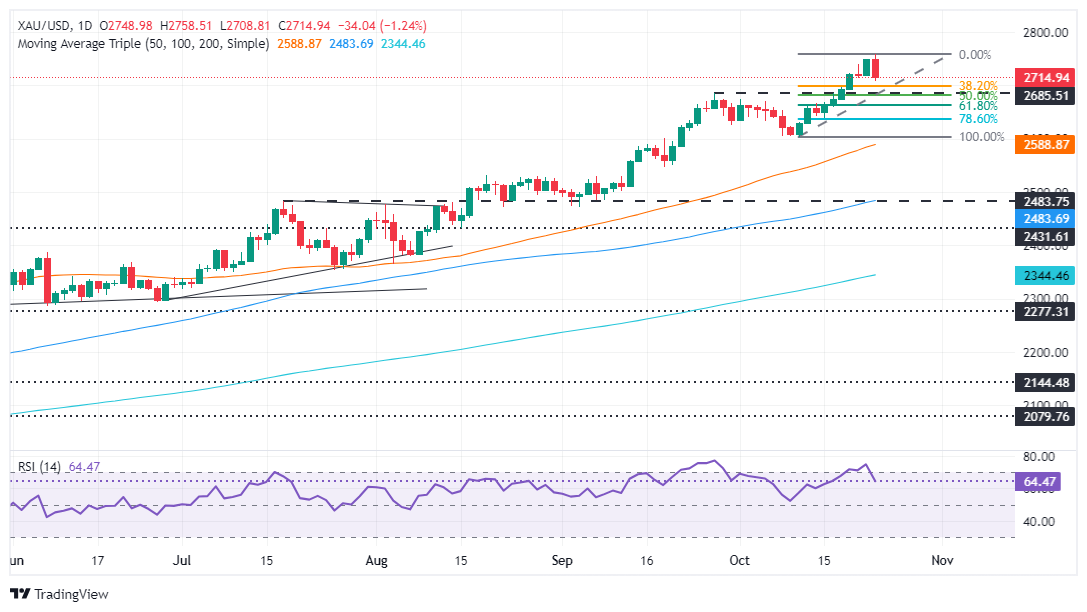
XAU/USD technical outlook: Gold price retreats below $2,720
Gold price retreats sharply, forming a Bullish Engulfing candle chart pattern or an “outside day.” If confirmed, the yellow metal could be headed for a pullback, following the 5.96% rally that started on October 10.
From a momentum standpoint, sellers are gathering some pace. The Relative Strength Index (RSI) fell sharply from overbought conditions, opening the door for further downside.
In the case of a daily close below $2,719, look for a retracement. The first support would be the 38% Fibonacci Retracement at $2,699, followed by the 50% and 61.8% Fib Retracements at $2,681 and $2,662, respectively.
On the other hand, if XAU/USD clears today’s high at $2,750 the next stop would be the all-time record high at $2,758, followed by $2,800.
Gold FAQs
Gold has played a key role in human’s history as it has been widely used as a store of value and medium of exchange. Currently, apart from its shine and usage for jewelry, the precious metal is widely seen as a safe-haven asset, meaning that it is considered a good investment during turbulent times. Gold is also widely seen as a hedge against inflation and against depreciating currencies as it doesn’t rely on any specific issuer or government.
Central banks are the biggest Gold holders. In their aim to support their currencies in turbulent times, central banks tend to diversify their reserves and buy Gold to improve the perceived strength of the economy and the currency. High Gold reserves can be a source of trust for a country’s solvency. Central banks added 1,136 tonnes of Gold worth around $70 billion to their reserves in 2022, according to data from the World Gold Council. This is the highest yearly purchase since records began. Central banks from emerging economies such as China, India and Turkey are quickly increasing their Gold reserves.
Gold has an inverse correlation with the US Dollar and US Treasuries, which are both major reserve and safe-haven assets. When the Dollar depreciates, Gold tends to rise, enabling investors and central banks to diversify their assets in turbulent times. Gold is also inversely correlated with risk assets. A rally in the stock market tends to weaken Gold price, while sell-offs in riskier markets tend to favor the precious metal.
The price can move due to a wide range of factors. Geopolitical instability or fears of a deep recession can quickly make Gold price escalate due to its safe-haven status. As a yield-less asset, Gold tends to rise with lower interest rates, while higher cost of money usually weighs down on the yellow metal. Still, most moves depend on how the US Dollar (USD) behaves as the asset is priced in dollars (XAU/USD). A strong Dollar tends to keep the price of Gold controlled, whereas a weaker Dollar is likely to push Gold prices up.
Author

Christian Borjon Valencia
FXStreet
Markets analyst, news editor, and trading instructor with over 14 years of experience across FX, commodities, US equity indices, and global macro markets.