Gold steadies near $4,600 due to risk-on mood, Fed caution bets
- Gold remains subdued amid fading safe-haven demand.
- Trump signaled delayed military action after Iran’s pledge, and allies urged restraint on a potential strike.
- The non-interest-bearing Gold weakened as US Jobless Claims reinforce expectations that the Fed will keep rates on hold.

Gold (XAU/USD) hovers around $4,600 during the early European hours on Friday. However, Gold prices fell amid decreasing safe-haven demand as geopolitical risks in Iran temporarily eased. US President Donald Trump signaled he may delay military action after Iran pledged not to execute protesters. Market sentiment was further eased by reports that Israel and other Middle Eastern allies urged the US to hold off on any potential strike against Iran.
Gold, a non-interest-bearing asset, loses its shine as Thursday’s US Initial Jobless Claims data reinforced expectations that the Federal Reserve (Fed) will keep interest rates on hold for the coming months. Fed funds futures have pushed expectations for the next rate cut back to June, reflecting stronger labor market conditions and policymakers’ concerns over sticky inflation.
Safe-haven Gold depreciates as risk sentiment improves after President Trump said he has no plans to dismiss Fed Chair Jerome Powell despite reported Justice Department indictment threats. Trump also indicated he could delay action on Iran while moving ahead with trade measures targeting critical minerals and AI chips.
Daily Digest Market Movers: Gold declines as US Dollar could strengthen on Fed caution
- The US Dollar Index (DXY), which measures the value of the US Dollar against six major currencies, is losing ground after registering modest gains in the previous session. The DXY is trading around 99.30 at the time of writing, limiting the downside of the dollar-denominated Gold.
- The US Department of Labor (DOL) reported on Thursday that Initial Jobless Claims unexpectedly fell to 198K in the week ended January 10, below market expectations of 215K and down from the prior week’s revised 207K. The data confirmed that layoffs remain limited and that the labor market is holding up despite an extended period of high borrowing costs.
- The US Census Bureau reported on Wednesday that Retail Sales rose more than expected to $735.9 billion in November, up 0.6%, following a 0.1% contraction in October and beating market expectations of a 0.4% increase. Meanwhile, the Producer Price Index (PPI) came in hot in November, with both headline and core measures reaching 3% year-over-year (YoY).
- Morgan Stanley analysts delayed their expectations for rate cuts to June and September from January and April following Friday’s jobs report.
- Minneapolis Fed President Neel Kashkari said at the Midwest Economic Forecast Forum hosted online by the Wisconsin Bankers Association on Wednesday that the overall economy seems quite resilient and that he has seen less tariff pass-through than expected. Kashkari added that inflation is still too high but is moving the right way.
- Fed Beige Book noted that US economic activity picked up at a "slight to modest pace" in most parts of the country since mid-November. "This marks an improvement over the last three report cycles, where a majority of Fed districts reported little change."
- US Core Consumer Price Index (CPI), excluding food and energy, rose 0.2% in December, below market expectations, while annual core inflation held at 2.6%, matching a four-year low. The data provided a clearer sign of easing inflation after earlier releases were skewed by shutdown effects. Meanwhile, CPI increased by 0.3% month-over-month in December 2025, matching market expectations and repeating the rise seen in September. The annual inflation remains at 2.7% increase as expected.
Gold declines as ascending wedge indicates fading upside momentum
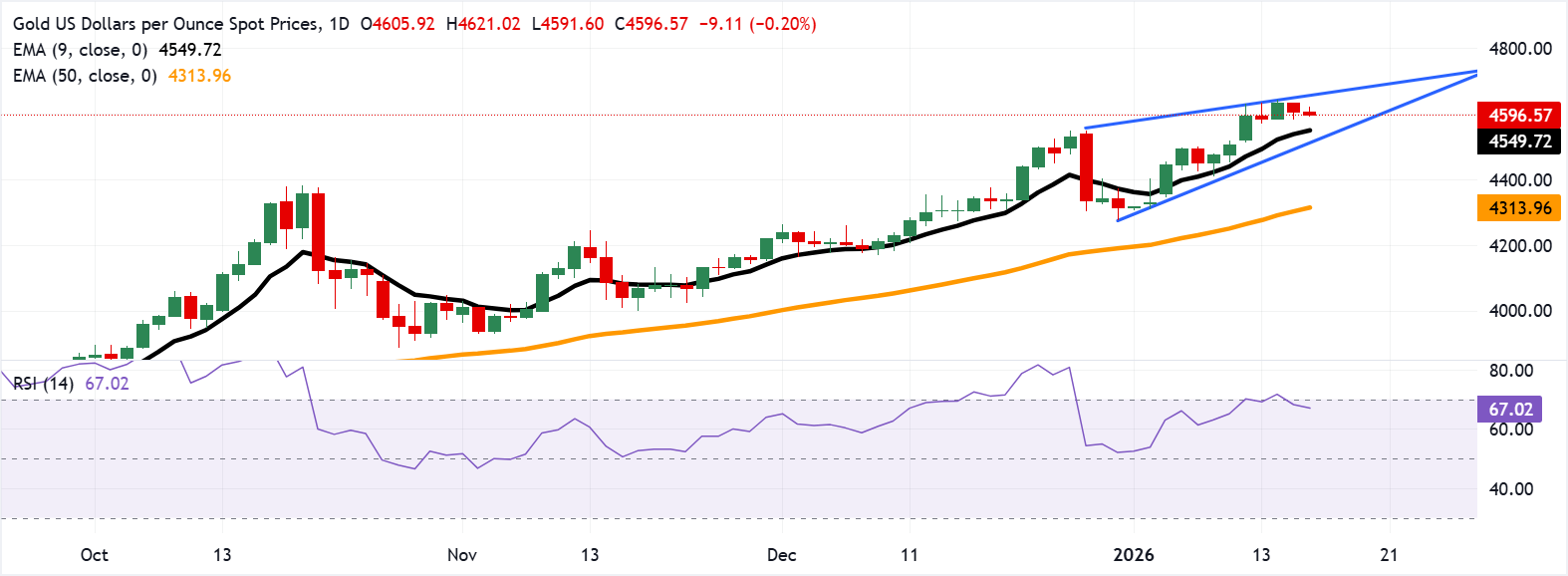
Gold (XAU/USD) is trading around $4,600 on Friday. Daily chart analysis shows the XAU/USD pair trading within a developing ascending wedge, indicating fading upside momentum and the risk of a bearish reversal if prices break below the lower trendline on strong volume.
The immediate resistance appears at the record high of $4,643, reached on January 14, followed by the upper boundary of the ascending wedge around $4,660. A break above this confluence resistance zone would lead the XAU/USD pair to the $4,700 level.
On the downside, the initial support lies at the nine-day Exponential Moving Average (EMA) of $4,549, followed by the lower ascending wedge boundary around $4,520.00. Further declines below the wedge would open the doors for the XAU/USD pair to navigate the region around the 50-day EMA at $4,313.
Gold FAQs
Gold has played a key role in human’s history as it has been widely used as a store of value and medium of exchange. Currently, apart from its shine and usage for jewelry, the precious metal is widely seen as a safe-haven asset, meaning that it is considered a good investment during turbulent times. Gold is also widely seen as a hedge against inflation and against depreciating currencies as it doesn’t rely on any specific issuer or government.
Central banks are the biggest Gold holders. In their aim to support their currencies in turbulent times, central banks tend to diversify their reserves and buy Gold to improve the perceived strength of the economy and the currency. High Gold reserves can be a source of trust for a country’s solvency. Central banks added 1,136 tonnes of Gold worth around $70 billion to their reserves in 2022, according to data from the World Gold Council. This is the highest yearly purchase since records began. Central banks from emerging economies such as China, India and Turkey are quickly increasing their Gold reserves.
Gold has an inverse correlation with the US Dollar and US Treasuries, which are both major reserve and safe-haven assets. When the Dollar depreciates, Gold tends to rise, enabling investors and central banks to diversify their assets in turbulent times. Gold is also inversely correlated with risk assets. A rally in the stock market tends to weaken Gold price, while sell-offs in riskier markets tend to favor the precious metal.
The price can move due to a wide range of factors. Geopolitical instability or fears of a deep recession can quickly make Gold price escalate due to its safe-haven status. As a yield-less asset, Gold tends to rise with lower interest rates, while higher cost of money usually weighs down on the yellow metal. Still, most moves depend on how the US Dollar (USD) behaves as the asset is priced in dollars (XAU/USD). A strong Dollar tends to keep the price of Gold controlled, whereas a weaker Dollar is likely to push Gold prices up.
Author

Akhtar Faruqui
FXStreet
Akhtar Faruqui is a Forex Analyst based in New Delhi, India. With a keen eye for market trends and a passion for dissecting complex financial dynamics, he is dedicated to delivering accurate and insightful Forex news and analysis.















