Gold holds firm amid dovish Fed expectations
- Gold steadies near recent highs as markets price in a more dovish Fed path.
- Deutsche Bank lifts its 2026 Gold forecast, citing strong central-bank demand and investor inflows.
- Technically, XAU/USD is pressing against the top of a symmetrical triangle on the daily chart, with upside targets at $4,200 and $4,250.

Gold (XAU/USD) holds firm on Wednesday as traders lean into a more dovish Federal Reserve (Fed) outlook, with XAU/USD trading around $4,150, easing slightly after climbing to two-week highs near $4,173 earlier in the day.
Traders grew more confident in a softer monetary policy path after reports that White House Senior Adviser Kevin Hassett has emerged as the leading candidate to become the next Fed Chair. Hassett’s rise to the top of the shortlist is being viewed as a dovish signal, especially since he has previously advocated for interest rate cuts.
Furthermore, delayed US economic data released on Tuesday showed weaker consumer spending and a moderation in producer prices, leading markets to bolster expectations of a December rate cut.
Lower interest rates generally bode well for the non-interest-bearing precious metal. However, Gold could face headwinds from reduced safe-haven demand after positive headlines suggested signs of progress in Russia-Ukraine peace talks.
Market movers: Peace-talk headlines lift risk mood as DXY recovers
- The US Dollar Index (DXY), which tracks the Greenback against a basket of six major currencies, is hovering around 99.69, retreating after climbing to a daily high of 99.96 earlier in the day.
- The delayed US September data showed Durable Goods Orders rising 0.5%, beating the 0.3% forecast after a 3.0% increase in August, while orders excluding transportation rose 0.6%, above both the 0.2% forecast and the 0.5% level seen in the previous month. Orders excluding defense increased 0.1%, missing the 1.9% forecast and aligning with the 1.9% August reading. Initial Jobless Claims came in at 216K, better than the 225K forecast, with the last published figure revised to 222K from 220K.
- Early signs of progress in US-brokered Russia-Ukraine peace talks supported risk sentiment after an ABC News report cited a US official saying Ukraine had agreed with the US on the terms of a possible peace deal during talks in Abu Dhabi. However, the Kremlin said on Wednesday that it is premature to talk about reaching a peace agreement, according to Interfax.
- Deutsche Bank raised its 2026 Gold forecast to $4,450 from $4,000 on Wednesday, citing stronger central-bank buying and growing investor interest. The bank now expects a possible high near $4,950, which would be about 14% above current December 2026 futures.
- According to the World Gold Council report published on 25 November, global Gold ETF holdings saw a net inflow of 55.1 tonnes in October 2025, driven by strong additions in North America (47.2 tonnes) and Asia (44.8 tonnes), while Europe recorded notable outflows of 37.3 tonnes.
- The US calendar features second-tier releases on Wednesday, including September Durable Goods Orders, weekly Initial Jobless Claims, and the Fed’s Beige Book
Technical analysis: XAU/USD eyes breakout from triangle pattern
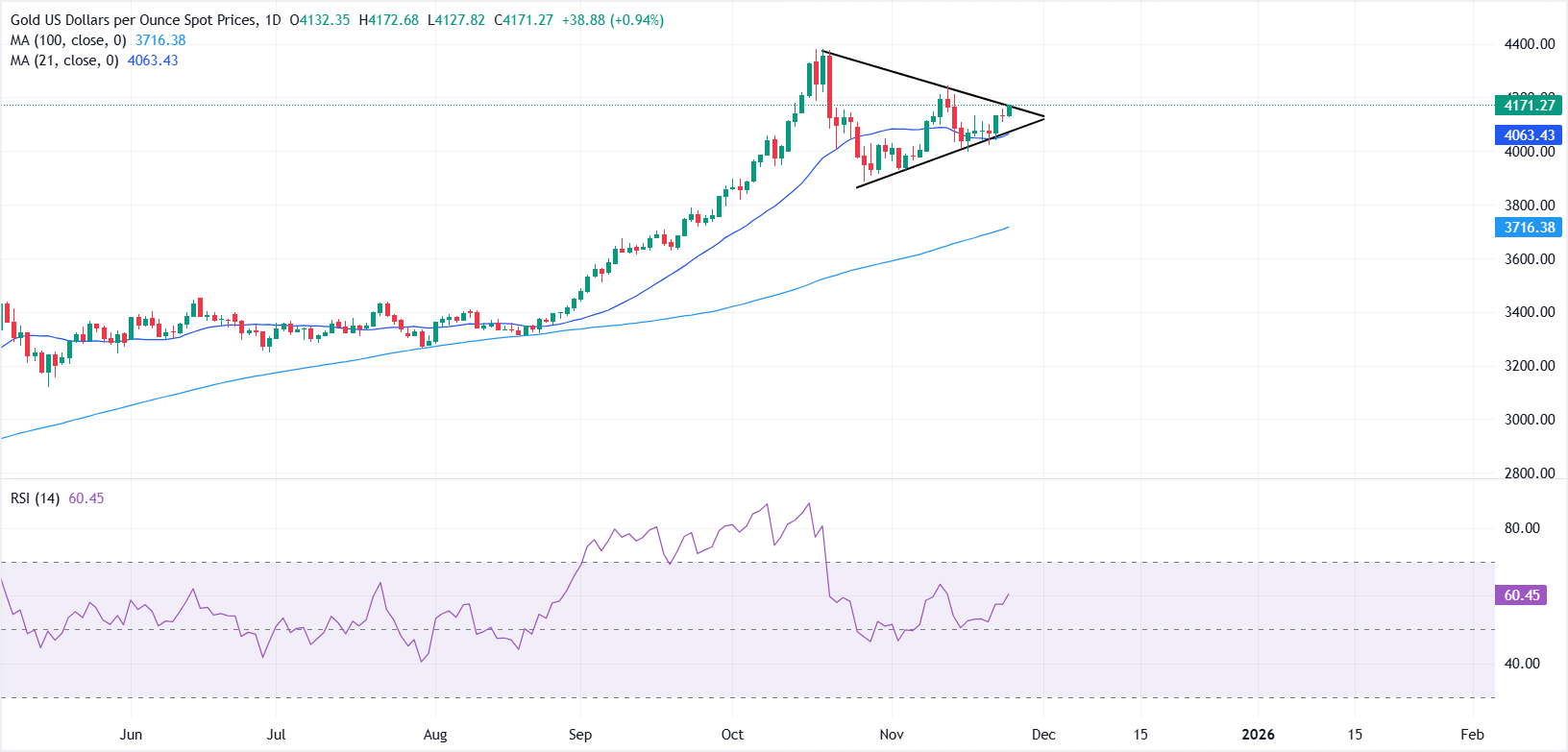
From a technical perspective, Gold is attempting a breakout from a symmetrical triangle pattern on the daily chart. A successful move above the pattern resistance would strengthen the bullish trend, opening the door for upside targets near $4,200 and $4,250.
On the downside, initial support is seen around $4,150, while stronger support sits near $4,050–$4,070 at the base of the triangle, which is also aligned with the 21-day Simple Moving Average (SMA).
The Relative Strength Index (RSI) stands at 60.45, indicating firm positive momentum and supporting the bullish bias, with further room to rise before reaching overbought territory.
Gold FAQs
Gold has played a key role in human’s history as it has been widely used as a store of value and medium of exchange. Currently, apart from its shine and usage for jewelry, the precious metal is widely seen as a safe-haven asset, meaning that it is considered a good investment during turbulent times. Gold is also widely seen as a hedge against inflation and against depreciating currencies as it doesn’t rely on any specific issuer or government.
Central banks are the biggest Gold holders. In their aim to support their currencies in turbulent times, central banks tend to diversify their reserves and buy Gold to improve the perceived strength of the economy and the currency. High Gold reserves can be a source of trust for a country’s solvency. Central banks added 1,136 tonnes of Gold worth around $70 billion to their reserves in 2022, according to data from the World Gold Council. This is the highest yearly purchase since records began. Central banks from emerging economies such as China, India and Turkey are quickly increasing their Gold reserves.
Gold has an inverse correlation with the US Dollar and US Treasuries, which are both major reserve and safe-haven assets. When the Dollar depreciates, Gold tends to rise, enabling investors and central banks to diversify their assets in turbulent times. Gold is also inversely correlated with risk assets. A rally in the stock market tends to weaken Gold price, while sell-offs in riskier markets tend to favor the precious metal.
The price can move due to a wide range of factors. Geopolitical instability or fears of a deep recession can quickly make Gold price escalate due to its safe-haven status. As a yield-less asset, Gold tends to rise with lower interest rates, while higher cost of money usually weighs down on the yellow metal. Still, most moves depend on how the US Dollar (USD) behaves as the asset is priced in dollars (XAU/USD). A strong Dollar tends to keep the price of Gold controlled, whereas a weaker Dollar is likely to push Gold prices up.
Author

Vishal Chaturvedi
FXStreet
I am a macro-focused research analyst with over four years of experience covering forex and commodities market. I enjoy breaking down complex economic trends and turning them into clear, actionable insights that help traders stay ahead of the curve.

















