Gold holds near record highs amid economic and geopolitical uncertainties
- Gold hits another all-time high near $4,642 as economic and geopolitical risks keep safe-haven demand firm.
- Softer US core CPI keeps expectations tilted toward a gradual Fed easing path.
- Technically, Gold continues to trend higher, though overbought signals flash caution near record highs.

Gold (XAU/USD) regains a positive footing on Wednesday after a shallow pullback from record highs the previous day, as lingering economic and geopolitical uncertainties continue to underpin safe-haven demand.
At the time of writing, XAU/USD trades around $4,610, easing slightly after climbing to a fresh all-time high near $4,642 earlier in the day.
The yellow metal is up nearly 2.5% so far this week, supported by concerns over the Federal Reserve’s (Fed) independence and rising unrest in Iran, which have revived fears of possible United States (US) involvement and the risk of wider regional instability.
Markets are also closely watching Washington’s renewed interest in Greenland, with high-level talks scheduled later on Wednesday.
Further support has come from signs of easing inflation pressure in the US. Data released on Tuesday showed that the core Consumer Price Index (CPI) rose less than expected, reinforcing expectations that the Fed can continue along a gradual easing path.
Market movers: Markets digest US data Fed outlook, and rising geopolitical risk
- Headline PPI rose 0.2% MoM in November, matching expectations and accelerating from October, while the annual rate climbed to 3% from 2.8%, coming in above forecasts of 2.7%. Core PPI was unchanged on the month, undershooting expectations for a 0.2% rise, but the annual core rate increased to 3% from 2.9%, also exceeding the forecast.
- Retail Sales rose 0.6% MoM in November, beating expectations of a 0.4% increase and reversing October’s 0.1% decline. Annual sales growth held at 3.3%. Sales excluding autos climbed 0.5% on the month, above forecasts of 0.4% and October’s 0.2% rise. The control group, which feeds directly into Gross Domestic Product (GDP) calculations, increased 0.4% after October’s 0.6% rise.
- US headline CPI rose 0.3% MoM in December, in line with expectations and unchanged from November, keeping the annual rate steady at 2.7%. Core CPI increased 0.2% MoM, below the 0.3% forecast. On a yearly basis, core inflation stood at 2.6%, below the 2.7% forecast.
- US President Trump renewed his attacks on Fed Chair Jerome Powell after the inflation data, calling the numbers “great” and pressing for rate cuts. His remarks come as markets remain unsettled by reports of a criminal investigation tied to Powell’s testimony on the Fed’s headquarters renovation, keeping concerns over central bank independence in focus.
- Risks of possible US military action in Iran have risen after President Donald Trump said in a post on Truth Social on Tuesday, “Iranian Patriots, KEEP PROTESTING — TAKE OVER YOUR INSTITUTIONS!!!… HELP IS ON ITS WAY,” adding that all meetings with Iranian officials are cancelled until the violence ends. Trump has previously indicated that military action remains an option if Tehran continues its crackdown.
- Markets are also on alert for a possible US Supreme Court ruling later on Wednesday on the legality of President Donald Trump’s use of emergency tariff powers.
- St. Louis Fed President Alberto Musalem said on Tuesday there is “little reason for further easing of policy in the near term” and that policy is “well positioned to balance risks on both sides.” He added that the latest inflation reading was encouraging and supports the view that inflation could converge toward 2% this year.
Technical analysis: Uptrend intact despite overbought conditions
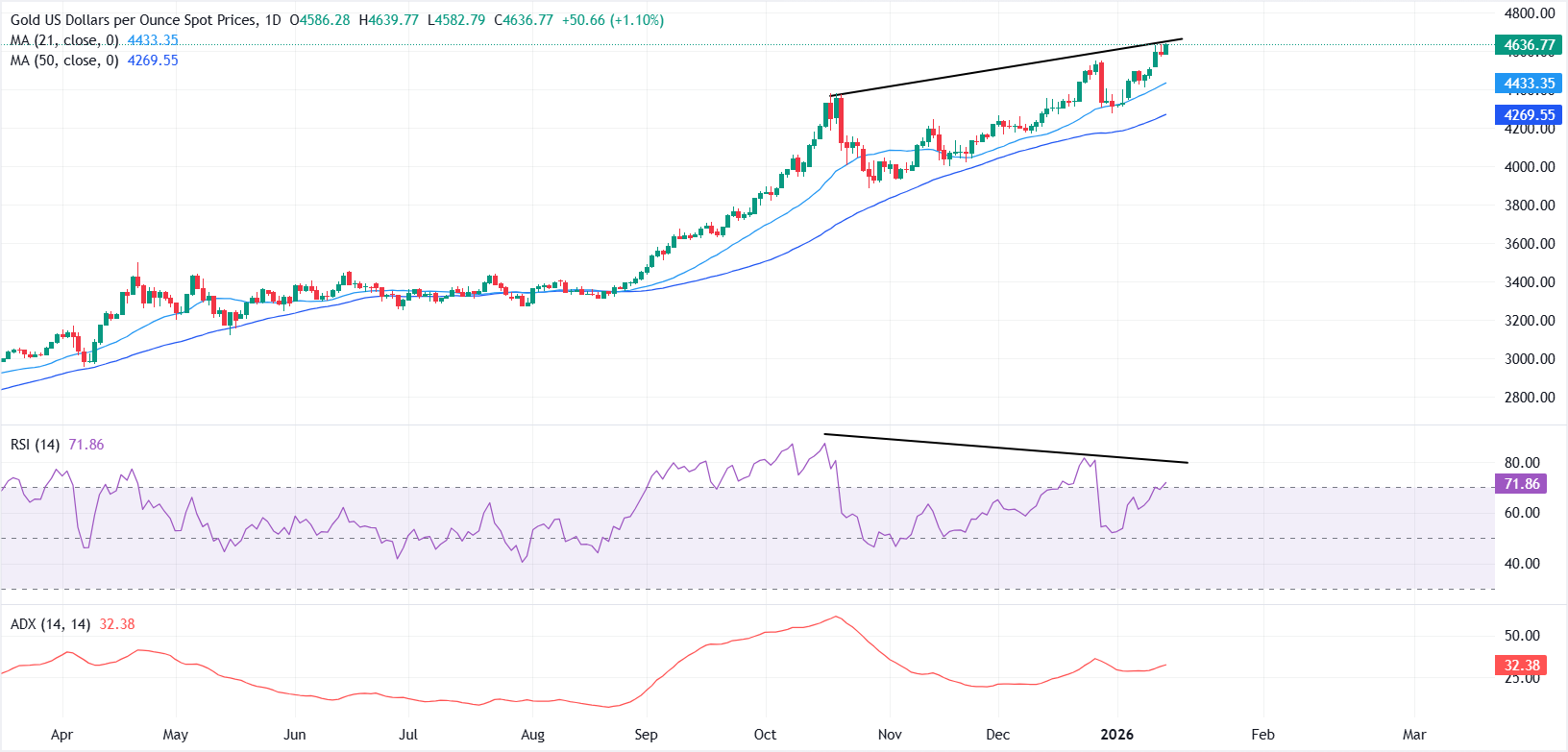
From a technical perspective, XAU/USD continues to extend its upward trajectory, shrugging off overbought conditions and fears of an overstretched rally. Buyers remain firmly in control, with price action holding comfortably above both the short and long-term moving averages, underscoring the strength of the broader uptrend.
However, some caution is warranted. The Relative Strength Index (RSI) stands near 71, firmly in overbought territory, and a bearish divergence on the daily and 4-hour charts suggests upside momentum is starting to cool.
This may limit near-term follow-through and raise the risk of brief consolidation or shallow pullbacks. Still, the Average Directional Index (ADX) at 32.38 points to a strong underlying trend.
On the downside, initial support is seen near $4,600, followed by the 21-day SMA around $4,433. On the upside, a decisive hold above current levels keeps the focus on $4,650 as the next immediate bullish target, with room for an extension toward $4,700.
Gold FAQs
Gold has played a key role in human’s history as it has been widely used as a store of value and medium of exchange. Currently, apart from its shine and usage for jewelry, the precious metal is widely seen as a safe-haven asset, meaning that it is considered a good investment during turbulent times. Gold is also widely seen as a hedge against inflation and against depreciating currencies as it doesn’t rely on any specific issuer or government.
Central banks are the biggest Gold holders. In their aim to support their currencies in turbulent times, central banks tend to diversify their reserves and buy Gold to improve the perceived strength of the economy and the currency. High Gold reserves can be a source of trust for a country’s solvency. Central banks added 1,136 tonnes of Gold worth around $70 billion to their reserves in 2022, according to data from the World Gold Council. This is the highest yearly purchase since records began. Central banks from emerging economies such as China, India and Turkey are quickly increasing their Gold reserves.
Gold has an inverse correlation with the US Dollar and US Treasuries, which are both major reserve and safe-haven assets. When the Dollar depreciates, Gold tends to rise, enabling investors and central banks to diversify their assets in turbulent times. Gold is also inversely correlated with risk assets. A rally in the stock market tends to weaken Gold price, while sell-offs in riskier markets tend to favor the precious metal.
The price can move due to a wide range of factors. Geopolitical instability or fears of a deep recession can quickly make Gold price escalate due to its safe-haven status. As a yield-less asset, Gold tends to rise with lower interest rates, while higher cost of money usually weighs down on the yellow metal. Still, most moves depend on how the US Dollar (USD) behaves as the asset is priced in dollars (XAU/USD). A strong Dollar tends to keep the price of Gold controlled, whereas a weaker Dollar is likely to push Gold prices up.
Author

Vishal Chaturvedi
FXStreet
I am a macro-focused research analyst with over four years of experience covering forex and commodities market. I enjoy breaking down complex economic trends and turning them into clear, actionable insights that help traders stay ahead of the curve.