Gold range-bound as weak US Dollar offsets risk-on sentiment
- Gold prices stay well bid above $3,350, underpinned by a softer US Dollar.
- Softer-than-anticipated headline inflation and slightly higher core readings keep the Fed rate outlook in focus, easing tariff-related inflation fears.
- The US Dollar Index trades near 97.70, its lowest in over two weeks.
Gold (XAU/USD) is consolidating gains just above $3,350 during the American session, up 0.25%, after trimming earlier gains from a high of $3,370. The metal remains supported by a softer US Dollar, with the latest US inflation data reinforcing expectations that the Federal Reserve (Fed) will cut interest rates at its September 16-17 monetary policy meeting.
The latest US Consumer Price Index (CPI) report showed headline inflation rising in line with monthly forecasts in July, while the annual rate eased slightly to come in just below expectations. The more notable development was in the core measure, which excludes food and energy, where both the monthly and yearly increases were marginally above projections, underscoring persistent underlying inflation pressures.
Despite the mixed results, markets saw the glass half full as the report provided little evidence of an imminent spike in consumer prices due to recently announced tariffs.
Mild inflation, combined with signs of a cooling labor market, strengthened market expectations of a rate cut in September, with the CME FedWatch Tool now pricing in a probability of over 95% for a 25 basis point reduction. The US Dollar weakened across the board in response, lending support to the bullion.
Investor sentiment remains broadly constructive, with global equities near record highs. Optimism over a 90-day extension pausing higher US-China tariffs, and anticipation ahead of Friday’s US-Russia peace talks in Alaska could weigh on Gold, keeping bullish momentum in check as a risk-on tone tempers safe-haven demand.
Market movers: Soft inflation, Fed-Trump tensions shape market sentiment
- US headline inflation rose 0.2% MoM, matching the forecast, after a 0.3% increase in June. The annual rate eased to 2.7%, below the 2.8% forecast and unchanged from the previous reading. Core CPI climbed 0.3% on the month as expected, accelerating from the prior 0.2% gain, while the yearly rate rose to 3.1% from 2.9%, exceeding the 3.0% forecast.
- The US Dollar Index (DXY) extended its losing streak to a second day, dropping to levels last seen over two weeks ago near 97.70, pressured by mounting bets on a September rate cut and the likelihood of one more reduction before year-end.
- The US Dollar has fallen by more than 10% year-to-date as investor confidence erodes amid tariff tensions and mounting fiscal concerns. A fresh Treasury update on Tuesday showed US national debt surpassing $37 trillion for the first time, while legislation recently signed by President Trump is projected by the Congressional Budget Office to add roughly $4.1 trillion to the debt over the next decade, compounding pressure on the Greenback.
- The 10-year US Treasury yield fell toward 4.235% and the 30-year to about 4.825%, pressured by growing confidence that the Federal Reserve will restart its monetary policy easing cycle.
- US stocks were higher on Wednesday, extending the sharp gains from the prior session. The S&P 500 and the Nasdaq 100 rose around 0.3% each to extend their record highs, while the Dow added more than 300 points.
- US Treasury Secretary Scott Bessent told Bloomberg TV on Wednesday that sanctions or secondary tariffs could be increased if President Trump’s meeting with Russian President Vladimir Putin does not go well, adding that Trump will make it clear “all options are on the table.”
- US Treasury Secretary Scott Bessent also said that the Federal Reserve should be 150-175 basis points lower on rates. This followed his Fox Business interview late Tuesday, in which he urged a 50 bps cut in September, citing cooling inflation and revised weaker job data.
- On Tuesday, President Trump intensified his criticism of Federal Reserve Chair Jerome Powell, posting on Truth Social: “I am considering allowing a major lawsuit against Powell to proceed because of the horrible, and grossly incompetent, job he has done in managing the construction of the Fed Buildings.” The remarks add fresh political risk to markets and underscore growing concerns over the central bank’s independence.
- President Trump has nominated E.J. Antoni, the chief economist at the Heritage Foundation, to lead the Bureau of Labor Statistics after Erika McEntarfer was dismissed following a weak July jobs report. Antoni, who has been a vocal critic of the agency’s data collection methods, suggested in a pre-nomination interview with Fox Business on Tuesday that the monthly jobs report should be suspended in favor of quarterly releases.
- Federal Reserve policymakers continue to weigh their dual mandate of price stability and maximum employment. Recent economic releases have raised more concern on the jobs front, with hiring momentum slowing sharply over the past three months. Meanwhile, core inflation remains above the Fed’s 2% target but has shown no signs of a rapid acceleration.
Technical analysis: XAU/USD holds above $3,350 as bulls eye breakout
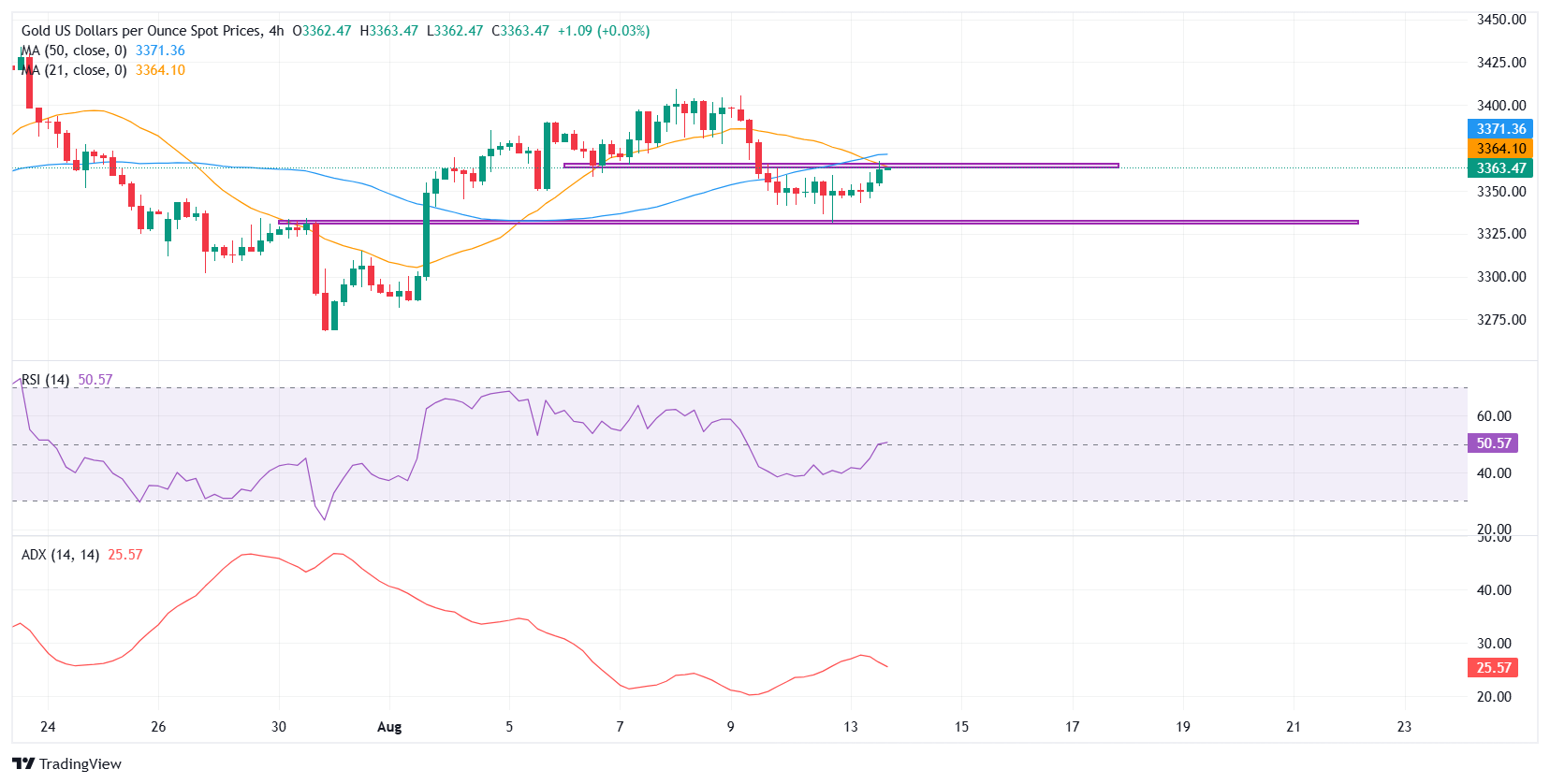
Gold is trading near $3,360, with the $3,360-$3,370 zone emerging as a key pivot area.
This region marks a previous support-turned-resistance and coincides with the convergence of the 21-period SMA ($3,365) and 50-period SMA ($3,371), making it a critical hurdle for bulls.
Price action shows repeated downside wick shadows, indicating buying interest on dips, yet the metal remains largely range-bound between $3,330 and $3,360 in recent sessions.
A breakout beyond the upper boundary could open the way toward $3,380 and possibly $3,400, while sustained rejection may keep prices consolidating or lead to a retest of $3,330, with a break below that level exposing the psychological $3,300 mark.
The Relative Strength Index (RSI) (14) is hovering near the neutral 50 mark at 48.82, indicating market indecision, while the ADX (14) reading of 26.49 reflects moderate trend strength but not enough to signal a decisive directional bias, suggesting that a clear breakout from the current range may require a fresh catalyst.
Gold FAQs
Gold has played a key role in human’s history as it has been widely used as a store of value and medium of exchange. Currently, apart from its shine and usage for jewelry, the precious metal is widely seen as a safe-haven asset, meaning that it is considered a good investment during turbulent times. Gold is also widely seen as a hedge against inflation and against depreciating currencies as it doesn’t rely on any specific issuer or government.
Central banks are the biggest Gold holders. In their aim to support their currencies in turbulent times, central banks tend to diversify their reserves and buy Gold to improve the perceived strength of the economy and the currency. High Gold reserves can be a source of trust for a country’s solvency. Central banks added 1,136 tonnes of Gold worth around $70 billion to their reserves in 2022, according to data from the World Gold Council. This is the highest yearly purchase since records began. Central banks from emerging economies such as China, India and Turkey are quickly increasing their Gold reserves.
Gold has an inverse correlation with the US Dollar and US Treasuries, which are both major reserve and safe-haven assets. When the Dollar depreciates, Gold tends to rise, enabling investors and central banks to diversify their assets in turbulent times. Gold is also inversely correlated with risk assets. A rally in the stock market tends to weaken Gold price, while sell-offs in riskier markets tend to favor the precious metal.
The price can move due to a wide range of factors. Geopolitical instability or fears of a deep recession can quickly make Gold price escalate due to its safe-haven status. As a yield-less asset, Gold tends to rise with lower interest rates, while higher cost of money usually weighs down on the yellow metal. Still, most moves depend on how the US Dollar (USD) behaves as the asset is priced in dollars (XAU/USD). A strong Dollar tends to keep the price of Gold controlled, whereas a weaker Dollar is likely to push Gold prices up.
Author

Vishal Chaturvedi
FXStreet
I am a macro-focused research analyst with over four years of experience covering forex and commodities market. I enjoy breaking down complex economic trends and turning them into clear, actionable insights that help traders stay ahead of the curve.