Gold rockets towards $5,400 as Fed hold, dissenters ignite breakout
- Gold spikes to $5,396 after the Fed holds rates, with two dissenters voting for an immediate cut.
- Powell strikes a neutral tone, citing stable labor markets and inflation still above target.
- Geopolitical risks and fading Dollar momentum keep safe-haven demand firmly elevated.
Gold price (XAU/USD) surges during the North American session as the Federal Reserve’s hold rates unchanged as expected, not unanimously as two dissenters voted for a rate cut. Meanwhile, Fed Chair Jerome Powell struck a neutral stance, maintaining the status quo. At the time of writing, the XAU/USD trades with gains of over 4% after reaching a record high at $5,412.
Bullion surges nearly 4% to fresh record highs as a split Fed decision and lingering geopolitical risks fuel demand
In the press conference, the Fed Chair Jerome Powell dodged questions linked to politics and him staying after ending his term as the top chief at the central bank. Regarding monetary policy, he said that there was broad support on the decision, that they remain data-dependent on a meeting-by-meeting approach.
About the labor market, he said it has stabilized, while inflation remains somewhat elevated. Powell said that Core PCE readings would be closer to 3% and expects prices to peak around mid-year.
Earlier, the Secretary of Treasury Scott Bessent denied rumors of an intervention in the FX markets to propel the Japanese Yen, he said on an interview on CNBC. He added that the US has always advocated for a strong Dollar policy, “but a strong dollar policy means setting the right fundamentals.”
After the Fed’s decision, the Greenback trimmed some of its earlier gains. The US Dollar Index (DXY) which tracks the strength of the American currency against other six, is up 0.58% at 96.37.
Meanwhile, geopolitical concerns lessened after Trump decided to lift tariffs on European countries related to Greenland, he announced duties on Canadian goods over the weekend if it signs a trade deal with China. Rising tensions between the US and Iran boosted Gold’s appeal as a safe haven.
Daily market movers: Fed’s decision pushes Gold to record highs
- Gold price ignored highs US Treasury yields, which usually are inversely correlated to Bullion’s value. The US 10-year Treasury note yield is up one and a half basis points, at 4.261%.
- The Federal Reserve’s monetary policy statement revealed that policymakers decided to keep rates unchanged at the 3.50%-3.75% range in a 10-2 vote split, as Fed Governors Stephen Miran ahd Christopher Waller ─one of Trump’s nominees to succeed Jerome Powell, voted for a 25 basis points rate cut.
- In the statement, policymakers reiterated that inflation remains somewhat elevated and that the unemployment rate “has shown signs of stabilization.” They stated that the economic outlook remains uncertain and that they will remain attentitive to both sides of the dual mandate.
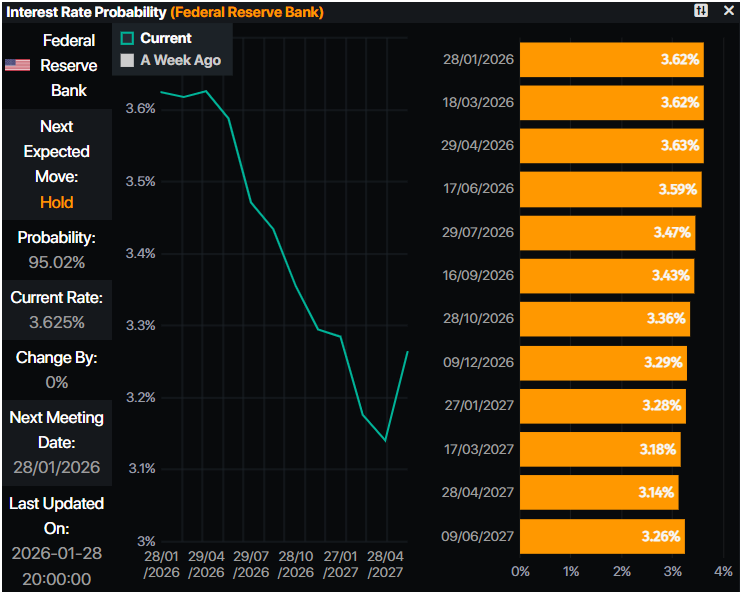
- Money markets data, revealed by Prime Market Terminal, shows that there’s a 95% chance of the Fed holding rates. For the whole year, traders are eyeing 46 basis points of easing.
Technical outlook: Gold soars past $5,400, eyes on $5,500
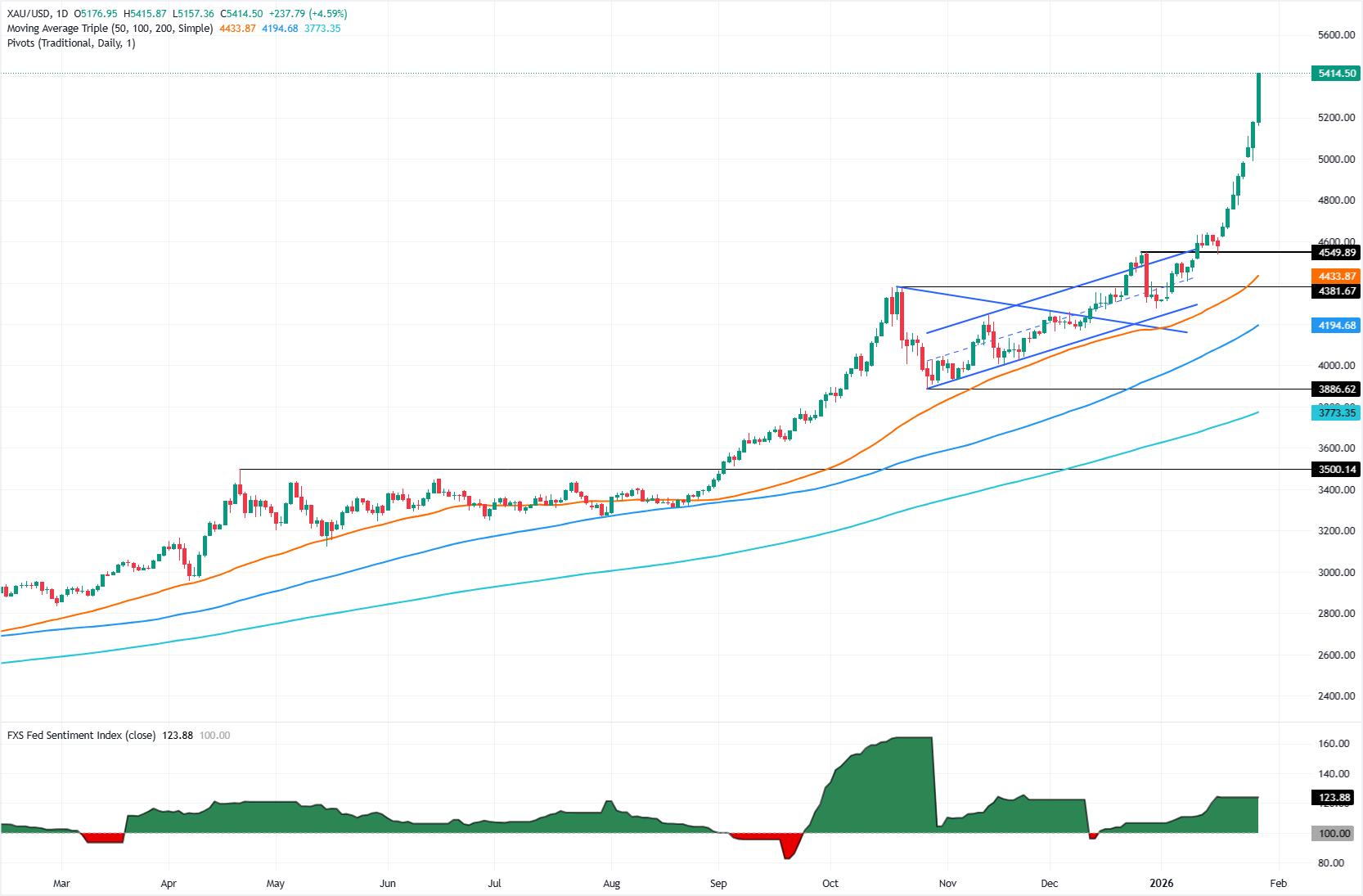
Gold price rally extended, reaching new record highs for six consecutive days, in a parabolic move that pushed the yellow metal from around $4,600 to a new record high of $5,311.
So far in the year, Gold is up 24%. A breach of the all-time high will expose $5,400 with buyers potentially eyeing a move towards $5,500.
Conversely, if XAU/USD tumbles below $5,300, the first support would be $5,250, followed by the $5,200 mark.
Fed FAQs
Monetary policy in the US is shaped by the Federal Reserve (Fed). The Fed has two mandates: to achieve price stability and foster full employment. Its primary tool to achieve these goals is by adjusting interest rates. When prices are rising too quickly and inflation is above the Fed’s 2% target, it raises interest rates, increasing borrowing costs throughout the economy. This results in a stronger US Dollar (USD) as it makes the US a more attractive place for international investors to park their money. When inflation falls below 2% or the Unemployment Rate is too high, the Fed may lower interest rates to encourage borrowing, which weighs on the Greenback.
The Federal Reserve (Fed) holds eight policy meetings a year, where the Federal Open Market Committee (FOMC) assesses economic conditions and makes monetary policy decisions. The FOMC is attended by twelve Fed officials – the seven members of the Board of Governors, the president of the Federal Reserve Bank of New York, and four of the remaining eleven regional Reserve Bank presidents, who serve one-year terms on a rotating basis.
In extreme situations, the Federal Reserve may resort to a policy named Quantitative Easing (QE). QE is the process by which the Fed substantially increases the flow of credit in a stuck financial system. It is a non-standard policy measure used during crises or when inflation is extremely low. It was the Fed’s weapon of choice during the Great Financial Crisis in 2008. It involves the Fed printing more Dollars and using them to buy high grade bonds from financial institutions. QE usually weakens the US Dollar.
Quantitative tightening (QT) is the reverse process of QE, whereby the Federal Reserve stops buying bonds from financial institutions and does not reinvest the principal from the bonds it holds maturing, to purchase new bonds. It is usually positive for the value of the US Dollar.
Author

Christian Borjon Valencia
FXStreet
Markets analyst, news editor, and trading instructor with over 14 years of experience across FX, commodities, US equity indices, and global macro markets.

















