Gold heads higher and flirts with another fresh all-time high on Monday ahead of US session
- Gold price stormed out of the gates and books 1% gain on Monday.
- Trump committed implementation for all countries, making Gold price pop.
- Gold trades above $3,120, already above several analysts’ calls.

Gold price (XAU/USD) is residing near $3,120 at the time of writing on Monday and keeps an eye on its earlier fresh all-time high near $3,128. The move comes as with some last-minute flight to safety after the United States (US) President Donald Trump confirmed that Tuesday's reciprocal tariffs will apply to all countries. It seems that any hopes for some last-minute easing or paring back are off the table ahead of the deadline on Wednesday.
Meanwhile, analysts from several major banks have raised their price targets for the precious metal, with Goldman Sachs Group Inc. ramping up its forecast to $3,300 by year-end. The lender cited higher-than-expected central bank demand and strong inflows into bullion-backed Exchange Traded Funds (ETFs). In the meantime, US yields gapped lower on Monday and are flirting with a break below the low of March at 4.172%.
Daily digest market movers: More upside looks normal
- Option pricing in Gold is not becoming more expensive, and it is even becoming cheaper. This comes as markets see the Gold price higher for longer. This is not like Coffee futures earlier this year, where a supply shock sent Option prices spiralling higher. Seeing the drop in Option prices for Gold contracts could mean more upside is available with current levels becoming the new normal, Bloomberg reports.
- The CME FedWatch tool sees a tilt in the chances of an interest rate cut by the Federal Reserve (Fed) as US yields are dropping lower this Monday. The tilt goes in favor of cutting rates, with chances for a rate cut in May increasing to 18.6% compared to near 11% one week ago. However, a rate cut in June looks almost inevitable, with only a 16.5% chance for rates to remain at current levels.
- This Monday, there is a very clear pattern ahead of reciprocal tariffs, with Gold rising, Bond prices shooting higher, and the US Dollar (USD) softening in this domino chain, while Equities sell off.
Gold Price Technical Analysis: Rolling through markets
Thus far, most of the analysts’ calls issued in recent weeks have already been reached, leaving analysts now to re-issue higher levels ahead. However, traders and market participants should not forget that this will not be a straight line higher, and profit-taking will occur along the way.
On the upside, the daily R1 resistance at $3,096 and the R2 resistance at $3,108 have already been broken in the steep rally earlier on Monday. From here, the big psychological figures are coming into play, with $3,130 and $3,150 as the next upside targets.
On the downside, R1 and R2 resistances should now support Gold’s price, followed by the daily Pivot Point at $3,075. Further down, the S1 support at $3,063 is quite far, though it could be tested if a headline comes out that pares back the earlier move.
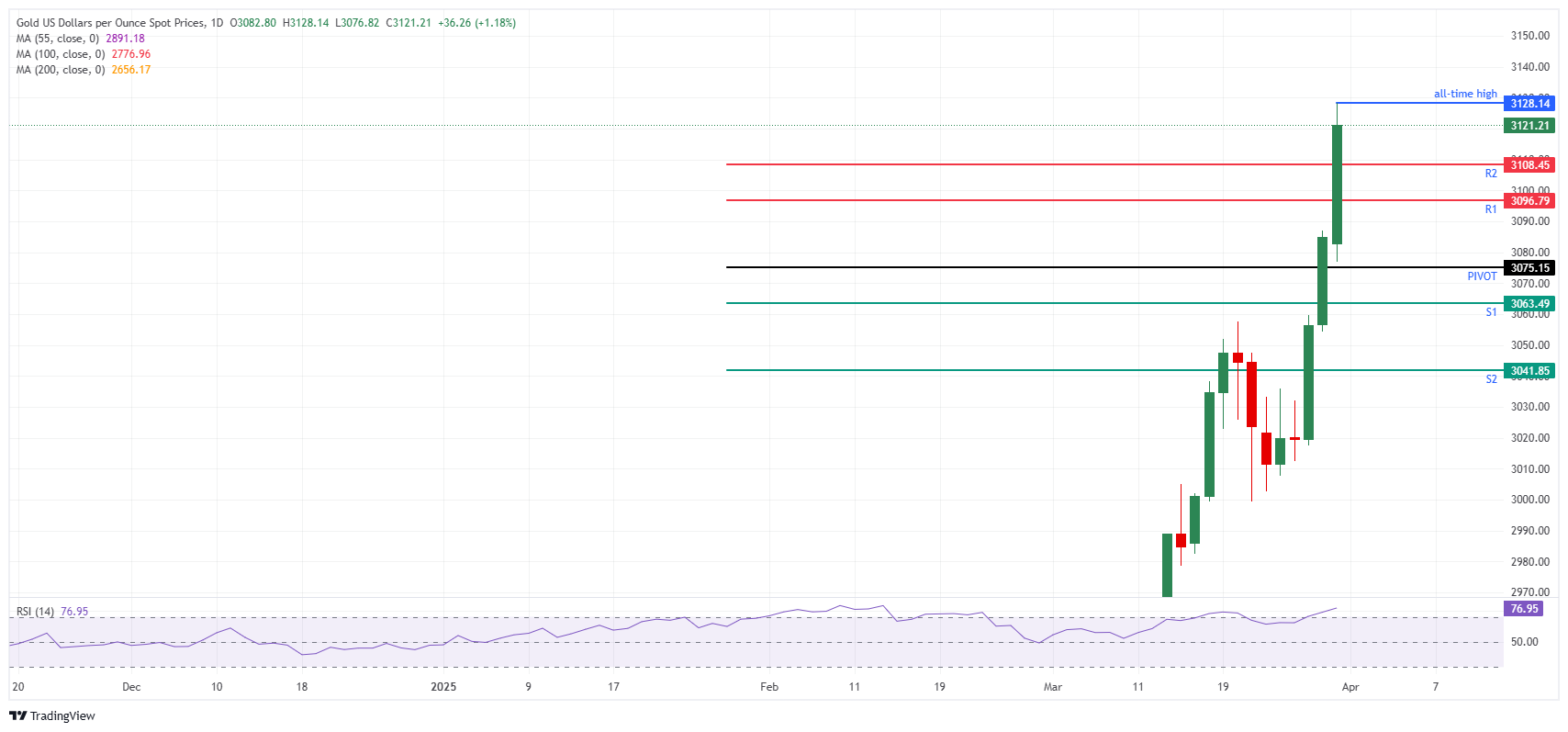
XAU/USD: Daily Chart
Tariffs FAQs
Tariffs are customs duties levied on certain merchandise imports or a category of products. Tariffs are designed to help local producers and manufacturers be more competitive in the market by providing a price advantage over similar goods that can be imported. Tariffs are widely used as tools of protectionism, along with trade barriers and import quotas.
Although tariffs and taxes both generate government revenue to fund public goods and services, they have several distinctions. Tariffs are prepaid at the port of entry, while taxes are paid at the time of purchase. Taxes are imposed on individual taxpayers and businesses, while tariffs are paid by importers.
There are two schools of thought among economists regarding the usage of tariffs. While some argue that tariffs are necessary to protect domestic industries and address trade imbalances, others see them as a harmful tool that could potentially drive prices higher over the long term and lead to a damaging trade war by encouraging tit-for-tat tariffs.
During the run-up to the presidential election in November 2024, Donald Trump made it clear that he intends to use tariffs to support the US economy and American producers. In 2024, Mexico, China and Canada accounted for 42% of total US imports. In this period, Mexico stood out as the top exporter with $466.6 billion, according to the US Census Bureau. Hence, Trump wants to focus on these three nations when imposing tariffs. He also plans to use the revenue generated through tariffs to lower personal income taxes.
Author

Filip Lagaart
FXStreet
Filip Lagaart is a former sales/trader with over 15 years of financial markets expertise under its belt.

















