Gold retakes $4,000 as fresh USD selling counters hawkish Fed and trade optimism
- Gold regains positive traction amid a modest USD weakness and reviving safe-haven demand.
- The US-China trade optimism and the Fed’s hawkish tilt might cap gains for the precious metal.
- Traders now look to speeches from influential FOMC members for some meaningful impetus.

Gold (XAU/USD) adds to its intraday gains and jumps back above the $4,000 psychological mark during the first half of the European session on Thursday. Concerns about economic risks stemming from a prolonged US government shutdown drag the US Dollar (USD) away from an over two-week high, touched the previous day, and help revive demand for the safe-haven precious metal. However, a combination of factors might hold back traders from placing aggressive bullish bets around the commodity.
Federal Reserve (Fed) Chair Jerome Powell pushed back against market expectations for another interest rate cut in December, which, in turn, could limit deeper USD losses. Apart from this, the latest optimism over a positive outcome from a high-stakes meeting between US President Donald Trump and Chinese leader Xi Jinping contributes to capping the safe-haven Gold. This makes it prudent to wait for some follow-through buying before confirming that the corrective slide from the all-time peak has run its course.
Daily Digest Market Movers: Gold bulls retain control amid modest USD weakness
- The US government shutdown has now entered its fourth week amid a deadlock in Congress on the Republican-backed funding bill, fueling economic concerns. This, in turn, drags the US Dollar away from the post-FOMC swing high and revives demand for the safe-haven Gold during the Asian session on Thursday.
- US President Donald Trump said after his highly anticipated meeting with China’s President Xi Jinping that purchases of soybeans will begin immediately, and all the rare earth issues have been settled. This, along with the Federal Reserve's hawkish tilt, might hold back traders from placing fresh bullish bets around the commodity.
- The US central bank, as was expected, cut interest rates by 25 basis points on Wednesday for the second time this year. The decision drew dissents from two policymakers, with Fed Governor Stephen Miran calling for a deeper cut and Kansas City Fed President Jeffrey Schmid favoring no cut amid inflation worries.
- The US central bank also said it would stop reducing the size of its balance sheet as soon as December, marking the end of its quantitative tightening program. In the post-meeting press conference, Fed Chair Jerome Powell, however, pushed back against expectations about another interest rate cut in December.
- Powell acknowledged the threats that committee members see to the job market, but also the risky nature of making further rate moves without a fuller picture of the economy. This might hold back the USD bears from placing aggressive bets and keep a lid on any meaningful appreciation for the non-yielding yellow metal.
- Traders now look forward to speeches from a slew of influential FOMC members, later during the North American session, for more cues about the future rate-cut path. The outlook, in turn, will play a key role in influencing the near-term USD price dynamics and provide some meaningful impetus to the XAU/USD pair.
Gold approaches 100-hour SMA pivotal hurdle; not out of the woods yet
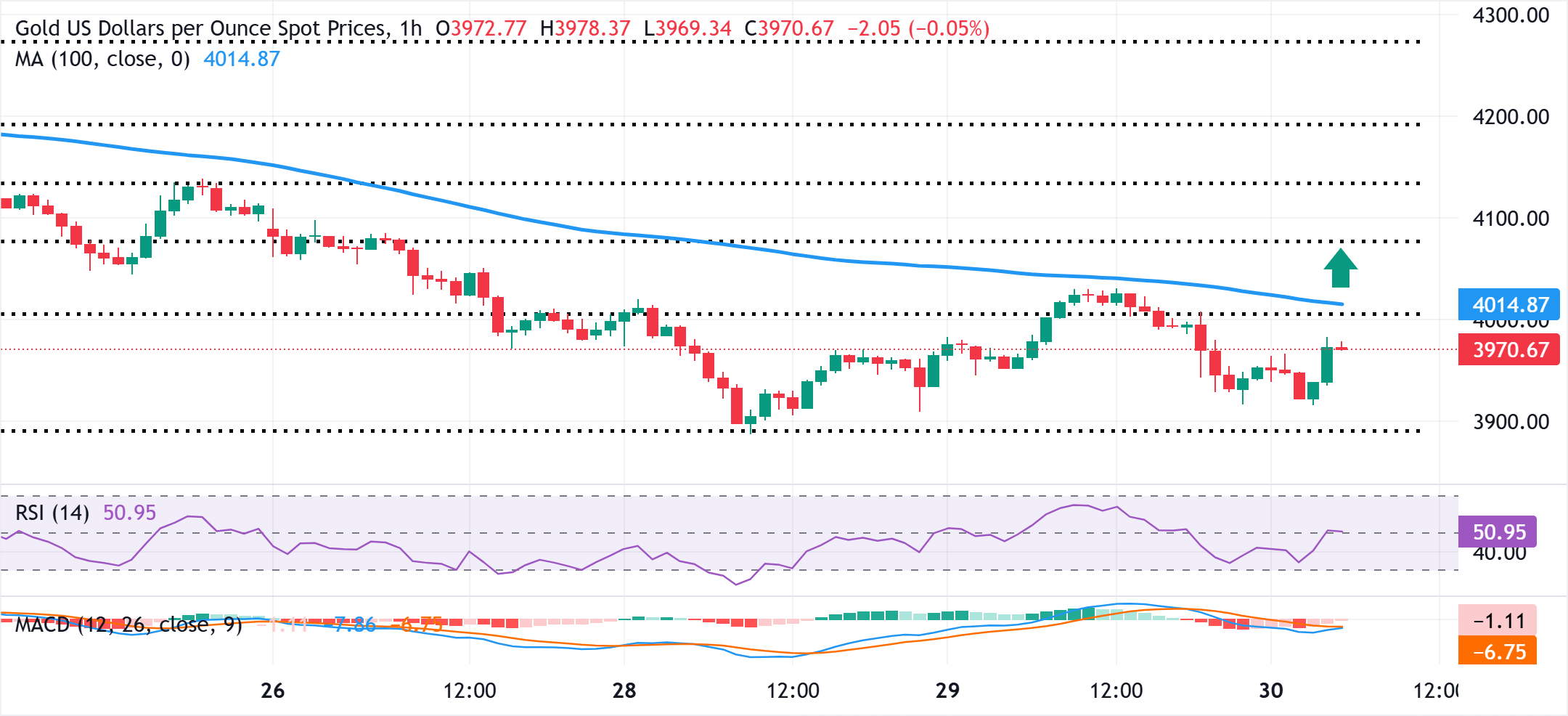
The overnight failure to find acceptance above the 23.6% Fibonacci retracement level of the recent corrective decline from the all-time high and the subsequent slide favor bearish traders. Moreover, oscillators on the daily chart have just started gaining negative traction, suggesting that any further move up might still be seen as a selling opportunity near the $4,000 psychological mark, or the 23.6% Fibo. level. This is closely followed by the 100-hour Simple Moving Average (SMA), around the $4,016 area, above which the Gold price could climb to the $4058-4,060 hurdle en route to the $4,075 region (38.2% Fibo. level) and the $4,100 mark.
On the flip side, weakness back below the $3,950 area might continue to find decent support near the $3,917-3,916 area ahead of the $3,900 round figure and the $3,886 zone, or an over three-week low touched on Tuesday. A convincing break below the latter could make the Gold price vulnerable to accelerate the fall towards the $3,850-3,845 intermediate support before eventually dropping to the $3,800 mark and the next relevant supports near the $3,765-3,760 zone, the $3,700 neighborhood.
US Dollar FAQs
The US Dollar (USD) is the official currency of the United States of America, and the ‘de facto’ currency of a significant number of other countries where it is found in circulation alongside local notes. It is the most heavily traded currency in the world, accounting for over 88% of all global foreign exchange turnover, or an average of $6.6 trillion in transactions per day, according to data from 2022. Following the second world war, the USD took over from the British Pound as the world’s reserve currency. For most of its history, the US Dollar was backed by Gold, until the Bretton Woods Agreement in 1971 when the Gold Standard went away.
The most important single factor impacting on the value of the US Dollar is monetary policy, which is shaped by the Federal Reserve (Fed). The Fed has two mandates: to achieve price stability (control inflation) and foster full employment. Its primary tool to achieve these two goals is by adjusting interest rates. When prices are rising too quickly and inflation is above the Fed’s 2% target, the Fed will raise rates, which helps the USD value. When inflation falls below 2% or the Unemployment Rate is too high, the Fed may lower interest rates, which weighs on the Greenback.
In extreme situations, the Federal Reserve can also print more Dollars and enact quantitative easing (QE). QE is the process by which the Fed substantially increases the flow of credit in a stuck financial system. It is a non-standard policy measure used when credit has dried up because banks will not lend to each other (out of the fear of counterparty default). It is a last resort when simply lowering interest rates is unlikely to achieve the necessary result. It was the Fed’s weapon of choice to combat the credit crunch that occurred during the Great Financial Crisis in 2008. It involves the Fed printing more Dollars and using them to buy US government bonds predominantly from financial institutions. QE usually leads to a weaker US Dollar.
Quantitative tightening (QT) is the reverse process whereby the Federal Reserve stops buying bonds from financial institutions and does not reinvest the principal from the bonds it holds maturing in new purchases. It is usually positive for the US Dollar.
Author

Haresh Menghani
FXStreet
Haresh Menghani is a detail-oriented professional with 10+ years of extensive experience in analysing the global financial markets.