Gold trades slightly higher as Fed interest rate decision takes center stage
- Gold rebounds as traders position cautiously ahead of the Fed interest rate decision.
- Markets widely expect the Fed to deliver a second consecutive 25 bps interest rate cut, lowering the target range to 3.75%-4.00%.
- US-China trade optimism builds ahead of the Trump-Xi meeting on Thursday at the APEC Summit in South Korea.

Gold (XAU/USD) stages a modest recovery on Wednesday, after briefly slipping to a three-week low near $3,886 on Tuesday. The rebound comes as traders cautiously reposition ahead of the Federal Reserve’s (Fed) interest rate decision at 18:00 GMT. At the time of writing, XAU/USD is trading around $3,995, up nearly 1.0%, snapping a three-day losing streak as investors rotate back into safe-haven assets.
Gold’s recent weakness was largely driven by a risk-on tone fueled by optimism surrounding US-China trade progress, which weighed on demand for the precious metal. The decline saw the metal shed nearly 10% from last week’s all-time high of $4,381 before finding support around the $3,900 mark.
However, with the Fed’s monetary policy announcement now in focus, traders are reassessing their positions as the US central bank is widely expected to deliver a second consecutive 25-basis-point (bps) interest rate cut. The move would lower the target range to 3.75%-4.00%, following September’s so-called “risk-management” rate cut aimed at cushioning the economy from labor market headwinds.
While the rate cut is seen as a done deal, the spotlight will fall on the accompanying monetary policy statement and Chair Jerome Powell’s post-meeting press conference, which are expected to guide market expectations for further easing in December. Any signal of a prolonged easing cycle could extend Gold’s rebound, while a cautious tone may cap upside momentum.
Market movers: Fed takes center stage ahead of Trump-Xi talks
- The US Dollar (USD) and Treasury yields trade mixed ahead of the Fed’s monetary policy outcome. The US Dollar Index (DXY), which tracks the Greenback’s value against a basket of six major currencies, is easing from its intraday high of 99.01 to trade around 98.71, while the benchmark 10-year US Treasury yield is up 2.0 basis points at 3.997%.
- The Fed faces a delicate situation amid limited labor market data due to the ongoing United States (US) government shutdown. However, Automatic Data Processing (ADP) announced it will begin releasing a preliminary weekly employment estimate every Tuesday. In its first release, ADP estimated that US private employers added roughly 14,250 jobs per week over the four weeks ending October 11.
- Amid the US government shutdown-driven data drought, last week’s delayed Consumer Price Index (CPI) report showed headline inflation rising 0.3% MoM in September, below the 0.4% forecast, while annual CPI held at 3.0%. Core CPI rose 0.2% MoM and 3.0% YoY, both softer than expectations, reinforcing prospects for further monetary easing.
- At the September meeting, the Fed noted that economic activity had moderated in the first half of the year, with job gains slowing and unemployment edging higher while inflation remained somewhat elevated. The Committee reaffirmed its dual mandate of maximum employment and 2% inflation over the longer run. Fed Governor Stephen Miran was the lone dissenter, favouring a deeper 50-basis-point cut, and is expected to once again push for a more aggressive easing stance at today’s meeting.
- Beyond the Fed, focus also turns to geopolitics as US President Donald Trump and Chinese President Xi Jinping are set to meet on Thursday at the sidelines of the APEC Summit in South Korea. Speaking on Wednesday, Trump said, “President Xi of China is coming tomorrow here, and we’re going to be, I hope, making a deal — I think it’ll be a good deal for both,” fuelling optimism over a potential trade breakthrough between Washington and Beijing.
Technical analysis:
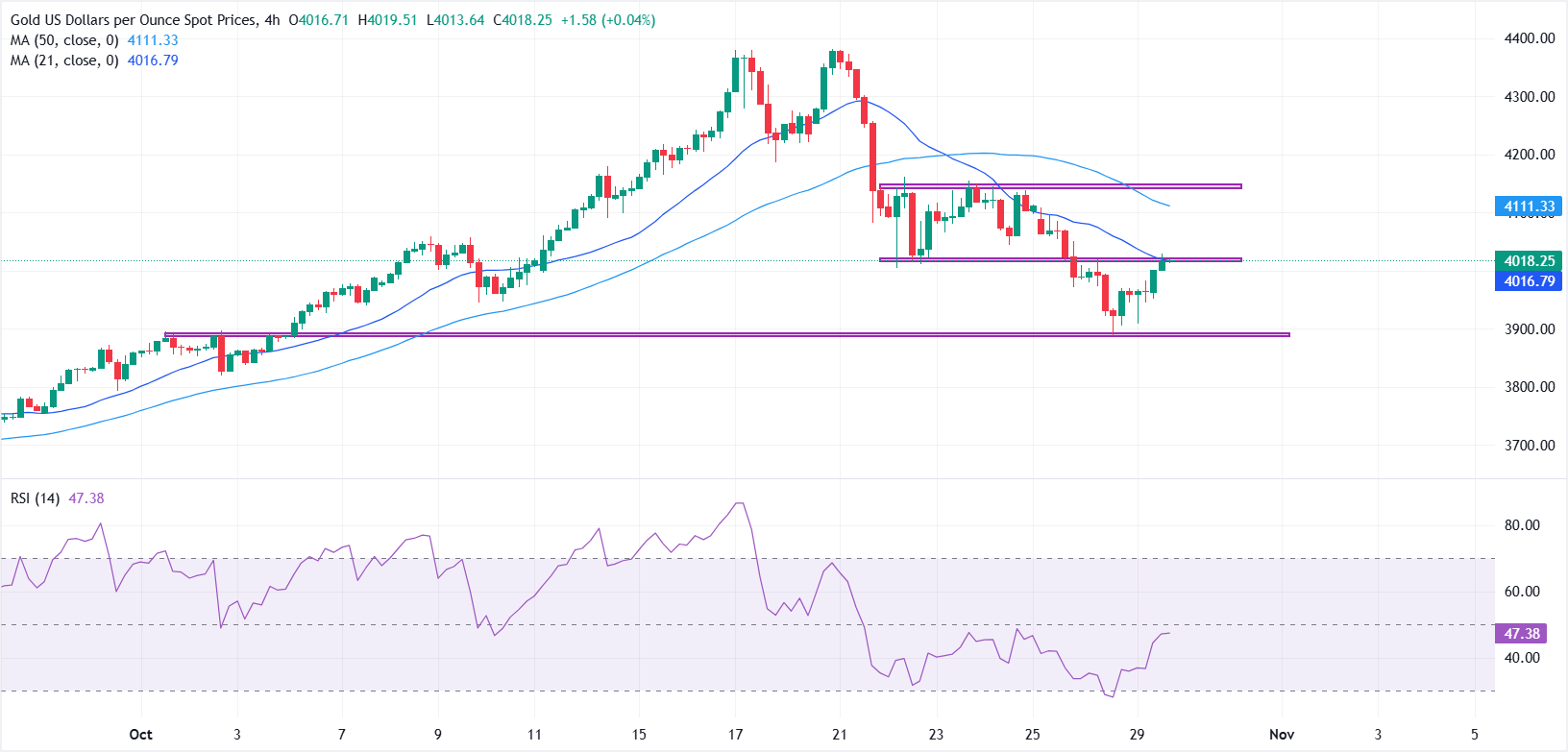
XAU/USD is attempting to stabilize above $4,000, but the rebound remains fragile. On the 4-hour chart, immediate resistance is seen in the $4,020–$4,050 zone, a former support area now reinforced by the 21-period Simple Moving Average (SMA). A decisive break above this region could open the door toward the next resistance at $4,100–$4,150, which aligns with the 50-period SMA.
On the downside, the $4,000 level remains a crucial pivot. A sustained break below this threshold would expose the next support at $3,900.
The Relative Strength Index (RSI) is turning higher, recovering from oversold territory but still below the neutral 50 mark, suggesting limited bullish momentum and warranting some caution. The Fed’s interest rate decision later today is likely to dictate the next directional move for the yellow metal.
US Dollar Price Today
The table below shows the percentage change of US Dollar (USD) against listed major currencies today. US Dollar was the strongest against the Swiss Franc.
| USD | EUR | GBP | JPY | CAD | AUD | NZD | CHF | |
|---|---|---|---|---|---|---|---|---|
| USD | 0.07% | 0.38% | 0.06% | -0.05% | -0.12% | 0.03% | 0.43% | |
| EUR | -0.07% | 0.32% | 0.00% | -0.11% | -0.19% | -0.03% | 0.36% | |
| GBP | -0.38% | -0.32% | -0.32% | -0.43% | -0.52% | -0.35% | 0.04% | |
| JPY | -0.06% | 0.00% | 0.32% | -0.12% | -0.19% | -0.03% | 0.36% | |
| CAD | 0.05% | 0.11% | 0.43% | 0.12% | -0.09% | 0.08% | 0.47% | |
| AUD | 0.12% | 0.19% | 0.52% | 0.19% | 0.09% | 0.16% | 0.55% | |
| NZD | -0.03% | 0.03% | 0.35% | 0.03% | -0.08% | -0.16% | 0.40% | |
| CHF | -0.43% | -0.36% | -0.04% | -0.36% | -0.47% | -0.55% | -0.40% |
The heat map shows percentage changes of major currencies against each other. The base currency is picked from the left column, while the quote currency is picked from the top row. For example, if you pick the US Dollar from the left column and move along the horizontal line to the Japanese Yen, the percentage change displayed in the box will represent USD (base)/JPY (quote).
Author

Vishal Chaturvedi
FXStreet
I am a macro-focused research analyst with over four years of experience covering forex and commodities market. I enjoy breaking down complex economic trends and turning them into clear, actionable insights that help traders stay ahead of the curve.

















