Gold firm above $4,200 on broad dovish repricing for December
- Gold breaks above $4,200 as markets price 87% odds of a December Fed rate cut.
- Dovish comments from Fed’s Williams and Waller strengthen expectations for continued easing policy.
- Russia–Ukraine peace progress may cap gains, though soft US inflation keeps Gold’s bias intact.

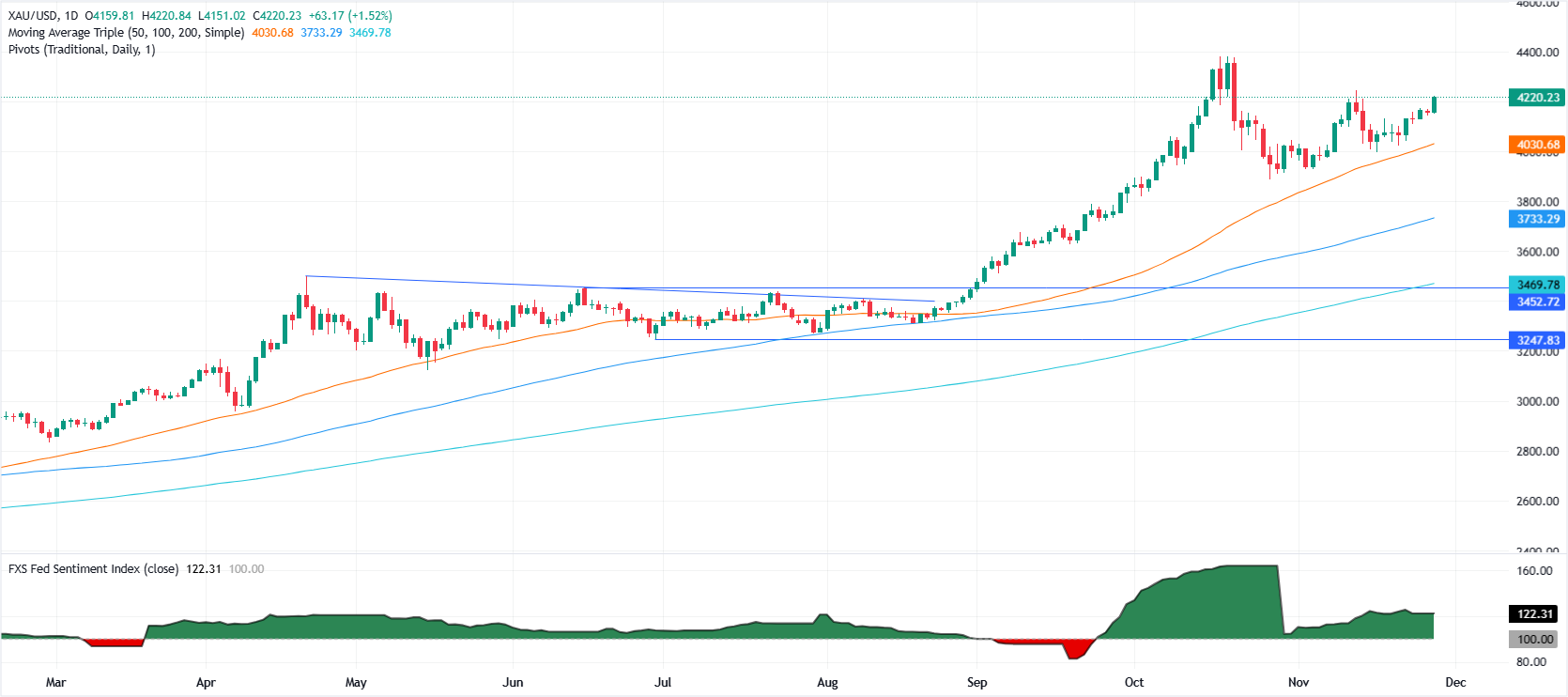
Gold (XAU/USD) rises over 1% on Friday amid a scarce economic docket, but traders are pricing further easing by the Federal Reserve (Fed) at the next meeting, pushing the non-yielding metal past the $4,200 mark for the first time in the last ten days.
Bullion surges over 1% in thin holiday trade as easing expectations climb toward 87% despite mixed US data
Expectations that the Federal Reserve would continue its easing cycle increased as the CME FedWatch Tool shows odds for a 0.25% reduction at the December 9-10 meeting at 87%,. Meanwhile, Fed officials remained muted since Wednesday, heading for Thanksgiving, as the blackout period begins on Saturday.
Policymakers at the Federal Open Market Committee (FOMC) remain split about the next move. Nonetheless, the latest comments from New York Fed John Williams and Fed Governor Christopher Waller poured cold water on the hawks and strengthened the doves' position ahead of the meeting.
US data has been mixed, with inflation on the producer side seeming to be stalling after the PPI rose to 3.1% YoY in July, before printing back-to-back readings of 2.7%. Even though this opens the door for further easing, the latest Initial Jobless Claims print shows the jobs market remains solid, despite giving signs of weakness.
Given the backdrop, Gold prices could continue to edge up. However, developments pointing towards peace talks between Russia and Ukraine, led by the White House, could cap bullion’s advance amid an obvious sentiment shift.
Next week, the US economic docket will feature the November ISM Manufacturing and Services PMIs, Industrial Production, the ADP Employment Change and Initial Jobless Claims for the week ending November 29.
Daily market moves: Gold advances, but threatened by Russia-Ukraine war de-escalation
- The US Dollar Index (DXY), which tracks the buck’s performance versus six currencies, is down 0.04% at 99.49. At the same time, US Treasury yields recovered, with the 10-year US Treasury note yield up three basis points to 4.023%. US real yields, which correlate inversely to Gold prices, are also up two and a half basis points to 1.785%.
- Ukrainian President Zelensky said that Ukraine and US delegations will meet this week to work out a formula for peace and security, as discussed in Geneva. Meanwhile, Russia wants to move towards peace in Ukraine, despite its belief that Ukrainian President Zelensky is not legitimate.
- Russian President Vladimir Putin said Thursday that President Donald Trump’s proposal “could serve as a basis” for future negotiations but emphasized that no final version exists. Putin reiterated that hostilities will cease only if Ukrainian forces withdraw.
- Physical Gold exports from Hong Kong to China dipped, an indication that the Bullion might remain subdued in the near term.
Technical analysis: Buyers push Gold price above $4,200, eyes on record high
Gold price cleared $4,200, poised to test the November 13 high of $4,245 ahead of the $4,250 figure. Buyers are gathering momentum, as depicted by the Relative Strength Index (RSI), suggesting further upside.
Given the backdrop, if XAU/USD climbs past $4,300, the next resistance would be the record high of $4,381. On the flip side, if Gold tumbles below $4,200, the next support would be the November 25 low of $4,109, followed by the 20-day Simple Moving Average (SMA) at $4,078.
Gold FAQs
Gold has played a key role in human’s history as it has been widely used as a store of value and medium of exchange. Currently, apart from its shine and usage for jewelry, the precious metal is widely seen as a safe-haven asset, meaning that it is considered a good investment during turbulent times. Gold is also widely seen as a hedge against inflation and against depreciating currencies as it doesn’t rely on any specific issuer or government.
Central banks are the biggest Gold holders. In their aim to support their currencies in turbulent times, central banks tend to diversify their reserves and buy Gold to improve the perceived strength of the economy and the currency. High Gold reserves can be a source of trust for a country’s solvency. Central banks added 1,136 tonnes of Gold worth around $70 billion to their reserves in 2022, according to data from the World Gold Council. This is the highest yearly purchase since records began. Central banks from emerging economies such as China, India and Turkey are quickly increasing their Gold reserves.
Gold has an inverse correlation with the US Dollar and US Treasuries, which are both major reserve and safe-haven assets. When the Dollar depreciates, Gold tends to rise, enabling investors and central banks to diversify their assets in turbulent times. Gold is also inversely correlated with risk assets. A rally in the stock market tends to weaken Gold price, while sell-offs in riskier markets tend to favor the precious metal.
The price can move due to a wide range of factors. Geopolitical instability or fears of a deep recession can quickly make Gold price escalate due to its safe-haven status. As a yield-less asset, Gold tends to rise with lower interest rates, while higher cost of money usually weighs down on the yellow metal. Still, most moves depend on how the US Dollar (USD) behaves as the asset is priced in dollars (XAU/USD). A strong Dollar tends to keep the price of Gold controlled, whereas a weaker Dollar is likely to push Gold prices up.
Author

Christian Borjon Valencia
FXStreet
Markets analyst, news editor, and trading instructor with over 14 years of experience across FX, commodities, US equity indices, and global macro markets.

















