Gold falls to major trendline on USD strength, asset reallocation, risk-on
- Gold falls to key support from a major trendline for the long-term uptrend at $2,600.
- A strong US Dollar is reducing the price of Gold, whilst competition from Bitcoin and stocks is also bearish.
- Expectations for the Federal Reserve slowing the pace of interest rate cuts and reduced safe-haven demand could also weigh on Gold’s price.
Gold (XAU/USD) trades at seven-week lows around $2,600 as it finds support from a major trendline on Tuesday. A stronger US Dollar (USD) puts pressure on the precious metal due to market perceptions that President-elect Donald Trump’s economic policies will be positive for the Greenback. Given Gold is mainly priced and traded in US Dollars, a stronger USD alone is often enough to bring down its price.
Trump’s pledges to impose tariffs on imports, reduce taxes, and deport millions of illegal immigrants are likely to push up prices in the US and drive higher inflation. This would likely lead to the US Federal Reserve (Fed) slowing the pace of interest rate cuts as it tries to combat the resulting inflation. Relatively higher interest rates are negative for Gold since they increase the opportunity cost of holding the non-interest paying asset.
Market-based gauges are already showing a 31% probability the Fed will leave interest rates unchanged at their December meeting when previously they had shown a 100% probability of at least a quarter percent reduction, according to the CME FedWatch tool.
Gold price falls as competition from Bitcoin and Stocks bites
Gold is also falling due to competition from alternative assets such as Bitcoin (BTC), which keeps pushing to new all-time highs in the $80,000s because of expectations of laxer crypto regulation under the Trump administration.
US stocks are rising as investors anticipate lower corporation tax and looser regulations boosting company profits.
Impact on safe-haven flows
The perception that Trump will be able to bring an end to the Ukraine-Russia war, which he boasted he could settle “in one day – 24 hours,” might also be reducing safe-haven demand for Gold.
In a private call after his election victory, Trump supposedly warned Putin “not to escalate in Ukraine”, according to The Washington Post. However, this was later denied by the Kremlin who called such reports “pure fiction”, according to the BBC.
The war in the Middle East looks far from over as Trump strengthens ties with regional ally Israel, which is likely to stoke further enmity from Iran and its proxies. The latest reports suggest Israel is stepping up its bombardment of the Gaza Strip and Lebanon with a dawn raid killing at least 17 Palestinians in Gaza, “including 11 displaced people in the so-called “safe zone” of al-Mawasi,” according to Al Jazeera News, as well as 14 people in a northern Lebanese town far from the Israel-Lebanon border.
Technical Analysis: XAU/USD falls to support at major trendline
Gold falls to support from a major trendline for its long-term uptrend situated at around the $2,600 mark.
The precious metal has broken below the 50-day Simple Moving Average (SMA) at $2,648 and is now in a short-term downtrend. Given it is a principle of technical analysis that “the trend is your friend,” the odds favor a continuation lower.
XAU/USD Daily Chart
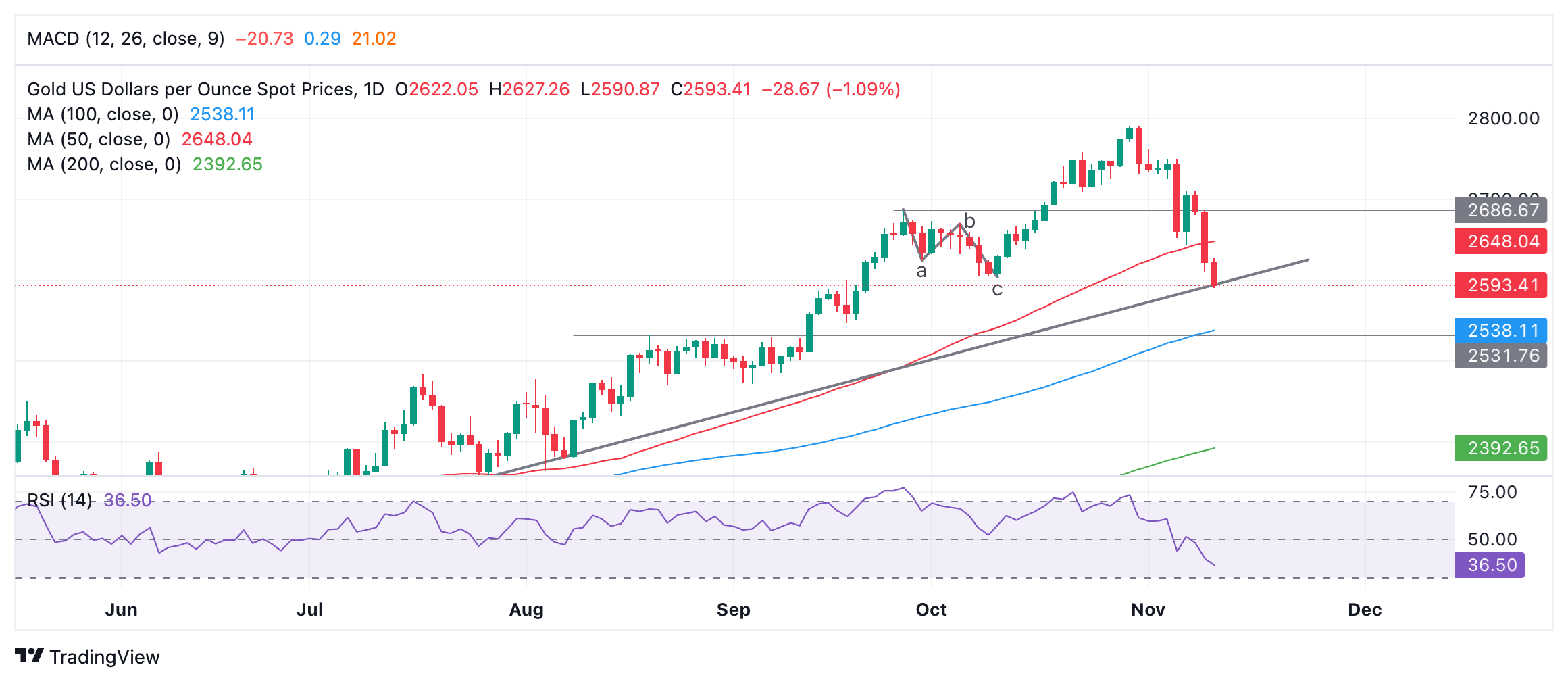
A decisive break below the major trendline would confirm an extension of the downtrend, probably to the next target at $2,538, the 100-day SMA and August highs.
A decisive break would be one accompanied by a longer-than-average red candle that pierced well below the trendline and closed near its low, or three red candles that broke clearly below the trendline.
However, the precious metal remains in an uptrend on a medium and long-term basis, giving the material risk of a reversal higher in line with these broader up cycles. Still, there are no signs currently of such a resumption as price action remains bearish for the time being.
Gold FAQs
Gold has played a key role in human’s history as it has been widely used as a store of value and medium of exchange. Currently, apart from its shine and usage for jewelry, the precious metal is widely seen as a safe-haven asset, meaning that it is considered a good investment during turbulent times. Gold is also widely seen as a hedge against inflation and against depreciating currencies as it doesn’t rely on any specific issuer or government.
Central banks are the biggest Gold holders. In their aim to support their currencies in turbulent times, central banks tend to diversify their reserves and buy Gold to improve the perceived strength of the economy and the currency. High Gold reserves can be a source of trust for a country’s solvency. Central banks added 1,136 tonnes of Gold worth around $70 billion to their reserves in 2022, according to data from the World Gold Council. This is the highest yearly purchase since records began. Central banks from emerging economies such as China, India and Turkey are quickly increasing their Gold reserves.
Gold has an inverse correlation with the US Dollar and US Treasuries, which are both major reserve and safe-haven assets. When the Dollar depreciates, Gold tends to rise, enabling investors and central banks to diversify their assets in turbulent times. Gold is also inversely correlated with risk assets. A rally in the stock market tends to weaken Gold price, while sell-offs in riskier markets tend to favor the precious metal.
The price can move due to a wide range of factors. Geopolitical instability or fears of a deep recession can quickly make Gold price escalate due to its safe-haven status. As a yield-less asset, Gold tends to rise with lower interest rates, while higher cost of money usually weighs down on the yellow metal. Still, most moves depend on how the US Dollar (USD) behaves as the asset is priced in dollars (XAU/USD). A strong Dollar tends to keep the price of Gold controlled, whereas a weaker Dollar is likely to push Gold prices up.
Author

Joaquin Monfort
FXStreet
Joaquin Monfort is a financial writer and analyst with over 10 years experience writing about financial markets and alt data. He holds a degree in Anthropology from London University and a Diploma in Technical analysis.
















