Gold falls for fourth day as US–EU trade deal boosts US Dollar, yields
- Gold weighed down by DXY surging nearly 1% as US 10-year yield climbs to 4.41%.
- US–EU deal cuts tariffs from 30% to 15%, easing trade tensions and lifting the US Dollar.
- Focus shifts to Fed rate decision, US GDP, jobs, and Core PCE data this week.


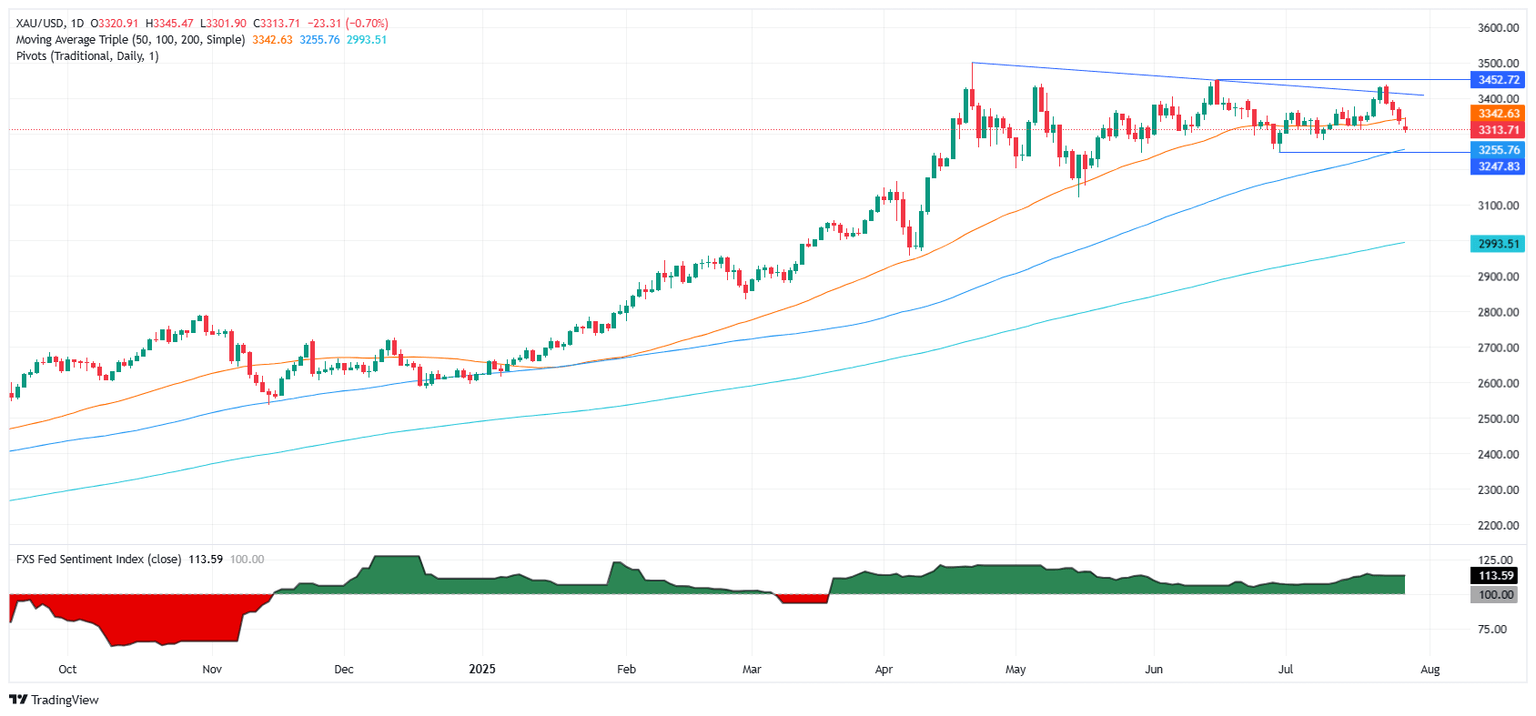
Gold price extended its losses for the fourth consecutive trading day, down more than 0.60%, as the European Union (EU) and the United States (US) reached a trade agreement over the weekend, reducing duties on EU goods from a proposed 30% to 15%. The XAU/USD trades at $3,312 after reaching a daily high of $3,345.
Market mood improved after the news of the trade deal. The US Dollar is staging a comeback as depicted by the US Dollar Index (DXY), which tracks the buck’s performance against six currencies and is up 0.99% at 98.64.
US Treasury yields are also showing signs of recovery, a headwind for Bullion prices. The US 10-year T-note yield is up 2.5 bps at 4.410%. US real yields are rising by nearly three basis points to 1.974%.
Although the US has reached deals with some major partners and shrugged off some trade uncertainty, the lack of progress with Canada and Mexico, two of the four largest trading partners, suggests that Gold bears are not out of the woods yet.
Traders' focus is on the Federal Reserve’s (Fed) monetary policy decision, expected on July 30. Investors had priced in a 99% chance of a hold but are awaiting Fed Chair Jerome Powell's press conference.
After this, the US economic docket will be packed with the release of Gross Domestic Product (GDP) figures, jobs data, the ISM Manufacturing PMI, and the Fed’s favorite inflation gauge, the Core Personal Consumption Expenditures (PCE) Price Index.
Daily digest market movers: Gold price on the backfoot on expectations for Fed hold
- Last week's US economic data, particularly employment, reaffirmed the Fed’s stance to keep the fed fund rate unchanged. This because inflation metrics had not resumed its downward trend toward the US central bank 2% goal.
- A Reuters poll revealed that market participants expect Gold price to average $3,320 a troy ounce in 2025 and $3,400 for 2026.
- The CME FedWatch Tool indicates that markets are pricing in a 63% chance of a 25-basis-point rate cut by the Fed at the September 17 meeting.
- Interest rate probability indicates that the Fed will maintain its current rates, with odds standing at 96% for a hold and 4% for a 25-basis-point rate cut at the July 30 meeting.
XAU/USD technical outlook: Gold dives below SMA confluence, eyes on $3,300
Gold is registering its fourth consecutive bearish session as prices fall below the 50-day Simple Moving Average (SMA) at $3,335. The Relative Strength Index (RSI) has turned bearish, indicating that the ongoing downtrend may continue. Nevertheless, from a market structure perspective, Gold’s trend remains upward.
If XAU/USD drops below $3,300, the next support would be the confluence of the 100-day Simple Moving Average (SMA) and the June 30 low near $3,244. A breach of the latter will expose $3,200 and the May 15 swing low of $3,120.
On the upside, if Gold reclaims $3,350, this clears the path toward $3,400, followed by the June 16 peak at $3,452 and ultimately the all-time high of $3,500.
Gold FAQs
Gold has played a key role in human’s history as it has been widely used as a store of value and medium of exchange. Currently, apart from its shine and usage for jewelry, the precious metal is widely seen as a safe-haven asset, meaning that it is considered a good investment during turbulent times. Gold is also widely seen as a hedge against inflation and against depreciating currencies as it doesn’t rely on any specific issuer or government.
Central banks are the biggest Gold holders. In their aim to support their currencies in turbulent times, central banks tend to diversify their reserves and buy Gold to improve the perceived strength of the economy and the currency. High Gold reserves can be a source of trust for a country’s solvency. Central banks added 1,136 tonnes of Gold worth around $70 billion to their reserves in 2022, according to data from the World Gold Council. This is the highest yearly purchase since records began. Central banks from emerging economies such as China, India and Turkey are quickly increasing their Gold reserves.
Gold has an inverse correlation with the US Dollar and US Treasuries, which are both major reserve and safe-haven assets. When the Dollar depreciates, Gold tends to rise, enabling investors and central banks to diversify their assets in turbulent times. Gold is also inversely correlated with risk assets. A rally in the stock market tends to weaken Gold price, while sell-offs in riskier markets tend to favor the precious metal.
The price can move due to a wide range of factors. Geopolitical instability or fears of a deep recession can quickly make Gold price escalate due to its safe-haven status. As a yield-less asset, Gold tends to rise with lower interest rates, while higher cost of money usually weighs down on the yellow metal. Still, most moves depend on how the US Dollar (USD) behaves as the asset is priced in dollars (XAU/USD). A strong Dollar tends to keep the price of Gold controlled, whereas a weaker Dollar is likely to push Gold prices up.
Author
Christian Borjon Valencia
FXStreet
Markets analyst, news editor, and trading instructor with over 14 years of experience across FX, commodities, US equity indices, and global macro markets.