Gold consolidates near all-time high as geopolitcal risks keep investors on edge
- Gold hits a fresh all-time high as trade war fears dominate markets.
- Bond market turmoil and fiscal concerns deepen risk aversion across global markets.
- XAU/USD remains firmly bid even as momentum indicators flash overbought signals.

Gold (XAU/USD) climbs to yet another record high on Wednesday as risk sentiment deteriorates across global markets, driving investors toward safe-haven assets amid rising geopolitical and economic uncertainty. At the time of writing, XAU/USD is consolidating around $4,855, after hitting a fresh all-time high near $4,888 earlier in the European session.
The metal’s bullish run shows little sign of slowing, with prices up more than 6% so far this week after US President Donald Trump reignited trade tensions with the European Union over control of Greenland.
The renewed rhetoric has raised fears of a broader trade war, with speculation growing that Europe could weaponize its vast holdings of US stocks and Treasuries, fueling “Sell America” sentiment.
The risk-off tone has been reinforced by turmoil in Japan’s sovereign bond market, where a sharp sell-off pushed long-dated yields to multi-decade highs and rattled global debt markets, including US Treasuries.
Ongoing volatility across bond markets is stoking concerns about the fiscal health of major economies, boosting demand for Gold as a hedge against macro and financial instability.
Market movers: Trade war fears dominate markets as US-EU tensions escalate
- Speaking at the World Economic Forum in Davos, US President Donald Trump reiterated his stance on Greenland, saying the territory is needed for strategic national security. Trump added that Greenland would not pose a threat to NATO, but would instead strengthen the alliance. He also dismissed concerns about military action, stating that he would not use force to acquire Greenland.
- US-EU tensions remain front and center after President Donald Trump threatened fresh tariffs on eight European nations, saying a 10% levy would be imposed from February 1 and raised to 25% in June unless “a deal is reached for the complete and total purchase of Greenland.”
- European leaders have pushed back against the tariff threats, reaffirming that the bloc stands ready to deploy countermeasures if needed. Attention has also turned to Europe’s large holdings of US assets, estimated at around $10 trillion, which some analysts say could be used as economic leverage if tensions escalate.
- On Tuesday, Danish pension fund AkademikerPension said it would sell off its holding of US Treasuries, worth about $100 million by month-end, because of “the poor US government finances.”
- The US Dollar Index (DXY), which tracks the Greenback's value against a basket of six major currencies, is trading flat around 98.50 after slipping to two-week lows on Tuesday.
- Focus is also on the US Supreme Court, which is set to hear arguments in a case linked to President Trump’s efforts to remove Federal Reserve (Fed) Governor Lisa Cook over mortgage-fraud allegations.
- The US data docket is thin on Wednesday, leaving markets sensitive to geopolitical headlines, with Pending Home Sales the only key release. Traders await the delayed Personal Consumption Expenditures (PCE) inflation data and the annualized third-quarter Gross Domestic Product (GDP) figures due on Thursday.
Technical analysis: XAU/USD stays bid despite stretched momentum signals
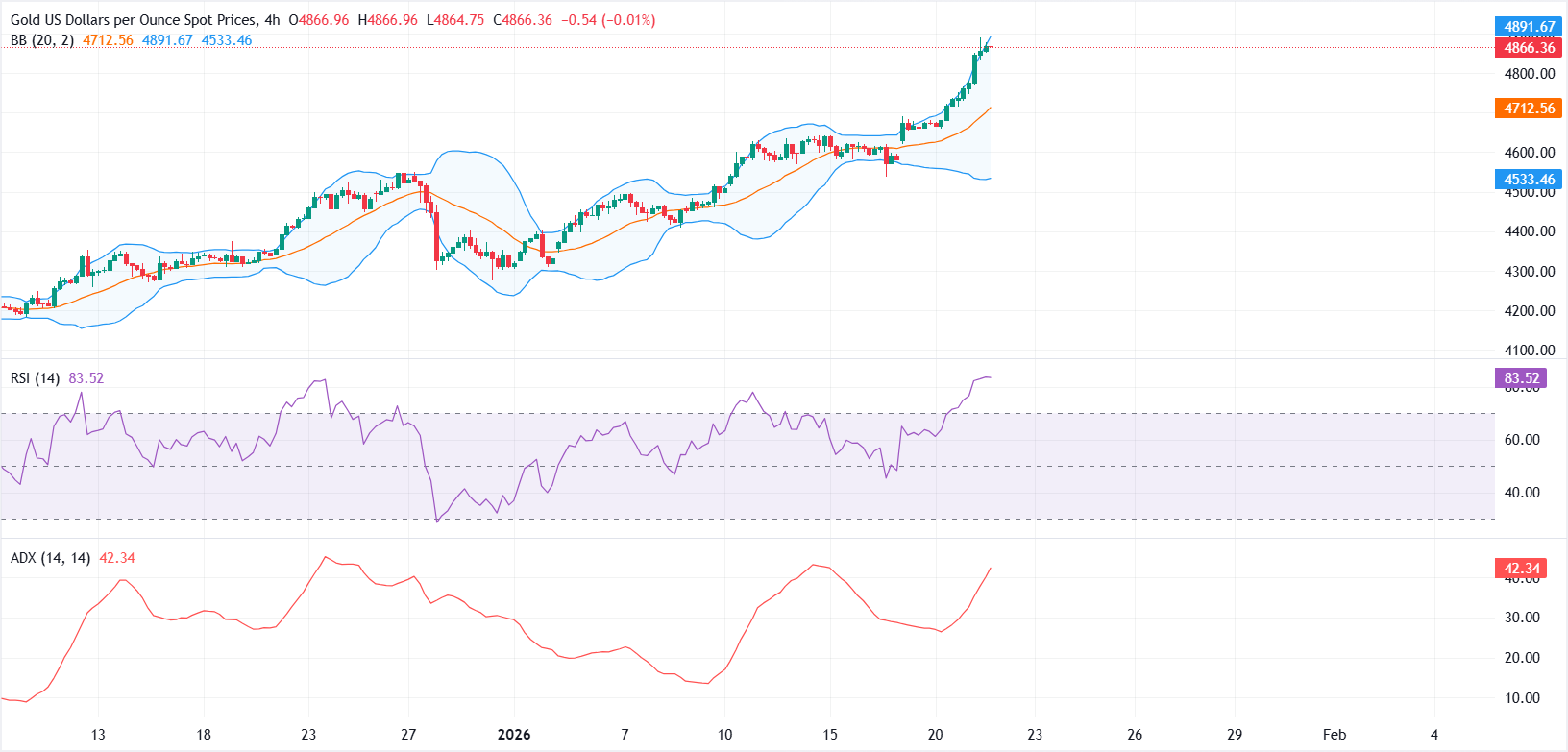
From a technical perspective, XAU/USD continues to navigate uncharted territory, with bulls refusing to step aside despite increasingly overbought conditions across multiple time frames.
On the 4-hour chart, the 20-period Simple Moving Average (SMA) within the Bollinger Band is sloping higher, reinforcing the bullish structure. Price action remains pressed against the upper Bollinger Band as the bands continue to widen, signaling stretched upside conditions and rising volatility.
A sustained move above the upper band near $4,868.15 would expose levels above $4,900, with $5,000 coming into view.
On the downside, the middle band around $4,699.64 marks the first layer of support, followed by the lower Bollinger Band near $4,531.13. As long as prices hold above that zone, the broader bullish bias would remain intact.
The Relative Strength Index (RSI) is near 83, deep in overbought territory and signaling the risk of a near-term pause or pullback. Still, trend strength remains firm, with the Average Directional Index (ADX) climbing toward 42, suggesting buyers remain in control despite stretched conditions.
Gold FAQs
Gold has played a key role in human’s history as it has been widely used as a store of value and medium of exchange. Currently, apart from its shine and usage for jewelry, the precious metal is widely seen as a safe-haven asset, meaning that it is considered a good investment during turbulent times. Gold is also widely seen as a hedge against inflation and against depreciating currencies as it doesn’t rely on any specific issuer or government.
Central banks are the biggest Gold holders. In their aim to support their currencies in turbulent times, central banks tend to diversify their reserves and buy Gold to improve the perceived strength of the economy and the currency. High Gold reserves can be a source of trust for a country’s solvency. Central banks added 1,136 tonnes of Gold worth around $70 billion to their reserves in 2022, according to data from the World Gold Council. This is the highest yearly purchase since records began. Central banks from emerging economies such as China, India and Turkey are quickly increasing their Gold reserves.
Gold has an inverse correlation with the US Dollar and US Treasuries, which are both major reserve and safe-haven assets. When the Dollar depreciates, Gold tends to rise, enabling investors and central banks to diversify their assets in turbulent times. Gold is also inversely correlated with risk assets. A rally in the stock market tends to weaken Gold price, while sell-offs in riskier markets tend to favor the precious metal.
The price can move due to a wide range of factors. Geopolitical instability or fears of a deep recession can quickly make Gold price escalate due to its safe-haven status. As a yield-less asset, Gold tends to rise with lower interest rates, while higher cost of money usually weighs down on the yellow metal. Still, most moves depend on how the US Dollar (USD) behaves as the asset is priced in dollars (XAU/USD). A strong Dollar tends to keep the price of Gold controlled, whereas a weaker Dollar is likely to push Gold prices up.
Author

Vishal Chaturvedi
FXStreet
I am a macro-focused research analyst with over four years of experience covering forex and commodities market. I enjoy breaking down complex economic trends and turning them into clear, actionable insights that help traders stay ahead of the curve.
















