EUR/USD wavers in range awaiting Trump's speech at the Davos forum
- EUR/USD consolidates previous gains above 1.1700 after being rejected at the 1.1760 area.
- The "Sell America" trade takes a breather ahead of Trump's speech at Davos.
- ECB President Christine Lagarde will also speak at the Davos Summit later on Wednesday.

EUR/USD is trading near 1.1728 at the time of writing, moderately higher in the daily chart and at a short distance from the nearly three-week highs, at 1.1765 reached on Tuesday. The Euro (EUR) consolidates previous gains with the US Dollar on the defensive, as investors hold their breath, ahead of US President Trump's speech at the Davos Economic Summit, due later on the day.
The common currency has been drawing support from the Greenback's weakness, with the market selling all US assets, after Trump threatened some European countries with additional tariffs for their opposition to his plans to purchase Greenland.
Investors are hoping that the meeting at the Davos World Economic Forum might help de-escalate tensions, although Trump's idea of disclosing private messages from European leaders has done little to calm things down.
European Central Bank (ECB) President Christine Lagarde will also take the stage somewhat later, although her speech has been overshadowed by the rising geopolitical tensions.
Euro Price Today
The table below shows the percentage change of Euro (EUR) against listed major currencies today. Euro was the strongest against the Swiss Franc.
| USD | EUR | GBP | JPY | CAD | AUD | NZD | CHF | |
|---|---|---|---|---|---|---|---|---|
| USD | 0.10% | 0.07% | -0.16% | 0.03% | -0.25% | -0.24% | 0.27% | |
| EUR | -0.10% | -0.02% | -0.26% | -0.07% | -0.35% | -0.31% | 0.17% | |
| GBP | -0.07% | 0.02% | -0.23% | -0.05% | -0.33% | -0.31% | 0.18% | |
| JPY | 0.16% | 0.26% | 0.23% | 0.19% | -0.09% | -0.07% | 0.42% | |
| CAD | -0.03% | 0.07% | 0.05% | -0.19% | -0.28% | -0.26% | 0.22% | |
| AUD | 0.25% | 0.35% | 0.33% | 0.09% | 0.28% | 0.02% | 0.53% | |
| NZD | 0.24% | 0.31% | 0.31% | 0.07% | 0.26% | -0.02% | 0.48% | |
| CHF | -0.27% | -0.17% | -0.18% | -0.42% | -0.22% | -0.53% | -0.48% |
The heat map shows percentage changes of major currencies against each other. The base currency is picked from the left column, while the quote currency is picked from the top row. For example, if you pick the Euro from the left column and move along the horizontal line to the US Dollar, the percentage change displayed in the box will represent EUR (base)/USD (quote).
Daily Digest Market Movers: Investors sell US assets amid the EU-US rift
- Trump's plans to take control of Greenland and his threat of additional tariffs to European countries opposing it have triggered sharp declines in the US Dollar and US Treasury bonds this week. The "Sell America" trade has taken a breather on Wednesday, with investors awaiting signs of de-escalation at the Davos meeting.
- Meanwhile, the European Parliament is considering suspending the trade deal with the US reached in July, in retaliation for threats over Greenland. "If he wants access to the single market at zero tariffs, be reliable," said Manfred Weber, president of the European People's Party on Tuesday.
- ECB's Lagarde is widely expected to reiterate that the bank is in a good place to respond to economic uncertainty and hint at a steady monetary policy for the foreseeable future.
- The US Supreme Court is hearing arguments in the Lisa Cook case on Wednesday, in another open front of President Trump's policy, his quest to gain control over the Federal Reserve's Monetary Policy Committee.
- During the European Session, ECB Governor, Jose Luis Escrivá, affirmed that there are no reasons to cut interest rates further and that monetary policy is likely to remain steady in the coming months.
- In the economic calendar on Tuesday, the German ZEW Survey revealed that the investors' sentiment about the German economy improved to 59.6 in January, its best reading in more than four years, from 45.8 in December, beating expectations of a 50 reading. The sentiment about the current situation has improved to -72.7 from -81 in the previous month, also above the -75.5 market consensus.
- In the US, the weekly ADP Employment Change showed an 8K increase in net jobs in the four weeks before December 27, down from 11.25K in the previous four weeks, confirming that employment creation remains at low levels.
Technical Analysis: EUR/USD consolidates gains above the 1.1700 area
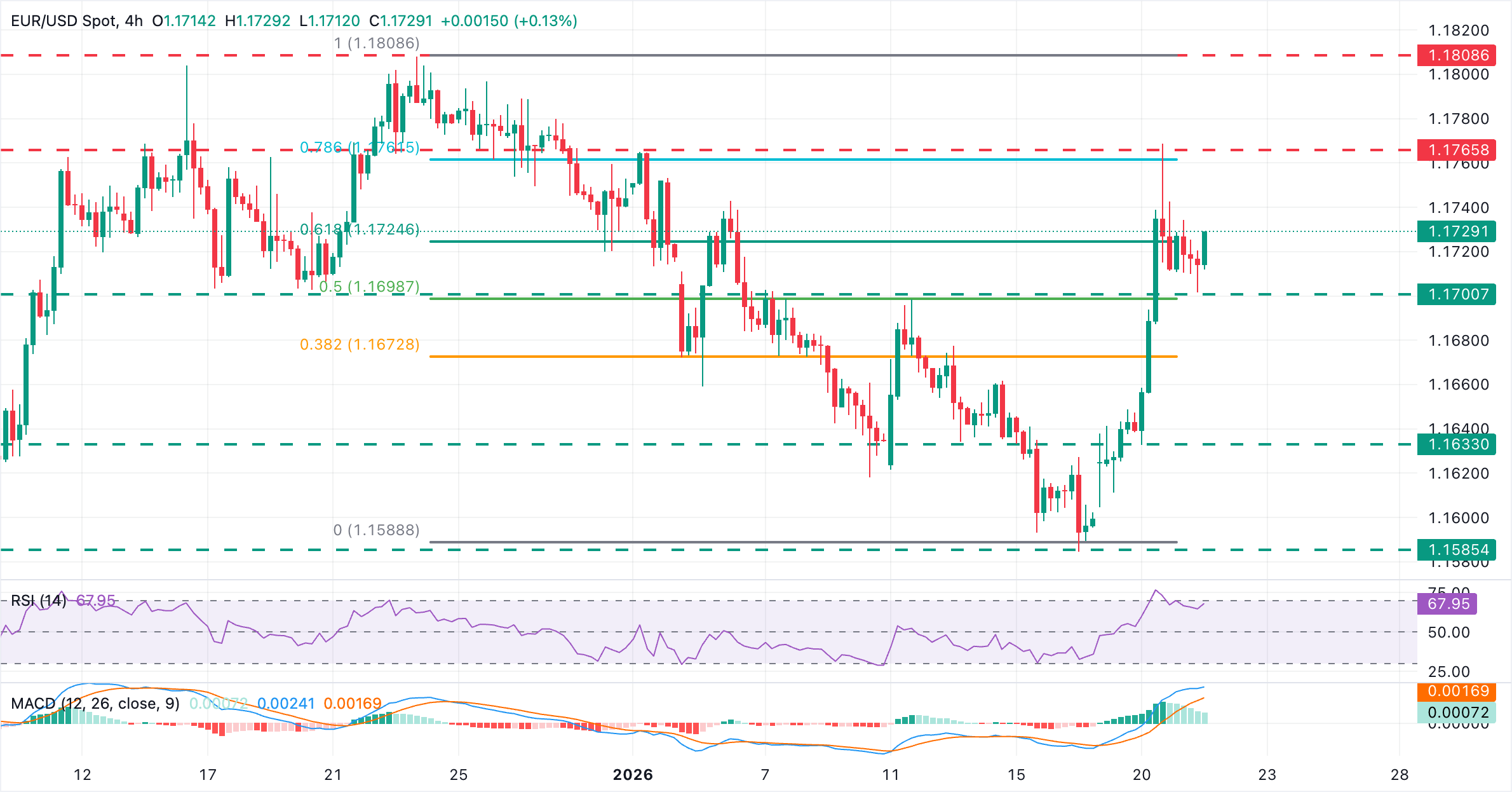
EUR/USD recovery met resistance at the 78.6% Fibonacci retracement of the early January sell-off, at 1.1761, and is consolidating gains above the 1.1700 area at the time of writing. Technical indicators remain bullish. The Moving Average Convergence Divergence (MACD) holds above the zero line on the 4-hour chart, and the Relative Strength Index (RSI) prints 67, just shy of overbought territory, which reinforces a positive bias.
Immediate support is at the intra-day low of 1.1710, which closes the path towards Tuesday's low, near 1.1630, and the January 16 low, at 1.1585.
On the upside, immediate resistance is in the area between the mentioned 76.8% Fibonacci retracement, at 1.1761, and the January 2 high at 1.1765. Further up, the target is the December 24 high, right above 1.1800.
(The technical analysis of this story was written with the help of an AI tool.)
Euro FAQs
The Euro is the currency for the 20 European Union countries that belong to the Eurozone. It is the second most heavily traded currency in the world behind the US Dollar. In 2022, it accounted for 31% of all foreign exchange transactions, with an average daily turnover of over $2.2 trillion a day. EUR/USD is the most heavily traded currency pair in the world, accounting for an estimated 30% off all transactions, followed by EUR/JPY (4%), EUR/GBP (3%) and EUR/AUD (2%).
The European Central Bank (ECB) in Frankfurt, Germany, is the reserve bank for the Eurozone. The ECB sets interest rates and manages monetary policy. The ECB’s primary mandate is to maintain price stability, which means either controlling inflation or stimulating growth. Its primary tool is the raising or lowering of interest rates. Relatively high interest rates – or the expectation of higher rates – will usually benefit the Euro and vice versa. The ECB Governing Council makes monetary policy decisions at meetings held eight times a year. Decisions are made by heads of the Eurozone national banks and six permanent members, including the President of the ECB, Christine Lagarde.
Eurozone inflation data, measured by the Harmonized Index of Consumer Prices (HICP), is an important econometric for the Euro. If inflation rises more than expected, especially if above the ECB’s 2% target, it obliges the ECB to raise interest rates to bring it back under control. Relatively high interest rates compared to its counterparts will usually benefit the Euro, as it makes the region more attractive as a place for global investors to park their money.
Data releases gauge the health of the economy and can impact on the Euro. Indicators such as GDP, Manufacturing and Services PMIs, employment, and consumer sentiment surveys can all influence the direction of the single currency. A strong economy is good for the Euro. Not only does it attract more foreign investment but it may encourage the ECB to put up interest rates, which will directly strengthen the Euro. Otherwise, if economic data is weak, the Euro is likely to fall. Economic data for the four largest economies in the euro area (Germany, France, Italy and Spain) are especially significant, as they account for 75% of the Eurozone’s economy.
Another significant data release for the Euro is the Trade Balance. This indicator measures the difference between what a country earns from its exports and what it spends on imports over a given period. If a country produces highly sought after exports then its currency will gain in value purely from the extra demand created from foreign buyers seeking to purchase these goods. Therefore, a positive net Trade Balance strengthens a currency and vice versa for a negative balance.
Author

Guillermo Alcala
FXStreet
Graduated in Communication Sciences at the Universidad del Pais Vasco and Universiteit van Amsterdam, Guillermo has been working as financial news editor and copywriter in diverse Forex-related firms, like FXStreet and Kantox.

















