Gold prices retreat after Trump and Xi engage in trade talks
- Gold prices ease after US President Trump confirmed that he had a "very good call" with President Xi.
- Positive developments and renewed hopes for a de-escalation of trade tensions have resulted in a pullback in Gold prices.
- Gold prices remain above the $3,350 psychological level ahead of Friday's important release of US Nonfarm Payrolls (NFP).

Gold prices are holding firm on Thursday, supported by easing geopolitical tensions, dovish central bank signals and ongoing weakness in US labour market data, factors that continue to drive demand for safe-haven assets.
After testing the key $3,400 psychological level during the European session, prices pulled back slightly but remain elevated as markets digest positive developments. US President Donald Trump announced via Truth Social that he had a productive and positive 90-minute phone call with Chinese President Xi Jinping, during which they discussed the details of a recently finalized trade deal. The potential de-escalation of trade tensions helped stabilize sentiment across risk-sensitive markets.
The phone call between Presidents Xi and Trump took place just hours before German Chancellor Friedrich Merz’s scheduled visit to the White House, where he is expected to press Trump to ease tariffs on European exports amid growing global trade tensions.
Meanwhile, the European Central Bank (ECB) delivered a widely expected 25 basis-point rate cut, followed by a press conference where President Christine Lagarde struck a cautious tone, warning that “while Euro area banks remain resilient, broader financial stability risks remain elevated.” In the US, economic data continued to show signs of a cooling labor market, with Initial Jobless Claims rising to 247,000, above the expected 235,000. Markets now await Friday’s Nonfarm Payrolls (NFP) report, which is forecast to show a slowdown in hiring to 130,000 jobs in May from 177,000 in April, with the unemployment rate expected to hold at 4.2%. Weaker employment data may increase expectations of a Federal Reserve rate cut in July, although market participants continue to bet on a cut in September, according to the FedWatch tool. For non-yielding assets like Gold, a lower interest rate environment reduces opportunity costs, providing a strong fundamental tailwind for prices.
Gold daily digest: ECB rate decision, trade talks, and US employment data ahead
- While the 25 bps rate cut was widely expected from the ECB, market focus shifted to the Monetary Policy Statement and Press Conference, where ECB President Christine Lagarde struck a cautious tone, noting that "while Euro area banks remain resilient, broader financial stability risks remain elevated."
- Softening labor data is reshaping market expectations for the Federal Reserve’s policy path. While a September rate cut is currently priced in, persistent weakness could bring forward rate cuts to July. This environment supports non-yielding assets, such as gold, as lower interest rates reduce opportunity costs and act as a bullish driver.
- The weak ADP employment data released on Wednesday showed that just 37K jobs were added to the US private sector in May.
- Market sentiment remains cautious due to a series of developments, including the US tariff increase on steel and aluminum from 25% to 50%, which took effect on Wednesday. The growing tariff threats and escalating trade tensions have posed a significant risk to risk assets, while a weaker US Dollar has been supportive of Gold prices.
- On Thursday, Reuters reported that Canadian Prime Minister called US tariffs “illegal” while Mexico and the European Union expressed similar frustration.
- On Wednesday, Mexican President Claudia Sheinbaum called the new tariffs "unjust, unsustainable, and without legal grounds," warning that if a deal is not reached, Mexico will be forced to respond with retaliatory measures.
- Canada and the EU have also threatened to retaliate if no progress is made in trade talks this week.
Gold technical analysis: Bulls retreat from psychological resistance at $3,400
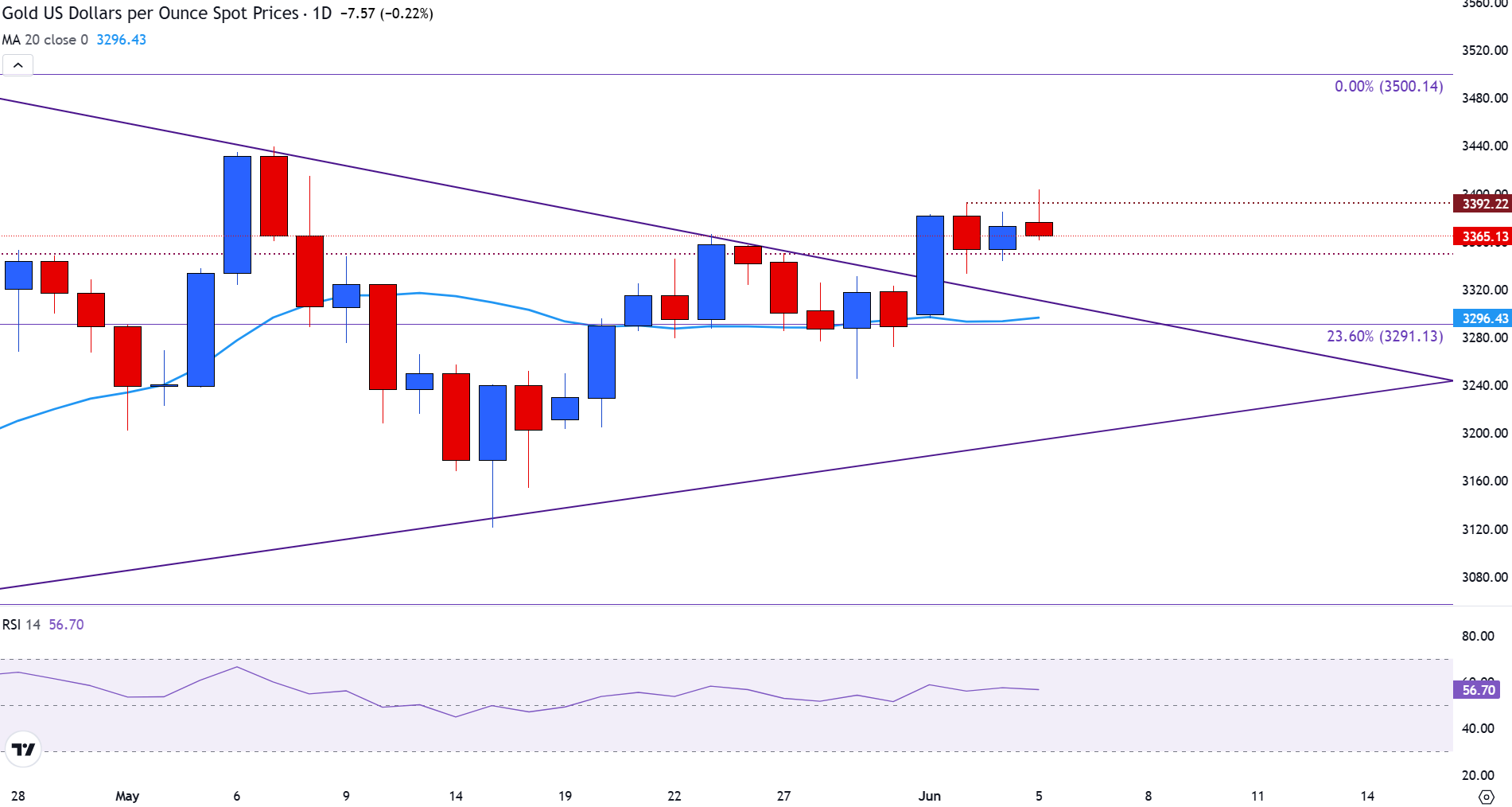
Gold (XAU/USD) is retreating from a strong rally that allowed bulls to retest the $3,400 psychological level during Thursday's European session.
With prices currently below $3,370, the first significant level of support remains firm at the $3,350 psychological level..
Despite a break above the triangle resistance, prices have failed to gain momentum above $3,350, a level that remains critical for Gold’s near-term move.
The 20-day Simple Moving Average (SMA), currently at $3,292, offers additional support.
A break below this level and the triangle base near $3,290 (aligned with the 23.6% Fibonacci retracement of the January-April rally) would expose the $3,057 support zone, marking the midpoint of the aforementioned move.
A deeper decline could extend to $2,804, the 78.6% Fibonacci retracement, if bearish pressure intensifies. The Relative Strength Index (RSI) at 56 supports a mildly bullish bias.
On the upside, a move above $3,370 and above Monday's high of $3,392 could drive prices back to $3,400, providing the potential for bulls to move back toward the April ATH of $3,500.
Gold daily chart
US-China Trade War FAQs
Generally speaking, a trade war is an economic conflict between two or more countries due to extreme protectionism on one end. It implies the creation of trade barriers, such as tariffs, which result in counter-barriers, escalating import costs, and hence the cost of living.
An economic conflict between the United States (US) and China began early in 2018, when President Donald Trump set trade barriers on China, claiming unfair commercial practices and intellectual property theft from the Asian giant. China took retaliatory action, imposing tariffs on multiple US goods, such as automobiles and soybeans. Tensions escalated until the two countries signed the US-China Phase One trade deal in January 2020. The agreement required structural reforms and other changes to China’s economic and trade regime and pretended to restore stability and trust between the two nations. However, the Coronavirus pandemic took the focus out of the conflict. Yet, it is worth mentioning that President Joe Biden, who took office after Trump, kept tariffs in place and even added some additional levies.
The return of Donald Trump to the White House as the 47th US President has sparked a fresh wave of tensions between the two countries. During the 2024 election campaign, Trump pledged to impose 60% tariffs on China once he returned to office, which he did on January 20, 2025. With Trump back, the US-China trade war is meant to resume where it was left, with tit-for-tat policies affecting the global economic landscape amid disruptions in global supply chains, resulting in a reduction in spending, particularly investment, and directly feeding into the Consumer Price Index inflation.
(This story was corrected on June 5 at 15:50 GMT to say Initial Jobless Claims rose to 247K, not 245K)
Author

Tammy Da Costa, CFTe®
FXStreet
Tammy is an economist and market analyst with a deep passion for financial markets, particularly commodities and geopolitics.