Gold sees odds for a new all-time high this week evaporate with upbeat NFP report
- Gold sees earlier gains being pared back a touch.
- Nonfarm Payrolls came in below consensus, while unemployment dropped.
- Gold sees odds for a new all-time high this Friday fade.

Gold’s price (XAU/USD) will not print a fresh all-time high this Friday ahead of the weekend. The Nonfarm Payrolls number came in at 143,000, which was below the expected 170,000 number. Markets were too eager though this week to add to their conviction that the number would be much lower, with the lowest estimate around 105,000, which results in a knee jerk reaction and Gold giving back its gains for this Friday.
Meanwhile, headlines emerged on Friday that China’s central bank, the People's Bank of China (PBOC), has expanded its Gold reserves for a third month in a row. Even at fresh all-time high prices, the central bank bought roughly 0.16 million troy ounces in January, Bloomberg reports. Meanwhile, threats from US President Donald Trump to slap more tariffs on the Eurozone and other countries are keeping Gold supported as a safe haven for investors should the tariff war escalate further.
Daily digest market movers: That is all folks
- Gold reserves held by the People’s Bank of China rose by 0.16 million troy ounces last month, according to data released Friday. The central bank resumed adding Gold reserves in November after a six-month halt that ended an 18-month buying spree, Bloomberg reports.
- The US-China trade war, fears that President Donald Trump will follow through on threats to impose tariffs on other nations, and his unconventional geopolitical possible interventions are supporting Gold’s role as a safe haven in uncertain times. The bull run looks set to continue, with prices likely to hit $3,000 an ounce within three months, Citigroup Inc. said in a note, Bloomberg reports.
- Zimbabwe’s Gold output rose to 3,134.34 kg in January, up from 2,375.32 kg a year earlier, Fidelity Gold Refinery said on Friday in an emailed statement, Reuters reported. It was mostly the smaller-scale miners who were good for the increase in output, while the larger mines declined in production.
- The US Nonfarm Payrolls employment report for January came in at 143,000, below the 170,000 consensus view for new workers in the month compared to 256,000 in December. However, broad expectations were for a much softer number, according to several bank analysts and forecasters. This dampened odds for a possible third rate cut in totality from the Federal Reserve for 2025, putting some selling pressure on Gold in the aftermath.
Technical Analysis: Sell the fact
With the Nonfarm Payrolls release on Friday, it is clear that if Gold hits a new all-time high, it will be due to a very weak number in employment data. However, as usual, caution needs to be taken with this build-up in expectations. Even a number in line with consensus could be enough to disappoint markets on their downside expectations, triggering a knee-jerk reaction with Gold facing some profit-taking ahead of the end of the week.
The Pivot Point level on Friday is the first nearby support at $2,854, followed by the S1 support at $2,835. From there, S2 support should come in at $2,815. In case of a correction, the bigger $2,790 level (the previous high of October 31, 2024) should be able to catch any falling knives.
On the upside, the R1 resistance comes in at $2,874, just slightly below the current all-time high at $2,882. In case the rally can pick up where it left off, the upside level to beat in terms of daily pivotal levels is the R2 resistance near $2,893 ahead of $2,900 as a big figure.
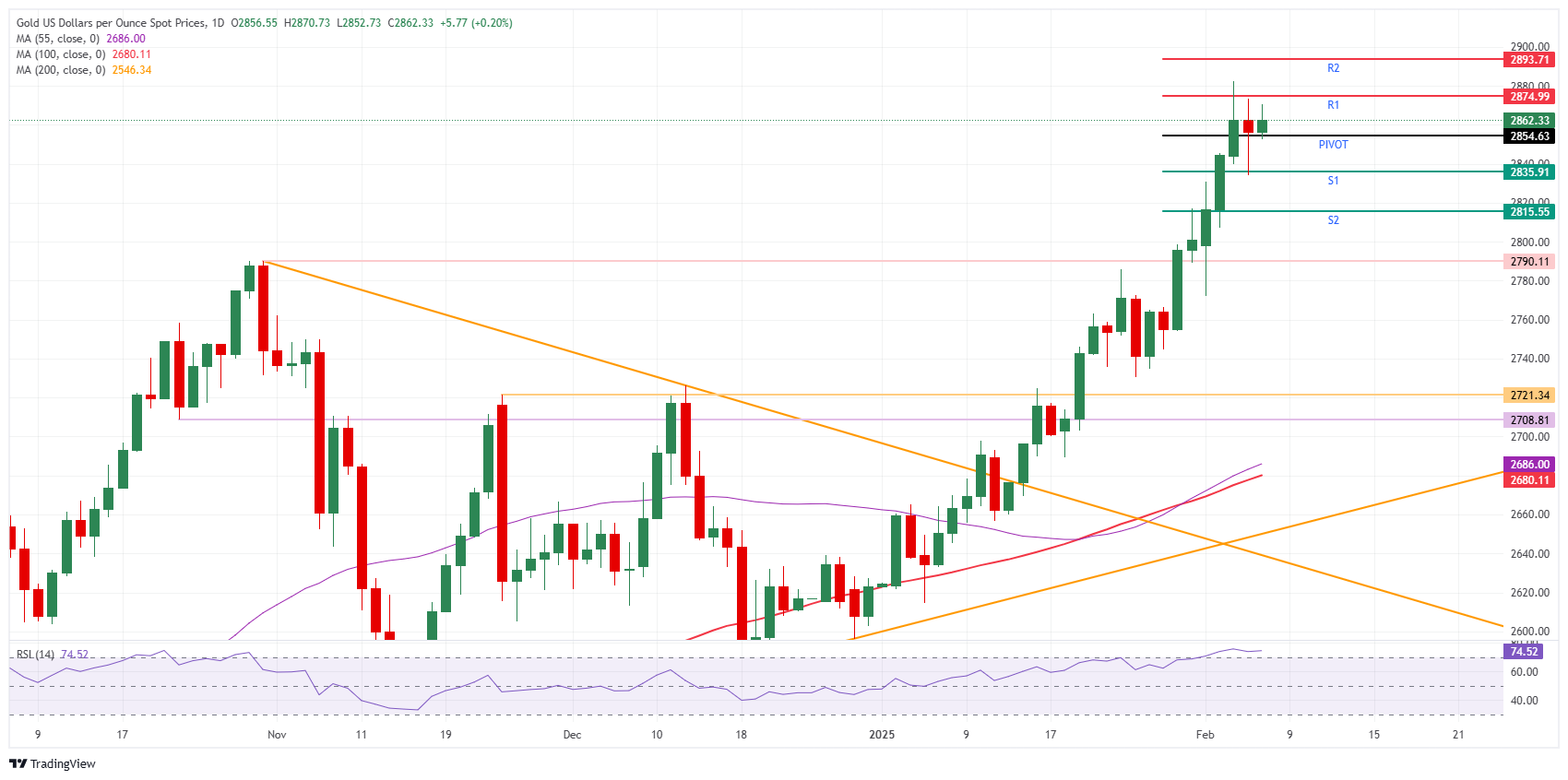
XAU/USD: Daily Chart
Nonfarm Payrolls FAQs
Nonfarm Payrolls (NFP) are part of the US Bureau of Labor Statistics monthly jobs report. The Nonfarm Payrolls component specifically measures the change in the number of people employed in the US during the previous month, excluding the farming industry.
The Nonfarm Payrolls figure can influence the decisions of the Federal Reserve by providing a measure of how successfully the Fed is meeting its mandate of fostering full employment and 2% inflation. A relatively high NFP figure means more people are in employment, earning more money and therefore probably spending more. A relatively low Nonfarm Payrolls’ result, on the either hand, could mean people are struggling to find work. The Fed will typically raise interest rates to combat high inflation triggered by low unemployment, and lower them to stimulate a stagnant labor market.
Nonfarm Payrolls generally have a positive correlation with the US Dollar. This means when payrolls’ figures come out higher-than-expected the USD tends to rally and vice versa when they are lower. NFPs influence the US Dollar by virtue of their impact on inflation, monetary policy expectations and interest rates. A higher NFP usually means the Federal Reserve will be more tight in its monetary policy, supporting the USD.
Nonfarm Payrolls are generally negatively-correlated with the price of Gold. This means a higher-than-expected payrolls’ figure will have a depressing effect on the Gold price and vice versa. Higher NFP generally has a positive effect on the value of the USD, and like most major commodities Gold is priced in US Dollars. If the USD gains in value, therefore, it requires less Dollars to buy an ounce of Gold. Also, higher interest rates (typically helped higher NFPs) also lessen the attractiveness of Gold as an investment compared to staying in cash, where the money will at least earn interest.
Nonfarm Payrolls is only one component within a bigger jobs report and it can be overshadowed by the other components. At times, when NFP come out higher-than-forecast, but the Average Weekly Earnings is lower than expected, the market has ignored the potentially inflationary effect of the headline result and interpreted the fall in earnings as deflationary. The Participation Rate and the Average Weekly Hours components can also influence the market reaction, but only in seldom events like the “Great Resignation” or the Global Financial Crisis.
(This story was corrected on February 7 at 14:30 GMT to say Nonfarm Payrolls came in below consensus, not in around consensus.)
Author

Filip Lagaart
FXStreet
Filip Lagaart is a former sales/trader with over 15 years of financial markets expertise under its belt.
















