Gold steadies as US CPI softens and Trump boosts market optimism
- United States President Trump states that the US-China trade agreement is a "done deal", lifting risk sentiment.
- The US Consumer Price Index data for May misses expectations, with the focus shifting to the US Producer Price Index data on Thursday.
- Gold prices remain above $3,300, but recent US-China trade progress limits the safe appeal of Gold.

Gold prices are trading higher midweek as investors digest a softer-than-expected US Consumer Price Index (CPI) report for May, alongside renewed optimism surrounding US-China trade relations.
The US Consumer Price Index (CPI) came in softer than expected on Wednesday. Headline inflation rose 2.4% YoY in May, slightly below the 2.5% forecast and up from April’s 2.3%.
The core CPI, which excludes food and energy, remained steady at 2.8%, missing expectations of a rise to 2.9%. On a monthly basis, the CPI increased by just 0.1%, undershooting the 0.2% estimate, while the core CPI also rose by 0.1%, sharply below the 0.3% forecast.
The subdued inflation outlook boosted demand for non-yielding assets like Gold, which typically benefit from lower interest rate expectations.
Adding to the momentum, US President Donald Trump announced on Truth Social that “Our deal with China is done, subject to final approval with President Xi and me.”
“We’re getting a total of 55% tariffs, China is getting 10%.”
Trump’s remarks helped lift broader risk sentiment, easing some safe-haven demand but not enough to drag Gold into negative territory.
His insistence on a fair deal—“I won’t sign anything weak”—was interpreted as a sign of real progress in US-China trade talks.
Still, Gold’s upside remained modestly capped as traders balanced improving geopolitical sentiment with the implications of slowing inflation and shifting interest rate expectations.
Gold daily digest market movers: XAU/USD balances lower inflation with US-China optimism
- The US Consumer Price Index (CPI) came in softer than expected on Wednesday. Headline inflation rose 2.4% YoY in May, slightly below the 2.5% forecast and up from April’s 2.3%. The core CPI, which excludes food and energy, remained steady at 2.8%, missing expectations of a rise to 2.9%.
- On a monthly basis, the CPI increased by just 0.1%, undershooting the 0.2% estimate, while the core CPI also rose by 0.1%, sharply below the 0.3% forecast.
- According to the CME FedWatch Tool, market participants now expect the Fed to keep interest rates unchanged at the June and July meetings, with a 56.3% probability of a 25 basis point interest rate cut priced in for September.
- The US and China are close to reaching a trade deal that includes the removal of China’s export restrictions on rare earths, which is likely to offer some relief for the US supply chain. These minerals are crucial for sectors such as technology, defense and green energy, where they are essential for products like semiconductors, electric vehicles (EVs) and military hardware.
- On Thursday, the US will release the US Producer Price Index (PPI) data for May, which is expected to also show an increase in headline inflation from a producer level.
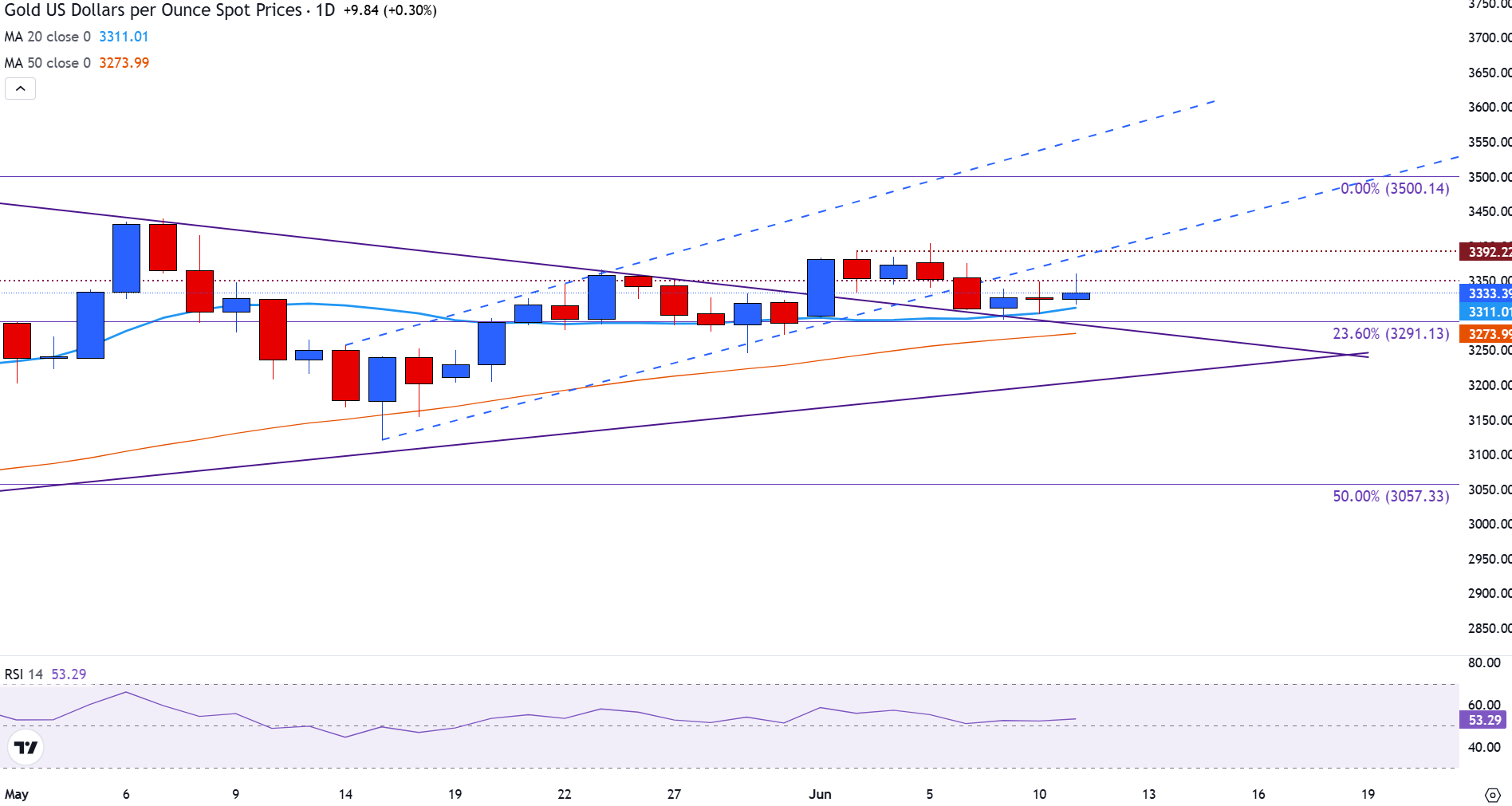
Gold technical analysis: XAU/USD steady near $3,340
Gold prices initially surged on Wednesday following a softer-than-expected US inflation report, briefly testing levels above $3,350. However, momentum faded during after Trump’s comments, with prices easing back to $3,340.
On the upside, resistance is forming near the psychological level of $3,350, and a break above this barrier could pave the way for a move toward Friday’s high of around $3,375.
Further up, the $3,400 psychological level limited the bullish potential last week. If buyers clear this zone and bullish momentum gains traction, a move toward the April all-time high at $3,500 may be possible.
However, the Relative Strength Index (RSI) indicator flattens near the neutral zone of 50 on the daily chart, signalling a lack of momentum and indecision among traders.
In the event of a downside move, the immediate support for the Gold price is at the 20-day Simple Moving Average (SMA) at $3,310, just above the next psychological support zone of the $3,300 mark, and ahead of the 23.6% Fibonacci retracement level of the January-April rise at $3,291.
Further down, the 50-day SMA could then provide an additional layer of support around $3,275, while the tip of a symmetrical triangle chart pattern could provide another important cushion for downside price action at $3,240.
(This story was corrected on June 11 at 15:07 GMT to say US President Donald Trump, not former US President Trump.)
Gold FAQs
Gold has played a key role in human’s history as it has been widely used as a store of value and medium of exchange. Currently, apart from its shine and usage for jewelry, the precious metal is widely seen as a safe-haven asset, meaning that it is considered a good investment during turbulent times. Gold is also widely seen as a hedge against inflation and against depreciating currencies as it doesn’t rely on any specific issuer or government.
Central banks are the biggest Gold holders. In their aim to support their currencies in turbulent times, central banks tend to diversify their reserves and buy Gold to improve the perceived strength of the economy and the currency. High Gold reserves can be a source of trust for a country’s solvency. Central banks added 1,136 tonnes of Gold worth around $70 billion to their reserves in 2022, according to data from the World Gold Council. This is the highest yearly purchase since records began. Central banks from emerging economies such as China, India and Turkey are quickly increasing their Gold reserves.
Gold has an inverse correlation with the US Dollar and US Treasuries, which are both major reserve and safe-haven assets. When the Dollar depreciates, Gold tends to rise, enabling investors and central banks to diversify their assets in turbulent times. Gold is also inversely correlated with risk assets. A rally in the stock market tends to weaken Gold price, while sell-offs in riskier markets tend to favor the precious metal.
The price can move due to a wide range of factors. Geopolitical instability or fears of a deep recession can quickly make Gold price escalate due to its safe-haven status. As a yield-less asset, Gold tends to rise with lower interest rates, while higher cost of money usually weighs down on the yellow metal. Still, most moves depend on how the US Dollar (USD) behaves as the asset is priced in dollars (XAU/USD). A strong Dollar tends to keep the price of Gold controlled, whereas a weaker Dollar is likely to push Gold prices up.
Author

Tammy Da Costa, CFTe®
FXStreet
Tammy is an economist and market analyst with a deep passion for financial markets, particularly commodities and geopolitics.