Gold starts to turn flat with markets digesting Trump's secondary tariffs
- Gold sees rally stay alive above $3,000 and still has its eyes on the current all-time high at $3,057.
- Less reciprocal tariffs, more secondary ones, focused on cars, aluminium and against countries buying Venezuelan Oil.
- Gold in search of a breakout in order to avoid persisent selling pressure on the topside.

Gold’s price (XAU/USD) hovers above $3,020 at the time of writing on Tuesday with markets crunching the numbers on the latest tariff commitments from United States (US) President Donald Trump. The president issued an executive order on Monday to impose “secondary tariffs” of 25% on all imports from those countries buying Oil from Venezuela, which would mean a sharp rise in levies on goods from China and India.
On Monday, Trump said reciprocal tariffs will be eased off for countries meeting US requests on reshoring their businesses and factories. He went further and said tariffs on cars, aluminum and pharmaceuticals will be issued in the very near future. Trump also added that lumber and chips could be a potential tariff target as well.
Daily digest market movers: China levies setback for US agriculture
- Gold is finally drawing decent volumes into bullion-backed Exchange Traded Funds (ETFs), in what has been one of the more interesting developments in commodities in the near end of the first quarter of 2025. If sustained, it augurs well for prices in the second quarter of the year, Bloomberg reports.
- In the takeover story between Australia’s Gold Road Resources and South Africa’s Gold Fields, Gold Road Resources chief executive Duncan Gibbs says a $3.3 billion takeover bid from Gold Fields is too low, describing the proposal from the Johannesburg-listed miner as extremely aggressive and hostile, Reuters reports.
- A proposal from the Trump administration to impose levies on Chinese-made ships entering US ports is sowing panic in the US agriculture industry, with farmers saying the added cost threatens to upend exports of wheat, corn and soyabeans, the Financial Times reports.
- Trump has come up with a new weapon of economic statecraft on Monday after threatening with “secondary tariffs” on countries that buy Oil from Venezuela to choke off its oil trade with other nations. This was triggering additional tariff concerns with markets seeing this as a secondary way to impose still vast amounts of tariffs without making them reciprocal, Bloomberg reports.
Technical Analysis: Bring your calculator
The bounce is getting underway this Tuesday after US President Trump’s comments about issuing ‘secondary’ tariffs. His administration is looking to ease off the reciprocal approach. This will make the entire assessment of levies and how to quantify them even more difficult.
On the upside, the daily R1 resistance comes in at $3,028. Further up, the R2 resistance at $3,046 coincides with Friday’s high and the R1 resistance from Monday. This means that this level is a heavy barrier before pointing to the current all-time high at $3,057.
On the downside, some red flags remain as the intraday S1 support stands at $2,997. That means the $3,000 mark is exposed and needs to act on its own as big support. There is no line of defense before to make sure any downturn is being slowed. Further down, the S2 support comes in at $2,984.
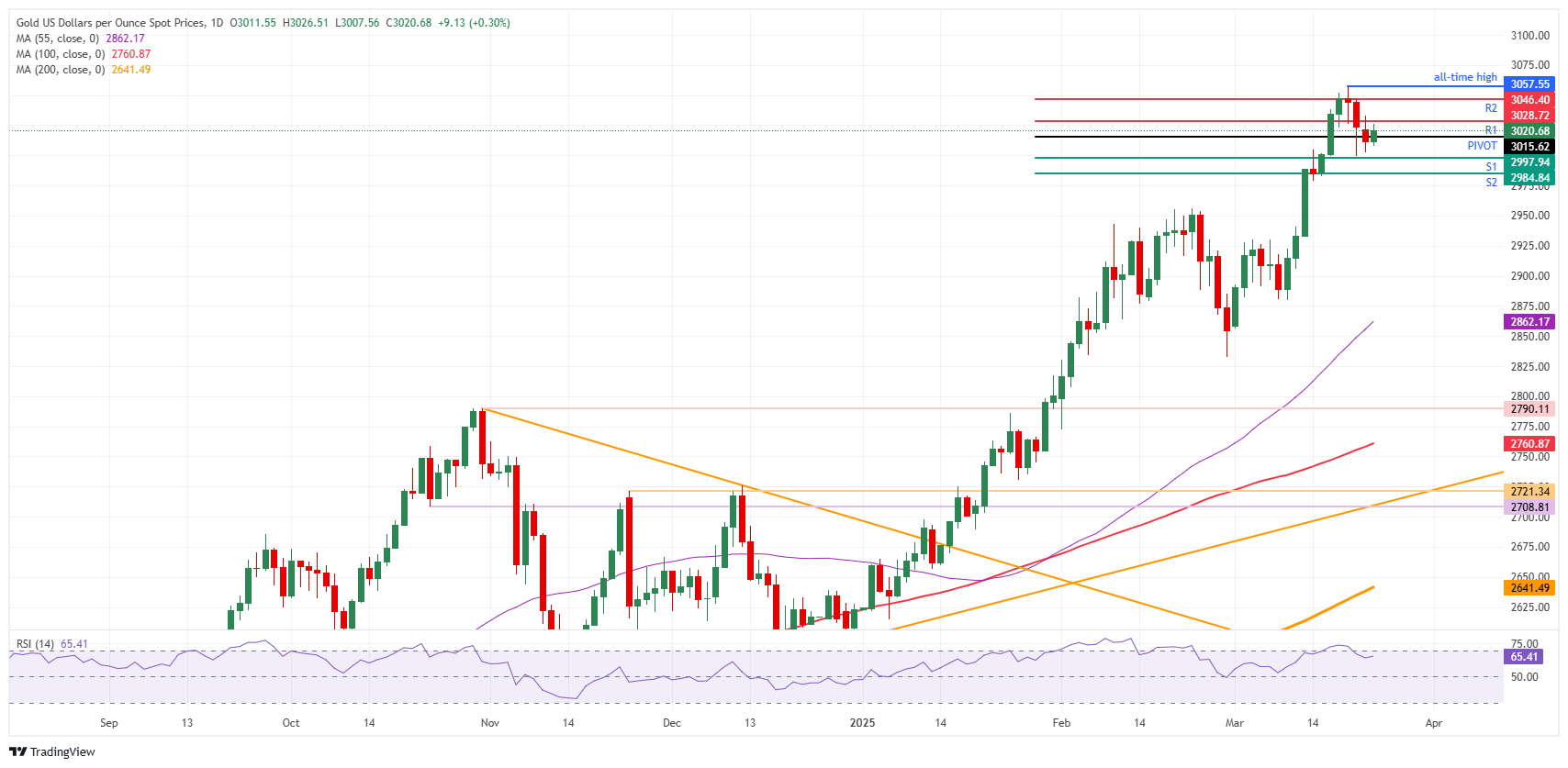
XAU/USD: Daily Chart
Interest rates FAQs
Interest rates are charged by financial institutions on loans to borrowers and are paid as interest to savers and depositors. They are influenced by base lending rates, which are set by central banks in response to changes in the economy. Central banks normally have a mandate to ensure price stability, which in most cases means targeting a core inflation rate of around 2%. If inflation falls below target the central bank may cut base lending rates, with a view to stimulating lending and boosting the economy. If inflation rises substantially above 2% it normally results in the central bank raising base lending rates in an attempt to lower inflation.
Higher interest rates generally help strengthen a country’s currency as they make it a more attractive place for global investors to park their money.
Higher interest rates overall weigh on the price of Gold because they increase the opportunity cost of holding Gold instead of investing in an interest-bearing asset or placing cash in the bank. If interest rates are high that usually pushes up the price of the US Dollar (USD), and since Gold is priced in Dollars, this has the effect of lowering the price of Gold.
The Fed funds rate is the overnight rate at which US banks lend to each other. It is the oft-quoted headline rate set by the Federal Reserve at its FOMC meetings. It is set as a range, for example 4.75%-5.00%, though the upper limit (in that case 5.00%) is the quoted figure. Market expectations for future Fed funds rate are tracked by the CME FedWatch tool, which shapes how many financial markets behave in anticipation of future Federal Reserve monetary policy decisions.
Author

Filip Lagaart
FXStreet
Filip Lagaart is a former sales/trader with over 15 years of financial markets expertise under its belt.