Gold has soft retreat on Memorial Day holiday
- Gold price remains stuck below $3,340 throughout the European trading session on Monday.
- Some sigh-of-relief in Europe after Trump announced a delay on EU tariffs until July 9.
- US debt concerns are in the background, capping the downside for the precious metal.

Gold (XAU/USD) price slips on Monday towards $3,333 at the time of writing, while US markets are closed due to Memorial Day's public holiday. The small correction comes after United States (US) President Donald Trump issues a statement on Truth Social that he would extend to July 9 the deadline for the European Union (EU) to face 50% tariffs. The decision came after a call between Trump and European Commission President Ursula Von Der Leyen on Sunday, and should help the EU broker a trade deal with the Trump administration.
Although this risk-on euphoria looks tempting to join, this does not mean the rally in the precious metal is over. A softer stance on trade weakens the safe-haven demand for Gold, but the metal’s safety appeal is still strong amid growing concerns about the fiscal position of the US government. Investors remain concerned that Trump’s tax bill, which last week passed the House and will be debated in the Senate, will further increase both the US deficit and debt.
Daily digest market movers: US credit downgrade = Gold price upgrade
- Citigroup Inc. raised its three-month price target for gold back to $3,500/ounce on tariff-related concerns, high geopolitical risks and solid economic growth in China and India. “Gold demand is firing on all cylinders,” Citi analysts said in a note, Bloomberg reports.
- US President Trump on Sunday announced that his plans to hit the EU with 50% tariffs would be delayed until July 9 to allow for time for both sides to negotiate a deal. The US leader on Friday had threatened higher-than-expected 50% levies against the bloc, while also warning Apple Inc. that it would be subject to 25% tariffs if it does not manufacture its iPhones in the US, Bloomberg reports.
- Josh Gilbert, market analyst at eToro, warned that these delays aren’t bringing any structural changes to Trump’s tariff policy. “Pauses are all well and good for now, but during this time, we need to see more agreements in place to confirm Trump’s more negotiable approach,” he said, Bloomberg reports.
- Vietnam’s Prime Minister Pham Minh Chinh has asked the country’s central bank, finance ministry and relevant agencies to study the establishment of a regulated Gold exchange to enable transparent public trading and prevent smuggling and manipulation, according to a statement on the government's website, Bloomberg reports.
- The US Dollar also falls on Monday, extending Friday’s losses, as enthusiasm appears to have faded for the world’s reserve currency this year amid mounting fiscal concerns in the US. Speculative traders remained bearish on the dollar but trimmed their positioning to $12.4 billion in the week ending May 20 from $16.5 billion in the week prior, according to CFTC data reported Friday, Reuters reports.
Gold Price Technical Analysis: Demand still stolid
Gold takes a step back as investors flee to risk assets following the agreement between Trump and von der Leyen to continue to negotiate about trade. Still, the delay is only a minor one, by just a month, and brokering a trade agreement between the two blocs is nearly impossible to do in such a short time span.. Therefore, these headlines need to be seen as brief injections of reliefs within an overall narrative that is still supportive for Gold due to heightened uncertainty.
On the upside, the R1 resistance at $3,386 is the first level to look out for as resistance. The R2 resistance at $3,415 follows not far behind and could open the door for a return to the $3,440 round level and potentially further course to new all-time highs at $3,500.
On the other side, some thick-layered support emerges in case the Gold price declines. On the downside, the daily S1 support comes in at $3,307, safeguarding the $3,300 big figure. Some intermediary support could come from the S2 support at $3,258. Further below, there is a technical pivotal level at $3,245, roughly converging with the S2 support at $3,240.
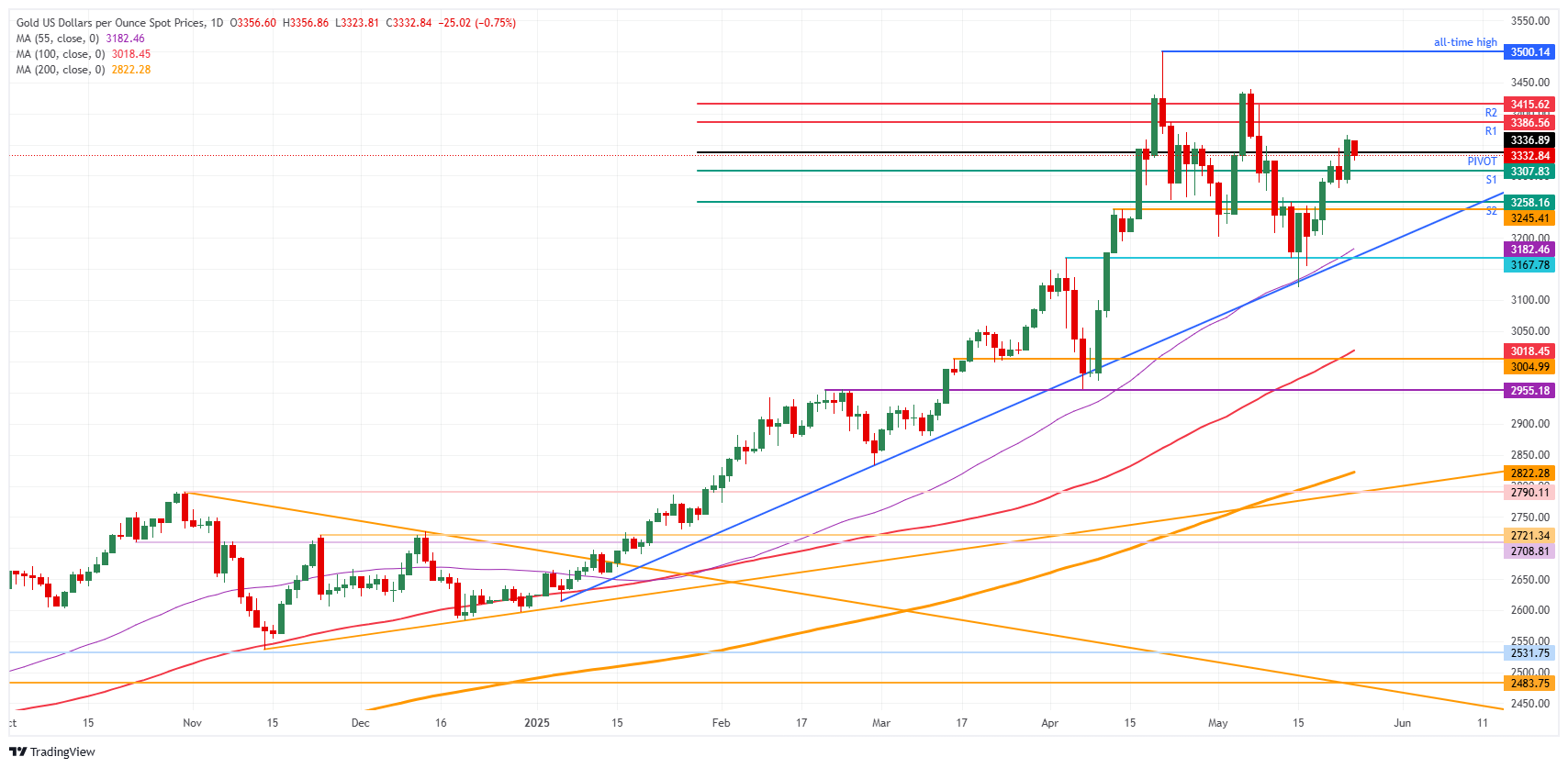
XAU/USD: Daily Chart
Interest rates FAQs
Interest rates are charged by financial institutions on loans to borrowers and are paid as interest to savers and depositors. They are influenced by base lending rates, which are set by central banks in response to changes in the economy. Central banks normally have a mandate to ensure price stability, which in most cases means targeting a core inflation rate of around 2%. If inflation falls below target the central bank may cut base lending rates, with a view to stimulating lending and boosting the economy. If inflation rises substantially above 2% it normally results in the central bank raising base lending rates in an attempt to lower inflation.
Higher interest rates generally help strengthen a country’s currency as they make it a more attractive place for global investors to park their money.
Higher interest rates overall weigh on the price of Gold because they increase the opportunity cost of holding Gold instead of investing in an interest-bearing asset or placing cash in the bank. If interest rates are high that usually pushes up the price of the US Dollar (USD), and since Gold is priced in Dollars, this has the effect of lowering the price of Gold.
The Fed funds rate is the overnight rate at which US banks lend to each other. It is the oft-quoted headline rate set by the Federal Reserve at its FOMC meetings. It is set as a range, for example 4.75%-5.00%, though the upper limit (in that case 5.00%) is the quoted figure. Market expectations for future Fed funds rate are tracked by the CME FedWatch tool, which shapes how many financial markets behave in anticipation of future Federal Reserve monetary policy decisions.
Author

Filip Lagaart
FXStreet
Filip Lagaart is a former sales/trader with over 15 years of financial markets expertise under its belt.